Is this moon new or young, a sliver or a crescent, silver or golden in the deep blue, the newly deep sky, is it striking or dazzling or mesmerising?
Is this a late spring, belated and all the more welcome, bursting with life, with green, bright green, saturated with rain and sunshine, saturated with colour and heat, heat unfamiliar and all the more welcome, or is it sudden summer?
Is this life at last, is this joy, is this joy of life, is it zest, is it just new life-force or is it happiness or elation or bliss?
Reality, as it laps up against the shores of your eyes and your ears and your nose, reality as it washes over the leas of your skin and seeps beneath, cannot be captured in words, not even in verse: reality, so dense it feels like a dream, is not a dream cloud nor a word cloud.
Although this poem would make a good one, with the message of sudden summer sounding out like birdcall, flooded with light and colour, steeped in joy, as if words were written from life and for life, as if words were part of life, of the wide earth and the deep sky and the reality beyond, of the ever-flowing life-force.
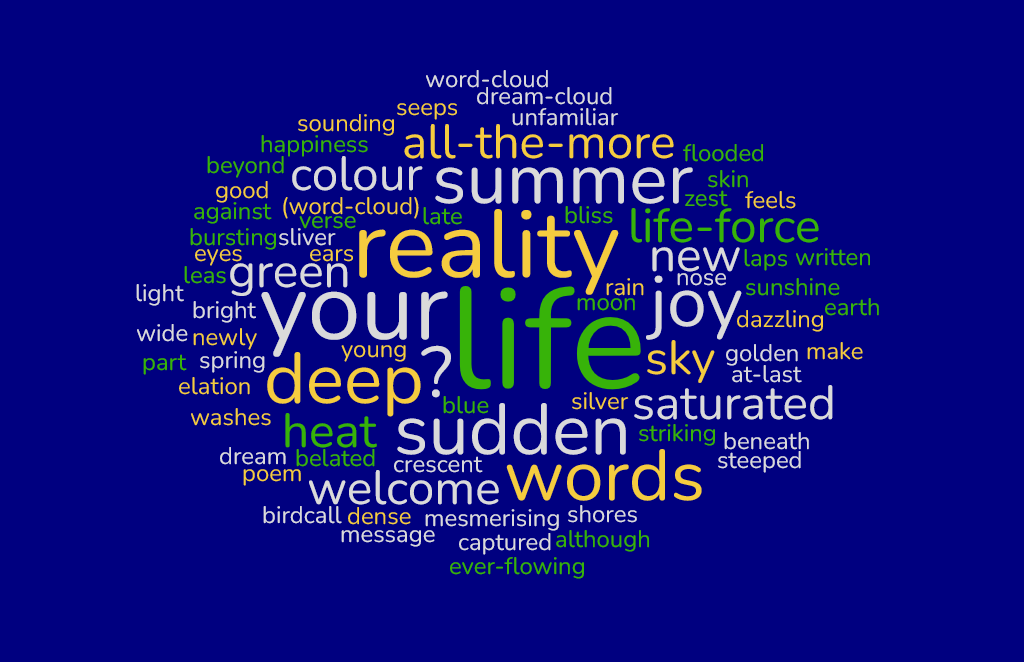
Word cloud of the poem Sudden Summer (colours edited but randomly allocated).
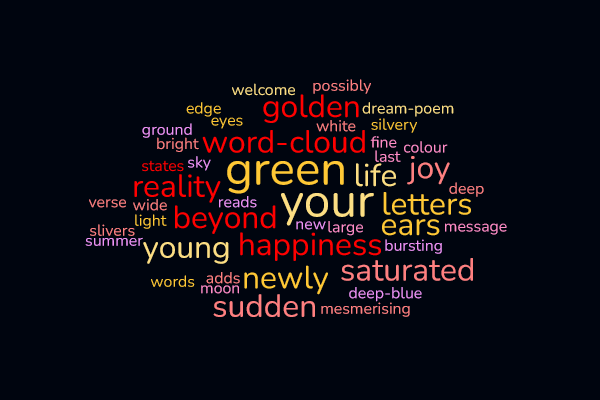
Happiness Beyond (Word Cloud)
Your life is a green reality, it reads in large green letters, and newly young; the sky is golden at last, it states in fine golden letters, and saturated with joy; eyes and ears are bursting with wide bright light, it adds in silvery white; and at the edge there is happiness beyond colour on deep-blue ground.
These are welcome words, sudden and possibly deep, a mesmerising message from slivers of verse in your ears, from the new dream poem, from the word cloud of Sudden summer: Your life is a green reality saturated with joy under the newly young moon.
The poem does what it describes: inventing words, lining them up, and sending them to others to greet them and cheer them up!
The newly coined terms had to be re-created in English – where they do of course not look as impressive. “lindwurmwörter”, for instance, really sounds and looks as long as a dragon, while “dragon’s tail words” looks like three words, even though I added the tail in to get a similar effect in meaning and length.
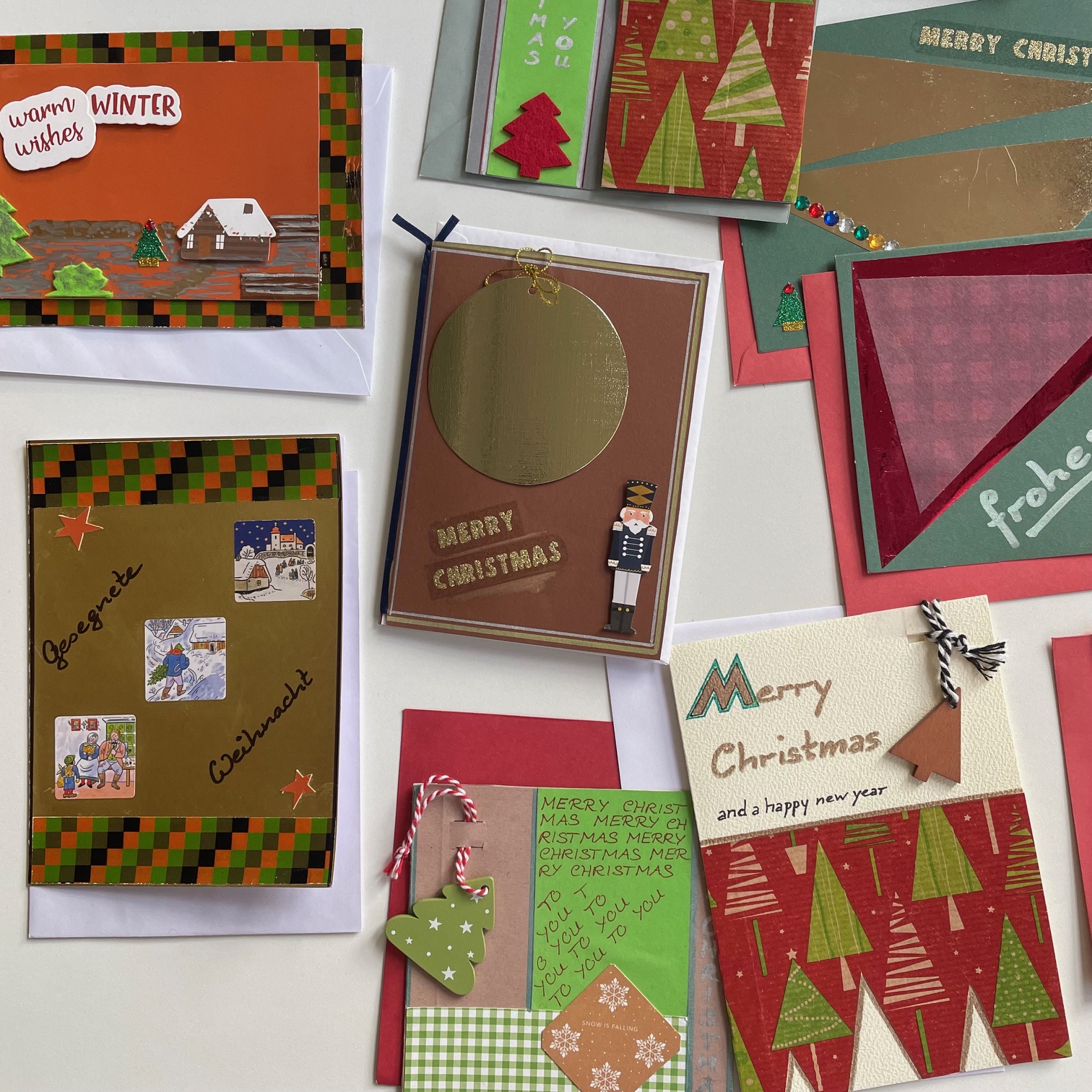
In England, many people hang Christmas cards up on golden strings. During the festive seasons of 2022/23 and 2023/24, I crafted many greeting cards myself, each of them unique.
Kurven von Tinte und Ketten von Lettern, Wörter und Worte wie bunte Girlanden steigen und ziehn über Erde und Meer… Ketten von Lettern, die leuchten und flattern, bunte Girlanden, die kreisen und landen, zaubern dir lautlose Rede her…
Es ist bloß Papier, es sind bloß Gedanken, doch bringen sie Herzen und Häuser ins Wanken und fallen gleich Samen in wartenden Sand. Was ist das Geheimnis der Blätter, der Briefe? Als ob eine Seele die andere riefe… Als ob ein Geist den andern entflammt!
My love, I’d so much love to give you a gift: a kite with the face of a friendly dragon, a goblet carved from a coconut shell, a rocking-chair on a scarlet rug, a house by a little lake, a little lake, a life –
But I have none of these things to give away: only smiles slotted through half-open doors, kisses smuggled on underground trains, words typed on a cluttered screen… only these worthless, priceless words.
You can find a poem shaped like a spinning top at Toys / Baskets / Bowls,
one shaped (and tinted) like a bush at By the Brittle Brown Fence, and one shaped (and tinted) like a balloon at Red Balloon!
I scanned the scattered shapes heaped around me and picked out the flowers and fresh fruits and fleeting clouds filled with sun and added some slanted squares of marble and slate and trunks of birch-trees and fashioned my finds into this spinning-top. Just don’t ask what it means. It’s a toy I made for you !
***
Baskets
The most delicately plaited words still awkward, thick like things. Bent over pads of paper, the poet labours, late, dexterous, impotent to convey music, silence… peace.
Like bowls of ordinary wood, robust, adept, like workers’ tools, these hands seem empty. Yet they are filled to the brim, invisibly: with jewel-like ideas the one,
the other with tranquillity.
Il me manque les mots…
Ils flottent sur les flots :
turquoise… îlots…
glaciers et glaçons…
le bateau, le ballon –
ardoise… sillage…
nuit et naufrage –
sans peindre une scène,
sans rendre une chaîne,
parure, ceinture,
magie d’écriture !
Ô langue étrangère,
étrange, passagère,
je te cherche, te chasse,
je regarde dans ma tasse –
il me manque les mots !
These lines describe the struggle to write literature in a foreign language. The poet has to look into her coffee-cup for inspiration…
The sequence of words appears to be disconnected but does produce the outline of a scene or story — a vague turquoise and grey image of a dangerous voyage — which also scans and rhymes. So there is the poem!
This poem or hymn may work quite well in a translation software.
The text is based on the Jewish-Christian myth of creation: Out of nothingness (or chaos), God called everything into being (and order). Light was the first thing made, and it was all done through the word.
There is also a concept in Christian philosophy that God continues creating the world every moment; if he ever ceased, everything would tumble back into nothing. These ideas are really the opposite of nihilism.
Other thoughts from the Letters of the Apostles (at the end of the Christian part of the Bible) are that the whole of creation is striving and struggling towards God as if in labour; and that at the end of time, we shall emerge from darkness to see God ‘face to face’.
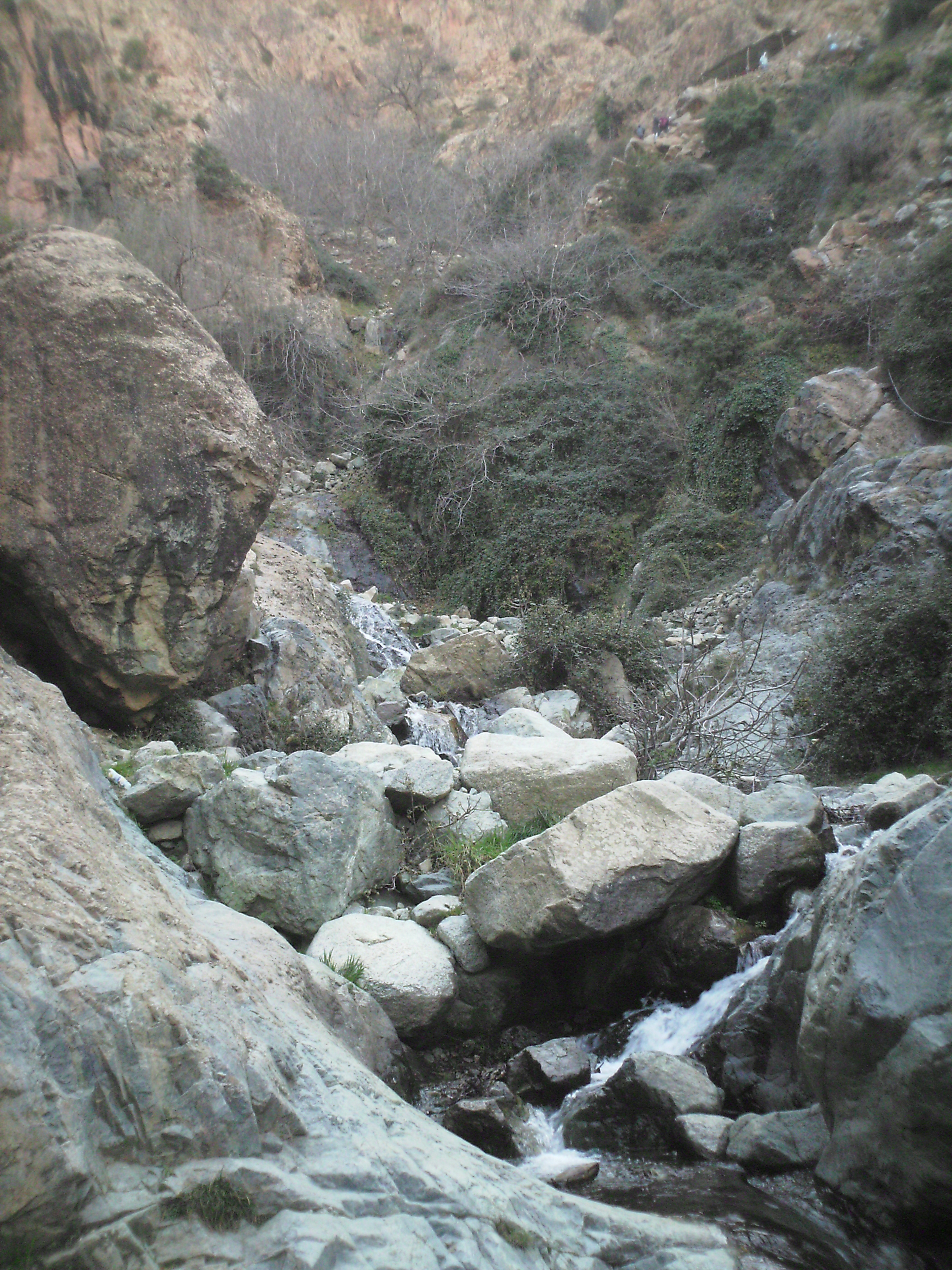
The title, ‘Origin’, means ‘first source’ in German; you can see the word ‘spring’ in it. Yet, I added the title in the end; the image and first lines stood clearly in my mind on waking up: the source springing from the rock, like the world out of nothingness, or life out of lifelessness.
A thought about a person stepping out from a building into the sunshine as if liberating himself or herself from a rockface can be found atGelbes Licht, with a statue by Michelangelo that must have inspired it.
Some more thoughts on the north of the planet… In winter all is grey, sky and land and water alike; but in summer, the world shines in blue and green and golden. This is before you look at the flowers and fruits, and the places and things whose colours show again, and the people who have come outdoors again. Winter lasts six months in Southern Europe, like in the myth of Persephone, but seven months in Central Europe and perhaps nine in Northern Europe… All the more do we enjoy the glories of summer!
This is one of many poems I wrote for my wedding anniversaries in August; I hope plenty of other people will be able to use it for their engagements, weddings, and anniversaries! The little poem I read at my wedding is simply calledI Love You.