The Sun God’s Roads

The Sun God’s Roads

I saw them emerging from forest and fog,
the roads of the fiery barbarian god,
I saw them, I walked them, I measured them – but
I dragged on their slopes and I slipped in their mud.

They followed the creek, they followed the crest,
they followed the sun all the way to the west,
they lead to the market, they lead to the fort,
they lead all the way to the northernmost port.

My roads ran across their fords and their fields,
as smooth as a line of square Roman shields,
as straight as the flight of a sure Roman lance,
as hard as its tip, in a steady advance.

Some sauntering highways are right underneath
while others meander through meadow and heath.
I took what I needed, I bridged all the gaps,
I dropped all the rest off the Caesar’s clear maps.

Minerva brought wisdom and Mars announced peace:
we drained a few swamps and we parcelled the leas,
we left the round huts by the winding wet way
and stamped our rectangles into the clay.

My map showed a ragged and rugged old isle
with gridlines unrolling now mile after mile.
I marked it as Jove had commanded us – but
I still muse about the strange tracks in the mud…

Christina Egan ©2019

On this blog, the year always starts with a Roman road. Here, a civil engineer from antiquity reports how his straight highways and rectangular buildings cut right across the uneven and muddy terrain, winding paths, and round buildings of the native Britons. You can still observe this striking phenomenon in Stonehenge, Silchester, and many other places.

We may assume that enthusiasm for this turn of civilisation was not universal. The Celts thought, for instance, that it was silly to worship gods in temples, as if in boxes, instead of in nature. As regards the superb new roads, they were immensely useful for the transport of goods and ideas, but served first of all for the movement of the legions and of metals mined in Britain.


Die Spur des Mars / The Trace of Mars

Die Spur des Mars

Unbeirrbar rollt die Straße,
über Hügel, über Flüsse
schnurgerade hingebreitet
wie ein Strahl vom flammendroten
goldstückgroßen Himmelsboten:
Mars hat Rom hierhergeleitet.

Christina Egan ©2020

As ever, the first poem of the year admires the roads of the Romans. At Cassel in the north of France, you can see them radiate from a hill and run entirely straight, regardless of the landscape. They served very well to transport people, goods, and ideas, but were first of all laid to occupy and exploit regions. Mars in the poem above stands for war and aggression but also for courage and strength.

Im Herzen von Köln (St. Andreas)

Im Herzen von Köln (St. Andreas)

Vorm Fenster herrscht
der alte Dom
und unterm Fuß
das alte Rom.

Minutentakt
Der Boden bebt,
die U-Bahn pulst,
die Erde lebt.

Die Straße dröhnt,
die Weltstadt wacht,
der Domplatz zittert
Tag und Nacht.

Der Baulärm grellt,
das Blaulicht greint,
die Flöte lockt,
die Geige weint.

Die Orgel jauchzt,
die Glocke braust,
die Stille ruft,
die Stille rauscht.

Am Kreuz hängt einer
ganz allein
und will das Herz
der Erde sein.

Die heilge Stadt
lebt noch aus ihm.
Sie weiß es kaum;
er gibt sich hin.

Minutentakt:
Der Tunnel braust,
der Erdschlund grollt,
die U-Bahn saust.

O Einsamkeiten –
Mein Herz brennt.
O eigne Sehnsucht –
Mein Herz rennt.

Doch Ruhe ist ja
nur in Ihm…
So knie ich nieder:
Nimm mich hin.

Christina Egan ©1992


Tall remnants of Roman city wall with Cologne Cathedral in the background
Photo: Christina Egan © 2014

The first poem of the year takes place in Roman streets again, in the midst of Cologne, in Sankt Andreas, the mighty mediaeval church right opposite the Cathedral. When you descend into the crypt, you are pretty close to antiquity. All around, Roman walls are displayed, or simply still standing.

For an English poem about Cologne with a similar content and in a similar style, see My City Calls (Grey Roofs Grey Walls). There, it is the city itself which provides comfort and hope, as religious faith does here. I noticed the striking parallel only yesterday on relaunching my poetry blog!

Northern Marsh

Northern Marsh

Beyond the Roman highway lay
the marshes, lush and veiled and vast,
on gravel and on sun-baked clay,
a northern, watery mirage.

The never-ending summer’s day
had lured me to a gentle ridge;
the brushwood seemed without a way,
the pools and brooks without a bridge.

And yet I knew that people dwelt
amidst the shimmering, shifting maze…
My flung-out road was but a belt
around an untamed country’s waist.

Christina Egan © 2020

The Hallowed City

The Hallowed City

I.

Aliusque et idem nasceris

When last I looked upon that golden hill,
the only coal-grey clouds along its crest
were pine-trees of Mediterranean zest,
clear-cut against the blue, timeless and still.
When I surveyed the city from the west,
beyond the river and the seventh hill,
my thirsty eyes rejoiced and drank their fill…
A pilgrimage it was and pagan quest.
Behind me passed the Sun on wheels of fire,
accompanied by Mnemosyne’s lyre.
Was this my long-lost and recovered home?
Born here and buried, had I now returned,
the same and not the same? My eye-lids burned.
This is the hallowed city. This is Rome.

Christina Egan © 2018

Drawing of curving Roman aqueducts crossing over

II.

Pulchrae loca vertor ad urbis

My eyes have seen the marble halls of Rome,
resplendent like the mighty mistress Moon
and multi-coloured like a field in bloom;
I’ve watched the buildings grow in brick and stone.
I’ve stood beneath the proud and perfect dome
which emulates the heavens’ sparkling room
and holds our destiny from dawn to doom.
I’ve roamed those hills and called a roof my home.
I’ve heard the chanting children, sighing harps,
the darting chariots and creaking carts,
the swish of virgin water, purple wine,
I’ve seen the aqueducts descend and curve,
the roads roll into Rome, unite, disperse —
I’ve tasted all that splendour. It was mine.

Christina Egan © 2018


The first blogpost of the year deals, as always, with Roman roads!

The impression of aqueducts, which illustrated one of my parents’ books about ancient civilisations, informed my entire life. Unfortunately, I do not know the artist, but there does not seem to be a copyright on it.

The quotes are from two Roman poems about Rome, Horace’s Carmen saeculare and Ovid’s Tristia.

I apply Horace’s idea that the sun is daily reborn, another and yet the same, to a person who feels he or she was reborn into this world many centuries later, another and yet the same; and I reinterpret Ovid’s lament about remembering his home from exile as a modern person’s longing for antiquity. Mnemosyne is the Greco-Roman divinity of memory, and the Sun and Moon, of course, are mighty gods, or at least representations of gods.

The Eagle’s Outpost

The Eagle’s Outpost

Gently, I lay my hand upon a stone:
it snuggles up to my pulsating palm.
The last time it enjoyed the sun god’s balm,
he gilded nimble chariots of Rome,
and legionnaires patrolled the city walls
above the river of a thousand miles,
while olives, dates and spices glowed in piles
and glittering fabrics flowed from shaded stalls.
The halls were fashioned of a thousand stones;
so were the roads rolled out to many lands;
and all were laid by many thousand hands…
This eagle’s outpost held ten thousand souls –
A dream of dreams, lifted into the light:
I was in Dura Europos last night.

Christina Egan © 2018

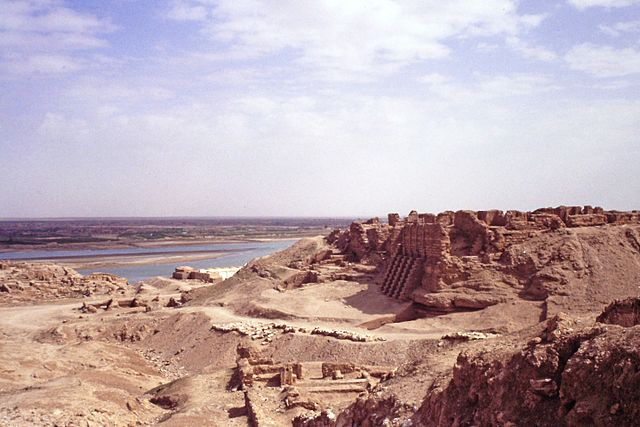
Runis of fortress on hilltop in arid land, above wide river with green fields.

The ruins of Dura Europos above the Euphrates, today in Syria, in 2016.
Photograph
 by Marina Milella [CC BY-SA 4.0], via Wikimedia Commons.


After 500 poems, the usual poem about a Roman Road to start the year!


Spätes Wiederfinden

Spätes Wiederfinden

I.

Die strohgedeckten Hütten sind verschüttet,
und in den Säulengängen haust der Wind.
Mir ist, als spürt’ ich unter meinen Sohlen,
wo eigne Schritte eingezeichnet sind.

Ich schliff das Pflaster unter den Sandalen,
ich legte jenes Pferd ins Mosaik;
ich wurde dort am Wegesrand begraben
mit meinem Krug voll Kummer und voll Glück.

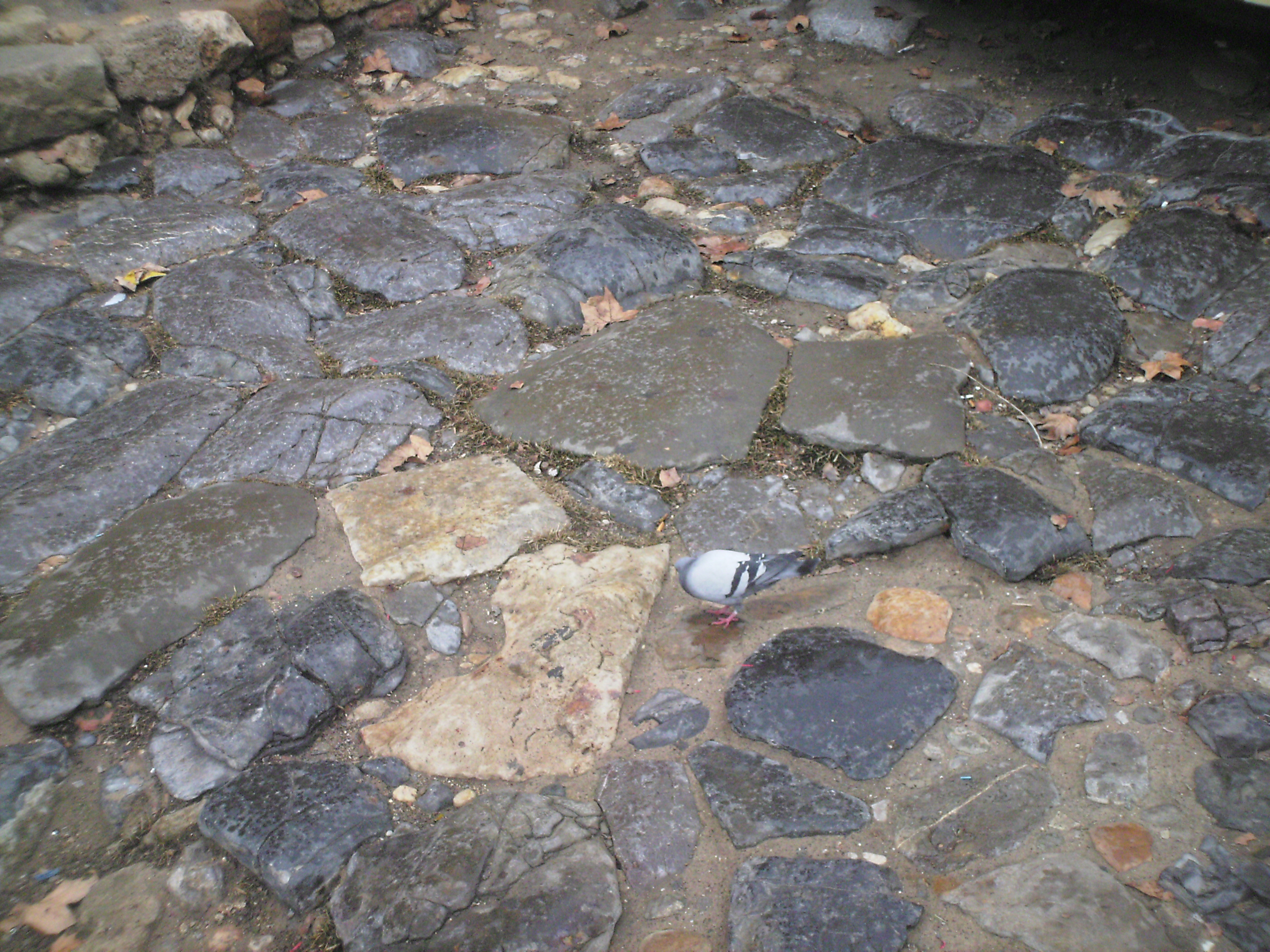
Very irregular pavement.

II.

Mir scheint, ich hätt’ schon vor Jahrhunderten
in deinen Augen wie ein Gast gewohnt.
Und wenn ich nur den Schlüssel wiederfände,
dann hätt’ auch dieses Leben sich gelohnt…

Was zählen da die wenigen Jahrzehnte,
in denen wir einander jetzt versäumt?
Ein kleiner Aufenthalt in deinen Augen
bringt, was ich in Jahrtausenden erträumt.

Christina Egan © 2011


The fifth year of this poetry blog sets off, as always, with a Roman road or another ancient road!

In the first poem, someone finds the place where they lived and died in a former existence; in the second one, they think they have also found their former love…

The location is imaginary. The three images for the former life all have to do with the earth: the feet and shoes; the mosaics in the floor; the grave by the wayside. Two of the images also refer to wandering, our wandering on earth: the soles wearing the pavement down and the horse in the mosaic. The second poem mentions the status of guest; as the psalms express it, we are all guests on earth.


Photograph: Christina Egan © 2016.  International highway, Via Domitia, crossing the forum of Narbonne. I suppose this bit had been much damaged and patched up, since the Romans built entirely straight and smooth roads!

Der letzte Tropfen

Der letzte Tropfen

Wein von der Farbe des Blutes, jedoch vom Dufte der Rosen,
Wein von des Abends Kühle, darauf von der Hitze des Herdes…
Halb nur bewußte Gebete murmelnd, vergieß’ ich das Opfer:
Göttern den ersten Tropfen, den letzten dem fernen Geliebten.
Unbekannt sind mir jene, nicht weniger fremd ist mir dieser,
marmornes Bildnis verborgen im Haine heiliger Pinien.
Glatt wie silberne Spiegel und pfeilgerade die Straßen,
welche das mächtige Rom über Sümpfe und Hügel geknüpft hat:
Dennoch führt nicht eine zum Ziel, zum Dache des andern,–
ewig harrt man allein, allein unter schweigenden Sternen.

Christina Egan © 2015

Roman mosaic of bottle and cup

Like every year, I begin this blog with a Roman road

The poem is written in hexametres, which I find difficult to emulate in English and German.

You can find another story with spilt wine and ancient roads, in the form of an English poem, at Quo vadis?.


Roman mosaic, Bardo Museum, Tunis.
Photograph: Christina Egan © 2014.

Paths from the Past

Paths from the Past

Flagstone on flagstone,
the pavement unrolls
beneath my eyes,
my resolute feet.

My steps seem to follow
irresistible tracks,
invisible traces,
uncharted faultlines.

Memory maybe
from before my birth?
Destiny maybe
beyond my death?

Flagstone on flagstone,
the story unfolds
beneath my breath,
my dexterous fingers.

Christina Egan © 2015

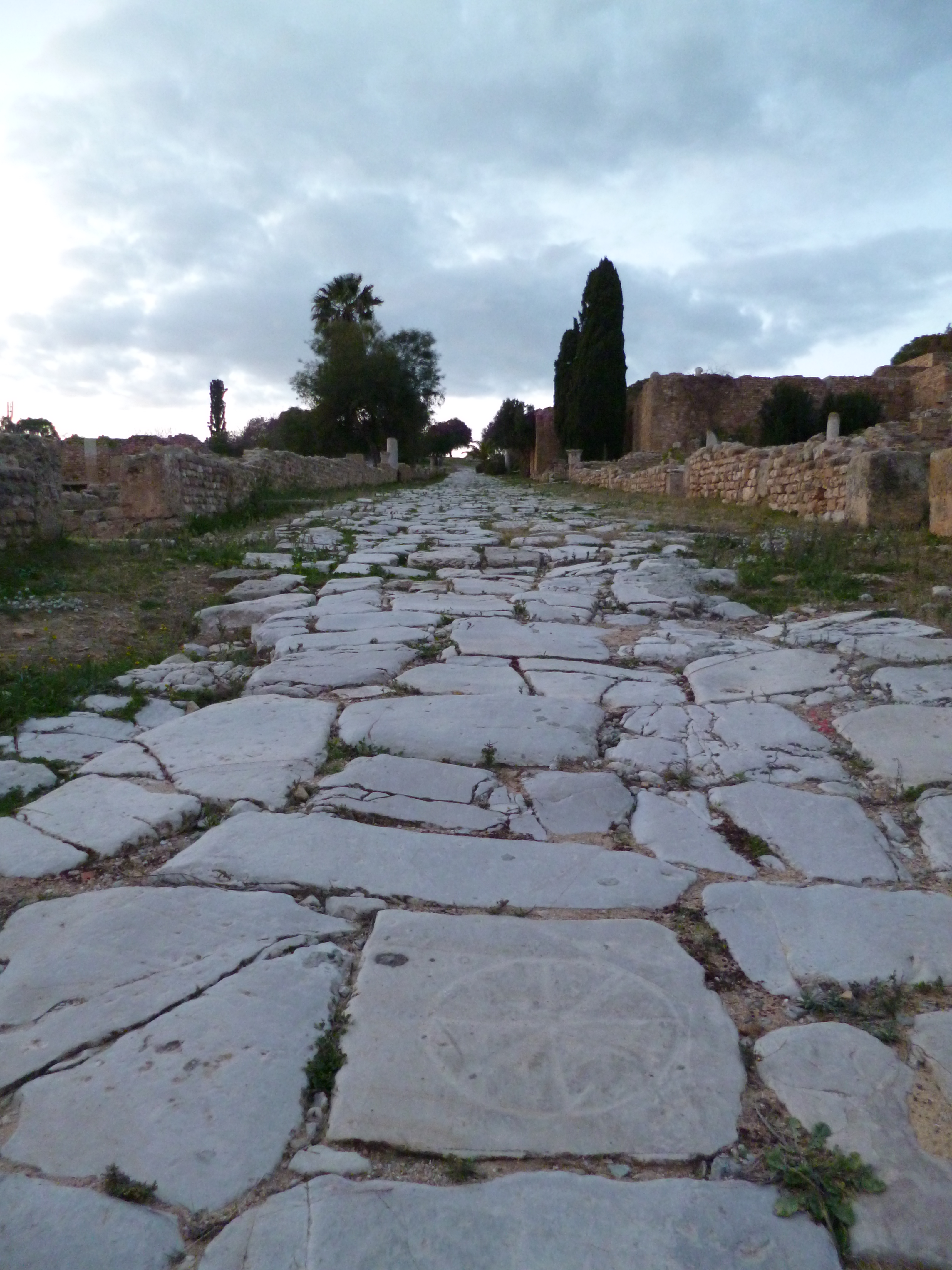
Straight Roman road with ruins and trees to the left and right, in the dusk

I begin the year with a Roman road for the third time round!

I do not speak of natural or magical force fields but of manmade structures; however, these are imbued with destiny, in that people were meant to build them, move along them, or return to them… perhaps even after thousands of years.

Roman road in Carthage, Tunisia. Photograph: Christina Egan © 2014

The City Lit Up

The City Lit Up

I lived between Ilex and Salix,
just north of Londinium Town,
and sometimes I climbed to the moss-well
between the oaks and looked down.

I looked at the thatch and the roof-tiles,
as red as the embers beneath,
I looked at the timber and marble,
the highways connecting the heath,

the gates, the walls and the broad bridge,
the fields afloat on the clay;
and I wondered if London would stretch
as vast as the valley one day,

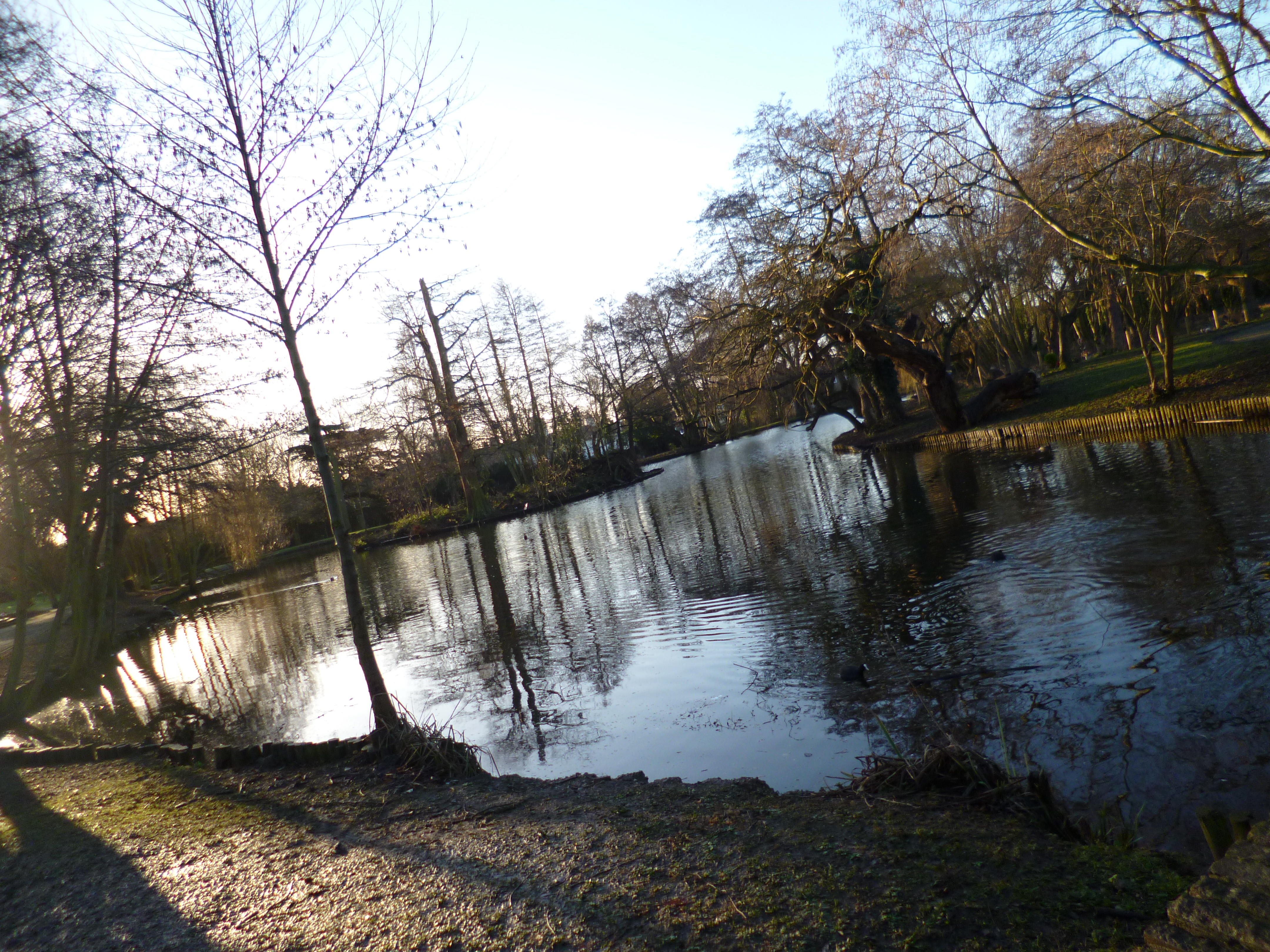
Pond in park, surrounded by bare trees, with tiny island

as vast as Rome, which had risen
from marshes and slopes long ago,
with columns touching the heavens
because the gods willed it so;

and if Rome could ever be shrinking
and sinking into the bog,
or London be burning or flooding
and melting into the fog…

The city lit up in the sunset
and faded away in the dusk;
I felt the chill in the oak-wood,
and down to my villa I rushed.

I entered the gate by the willows
and strode through the dolphins’ yard,
I passed the flickering torches
and stopped by my forefathers’ hearth.

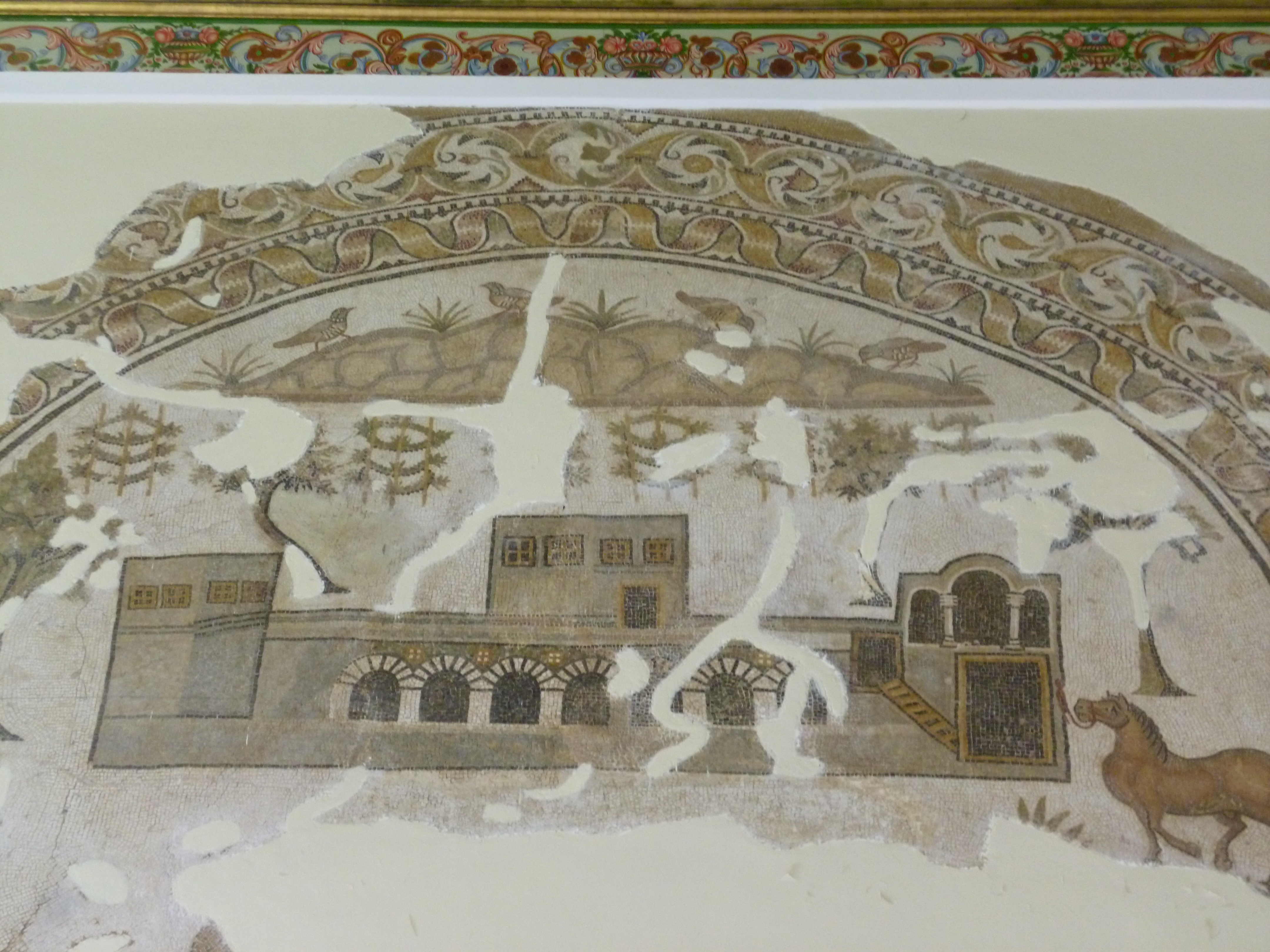
Roman mosaic of a mansion

My name was Appius Felix,
an heir to Aeneas of Troy;
I kept the seals and the idols
to pass them on to my boy.

I used the sword and the saddle,
I held the lyre and quill.
I lived between Ilex and Salix,
at the foot of the Moss-Well Hill.

Christina Egan © 2016


As you can see from the 100-metre-high summit of the Muswell Hill, London does stretch for many miles nowadays, filling the valley to both sides of the meandering River Thames.

You will also notice that there are large patches of green everywhere, some of them left over from ancient marshland and woodland. If you know your way, you can walk across London through woods and meadows, across hills and along rivers for miles!

My Roman observer lives in modern-day Wood Green or Bounds Green, near fictitious hamlets or villas called Ilex (holly or oak) and Salix (willow or osier).

This man firmly believes that gods guard his city and his country and that spirits guard his home and his family. He pursues some useful career in the service of the Empire, but he is also a bit of a poet.

I named him Appius after the statesman of the Republic who had contributed so much to Rome’s infrastructure as well as intellectual life, and Felix because he counts himself lucky.


You can find more on Londinium’s fortifications at Ode to London Wall  and more about its straight or winding highways at Quo vadis?

Photographs: Country villa, late Roman mosaic, Bardo Museum, Tunis. —  Pond in Tottenham, North London. Christina Egan © 2014