This is the Northern Land

This is the Northern Land

This is the northern land
of loose and juicy ground
where fern and forest glow
and wheat and fruit abound.

This is the continent
where mound responds to mound
and wind resounds on rock –
this is the home we found.

This is the realm of dusk
and star-embroidered night,
of fog caressing lakes…
and then the roaring light!

Christina Egan © 2013
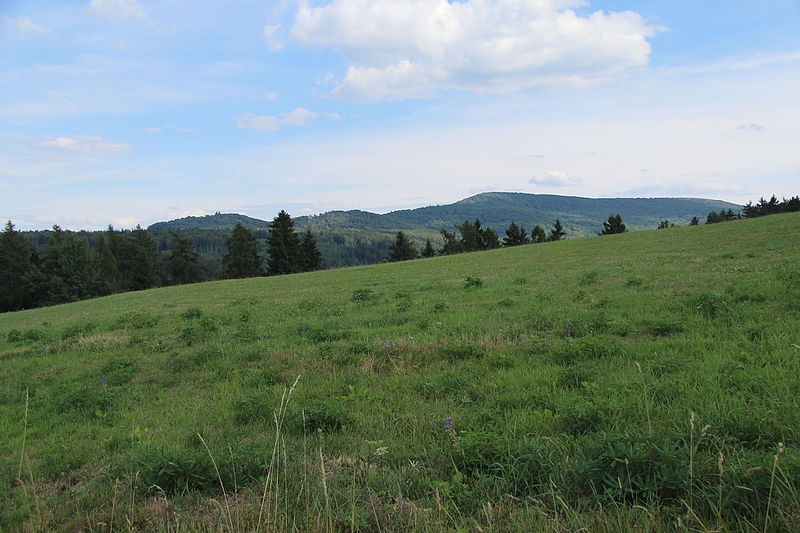
Mountain meadow filling lower half of picture, high trees right behing and mountain range in the distance along the middle, pale blue sky above.

Dammersfeld mountain ridge, Rhön (Central German Highlands).
Two of my great-grandparents grew up with precisely this view. —
Photograph
 by GerritR via Wikimedia Commons.


This poem was inspired by the Czech national anthem, Kde domov muj, which entirely refrains from politics and warfare and mainly describes the lush landscape of Central Europe. The Czech Republic abounds with hills and lakes, forests and fields.

My lines cover the whole of Central Europe or the whole continent (including the British Isles): my home is my region, or my country, or Central Europe, or all of Europe — none more so than the other.

The claim that even those who were born there ‘found’ their land may sound strange: yet their ancestors did immigrate one day, even if it was a thousand years or two thousand ago. No one just grew out of the ground. Moreover, most people are arguably of mixed ethnic origin, in our case, Celtic, Germanic, Slavic, Jewish, Hungarian, and more. No nation is an island.

Triumphboot des Sommers

Triumphboot des Sommers
(Chateau de Chillon, Genfersee)

Gesättigt mit Licht
der Spiegel des Sees,
die Glocke des Tals,
der lange Nachmittag
letzter Frische
vor dem bronzenen Sommer.

Hingeschüttet das ganze Geschmeide
der Erde von unter den Wurzeln,
schimmernde Schuppen
auf der Schlange Landes
zwischen Bucht und Gebirg.

Blondes seidiges Licht
fällt in die Fenster der Burg,
tief hinein ins Verlies,
reicht an den rohen Fels;
tastende Fingerkuppen
wärmen die toten Kamine,
die fernen Wände der Säle,
rufen verblichene Sänger herauf
zum zeitlosen Tanz.

Am anderen Ufer
ragen reglos die Segel
der senkrechten Felsen,
bewimpelt mit Wolken,
Triumphboot des Sommers.

Die Stunde der Sonnwende schlägt,
unhörbar,
unumkehrbar,
unzerstörbar.

Christina Egan © 2001


‘Triumphal Barge of Summer’ may work in a translation software. It is a memory of Lac Leman, a vast lake between towering mountains, around summer solstice. One of the most beautiful days of my life!

Schöpfung (Darß)

Schöpfung
(Darß)

I.

schwebend zwischen ungeheuern
wassern und verwunschnen teichen
will die erde sich erneuern
wälder zeugen dünen häufen

II.

wird die see den see erwählen
kraft die ruhe salz die süße
muß sich blau dem grau vermählen
daß es ineinanderfließe

III.

wie die schaumgekrönte göttin
einst dem wilden meer entstieg
so dem bloßen sand die blüte
und dem wüsten schmerz das lied

Christina Egan © 2015


On the Darß (Darss), you can observe ‘Creation’ at work:
between ocean and ponds, between dunes and woods.

The last poem describes the ‘Creation’ of art as another
natural, elemental, process: beauty born out of pain.

You can read an English poem about the Darss at
Midsummernight Far North.

Parallel English and German poems about a similar
phenomenon on the German North Sea coast are at
Views of North Sea Islands.