The Hallowed City

The Hallowed City

I.

Aliusque et idem nasceris

When last I looked upon that golden hill,
the only coal-grey clouds along its crest
were pine-trees of Mediterranean zest,
clear-cut against the blue, timeless and still.
When I surveyed the city from the west,
beyond the river and the seventh hill,
my thirsty eyes rejoiced and drank their fill…
A pilgrimage it was and pagan quest.
Behind me passed the Sun on wheels of fire,
accompanied by Mnemosyne’s lyre.
Was this my long-lost and recovered home?
Born here and buried, had I now returned,
the same and not the same? My eye-lids burned.
This is the hallowed city. This is Rome.

Christina Egan © 2018

Drawing of curving Roman aqueducts crossing over

II.

Pulchrae loca vertor ad urbis

My eyes have seen the marble halls of Rome,
resplendent like the mighty mistress Moon
and multi-coloured like a field in bloom;
I’ve watched the buildings grow in brick and stone.
I’ve stood beneath the proud and perfect dome
which emulates the heavens’ sparkling room
and holds our destiny from dawn to doom.
I’ve roamed those hills and called a roof my home.
I’ve heard the chanting children, sighing harps,
the darting chariots and creaking carts,
the swish of virgin water, purple wine,
I’ve seen the aqueducts descend and curve,
the roads roll into Rome, unite, disperse —
I’ve tasted all that splendour. It was mine.

Christina Egan © 2018


The first blogpost of the year deals, as always, with Roman roads!

The impression of aqueducts, which illustrated one of my parents’ books about ancient civilisations, informed my entire life. Unfortunately, I do not know the artist, but there does not seem to be a copyright on it.

The quotes are from two Roman poems about Rome, Horace’s Carmen saeculare and Ovid’s Tristia.

I apply Horace’s idea that the sun is daily reborn, another and yet the same, to a person who feels he or she was reborn into this world many centuries later, another and yet the same; and I reinterpret Ovid’s lament about remembering his home from exile as a modern person’s longing for antiquity. Mnemosyne is the Greco-Roman divinity of memory, and the Sun and Moon, of course, are mighty gods, or at least representations of gods.

Kerzenbekrönt

Kerzenbekrönt

Senkt sich die Dämmrung an frostigen Tagen
– früher denn jemals, doch zauberhaft blau –
hängt über stolzen gewölbten Mansarden,
hält über giebelgeschmückten Fassaden,
bannt aus dem Geiste das leidige Grau.

Stürzen Gestirne herab in Kaskaden
– feucht ist das Pflaster, doch goldengetönt –
spannen sich Perlen an Faden um Faden
blinkend und bebend von Laden zu Laden
bis an die Kirchtürme, kerzenbekrönt.

Christina Egan © 2016


This poem was inspired by a front page photograph of the superb newspaper Agora  in Fulda, Germany, which I had folded over. Then I noticed that beneath the idyllic historical street lit up for Christmas, an industrial container had been inserted through photo montage: as a makeshift home for a refugee family. I felt I had to write a second poem, which you can find at Farbechte Hoffnung.

The street shown is Friedrichstraße, which gives you quite a good impression of past centuries, despite severe damage during the Second World War and ensuing changes. Fulda is quite good for midwinter holidays because of the Christmas Market, the nativity scenes in the churches, numerous festive events… and the snow in the mountains.

explosion der rosen

explosion der rosen

wir warten auf den goldenen oktober
ein kuppeldach aus himmelblauem glas
auf rote zungen überm alten zuber
brilliantensplitter im erfrischten gras

wir warten auf die explosion der rosen
auf pilze wie verwunschene gehölze
und auf die falsche pracht der herbstzeitlosen
als ob die welt sich nicht schon stumm bewölkte

als ob der glanz nicht mündete in moder
die dahlie wie ein feuerwerk verginge
wir warten auf den goldenen oktober
und tauschen küsse wie brilliantenringe

Christina Egan © 2017

Formal garden with dahlias in fiery colours and tree with deep-red foliage.

Dahlia Garden in Fulda, Germany, in October.
Photograph: Christina Egan © 2010.

Strandkorb Song

Strandkorb Song

What happened to the beach-seat
we found in Germany,
the bench within a basket
beside the Baltic Sea?

The land was lush and sunlit,
the air was pure and free,
the dusk was full of magic,
the surf a mystery.

White hooded beach seats, in dunes of fine white sand, with fresh plants growing.What happened to the beach-seat
placed there for you and me?
What happened to the footsteps
along the singing sea?

You said you won’t forget it,
the dusk, the moon, and me.
Where has it gone, the moment
of blue eternity?

We cannot leave the basket,
in space and time so far:
it is a secret casket
which holds a sparkling star.

Christina Egan © 2017

‘Beach baskets’ in Ahlbeck on Usedom.
Photograph: Christina Egan © 2017.

Strandkörbe, ‘beach baskets’, or hooded beach seats, are an alluring feature of German beaches on both seas. 

The story refers to the Midsummernight Far North I have described before on this website. I have developed Strandkorb Song further as lyrics.

La table jaune

La table jaune

La table jaune limpide,
couleur de tournesol,
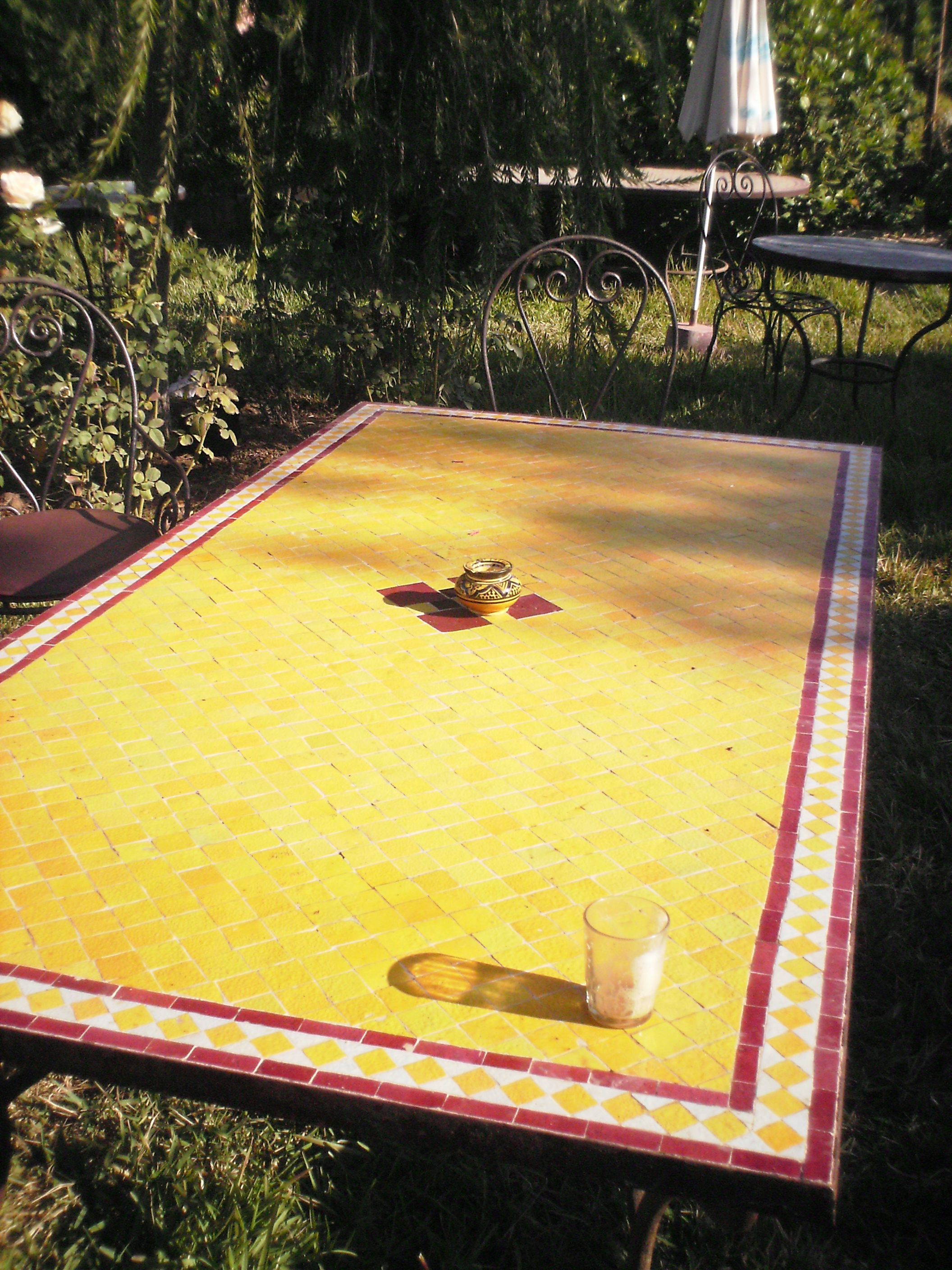
Table surface of bright yellow mosaic, with café chairs on the grass, sunlit.m’invite dans l’oasis
au cœur des plaines arides,
parmi palmiers et roses
en fleur sans fin, sans pause :
i
l met l’esprit au vol
vers les sommets saphir,
vers le soleil couchant,
mais fort même au nadir…

La table tournesol
est un tapis volant !
M
ais il me manque le mot
qui le transforme, le pose
carrément aux epaules
des vents comme un radeau…
Ô table jaune et rouge,
écoute-moi et bouge,
transporte-moi aux flots
de l’air vers l’horizon !

Christina Egan © 2016

The yellow table in the oasis becomes a flying carpet: it lifts the mind up towards the high mountains. Yet, to lift the body up also, it requires a password, and we do not have it!

The rose garden is set in a country where the sun is strong even towards evening or in midwinter, and where roses are always in blossom in abundance: I found it in Morocco.

Photograph: Roadside café in Morocco in midwinter. Christina Egan © 2012.


Die vierte Frucht

Die vierte Frucht

Vier Früchte blieben uns vom Paradiese
auf unsrer langen Wüstenwanderung,
auf daß durch sie die Kraft des Ursprungs fließe
in tausendfacher Anverwandelung:

Die Liebe lädt in saftigblauer Traube;
die Hoffnung duftet warm wie goldnes Brot;
in bittersüßem Grün neigt sich der Glaube;
die Freude aber lächelt sonnenrot.

Christina Egan © 2018

Für Sr. Caterina von der Freude in Gott

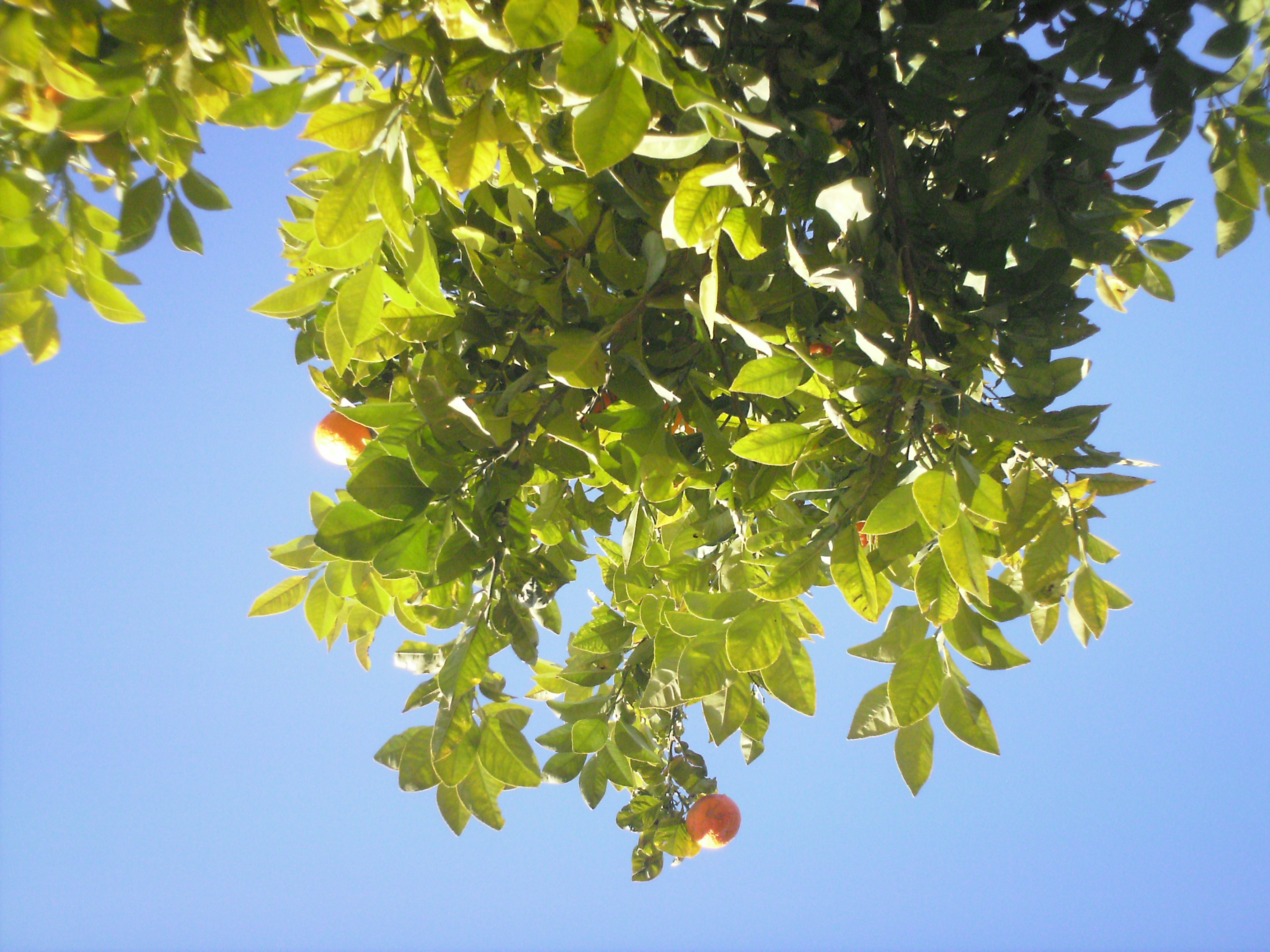
Oranges hanging from branches against blue sky

The four fruits of paradise, an idea I was inspired to by the three Christian chief virtues — faith, hope, love — to which I added joy, another gift or virtue promoted by the same stern author, St Paul. 

Rejoice in the Lord always: and again I say, Rejoice”.

Phil. 4,4

Love is envisaged as a blue or purple fruit, hope as a yellow one (or a loaf of bread), faith as a green fruit (possibly tasting bitter) and joy as a red or orange one… hopefully all sweet! The colours of the rainbow exist for our nourishment.

Photograph: Oranges in midwinter, in Morocco. Christina Egan © 2012.

Daedalus on the Battlements

Daedalus on the Battlements

You drag your baggage through the crowd,
and from the loud and glaring maze
you spill into the heavy haze
of autumn fog and stifling fumes,
into a tube you crawl through tubes,
into a bullet aimed at space –

You soar, you blink, anticipate
some mellow light, some subtle blues –
And then you float above the dunes
of salty sand, the plains of ice,
the shadow of a sheet of cloud –
You sail above the blazing skies!

Christina Egan © 2016


Another return to Greece with winter sunshine even before I arrived: a sunset above the clouds! — Daedalus escaped the labyrinth by flying from its walls; the flaming sun plays a key role in this myth. 

You may get the sense of this poem quite well in a translation software.

Septembertraum

Septembertraum

Warm wird noch einmal der Tag,
hält die Verfärbung des Laubes auf
und verführt das Grün überm Grund
zu Gewändern in haltlosen Farben!
Scharlach und Schnee und Ultramarin
rütteln die Flügel der Seele auf…

Mild wird noch einmal die Nacht,
als läge der Frühling vor unseren Füßen,
ausgerollt bis zum Horizont,
statt des unabwendbaren Herbstes.
Silbern und sanft steht der Park
und klar wie ein Kristall der Traum.

Christina Egan © 2014

Front gardens with brick walls, flower pots, rose tree.

A warm September day lures new flowers — in bright red, snow white, deep blue — instead of the inevitable discolouring of the leaves, while the night is still ‘silver and gentle’. 

For a moment of suspense, instead of autumn spring seems to be unfolding before us…

Not necessarily an autumnal equinox  event, but very much in the spirit of it.

Photograph: Christina Egan © 2013.

War and Peace (Red Fog / Green Shoots)

War and Peace

I.

Red Fog

Red fog rose
from the bloody river
when Baghdad’s proud walls
crumbled to dust.

The sobbing, the gasping
rose with the fog,
scratched the blank sky
till it wept blood.

High soared the blinking blades,
higher the cries of triumph,
down on the broken timber,
the toys forlorn in the ash.

Red ran the Tigris,
bearing pots and books and bodies
down through the desert,
frayed crimson silk.

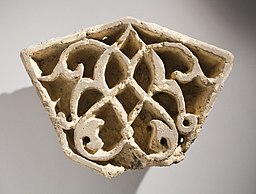
Decorative brick with symmetrical floral motiv, deeply incised.

II.

Green Shoots

Green shoots, vibrant,
blue buds, brilliant,
climbing the trellis
of ten thousand tiles.

The tall white walls,
the wide white courtyards,
the shimmering basins:
those were the flags of peace.

Not the carpets of ash
which the conquest leaves,
nor the polished parchment
where the truce is signed.

Peace is the pomegranate
in the smooth wooden bowl,
peace is the spinning-top
on the deep-green glaze.

Christina Egan © 2003 (I) / © 2018 (II)

These poems were inspired by the massacre of 1248 when the Mongols took Baghdad, but they can be applied to any war Mesopotamia has seen in the course of the millennia, or indeed to any other part of the world…

Brick from Baghdad, mid-13 century. Photograph: Los Angeles County Museum of Art.

August (Hell ist mein Herz) / Amseln und Schwalben

August

Hell ist mein Herz
unterm Kornblumenblau
in der Wiege der goldenen Hügel.

Steil steigt es auf
mit dem Schwalbengepfeif,
denn es reiften ihm stämmige Flügel.

Christina Egan © 2010


Written for a wedding anniversary in August.
Midsummer also stands for the middle of life
and for the fullness of life.

The next poem was written in May, when
summer is unfolding with the exultation of
blackbirds and swallows.

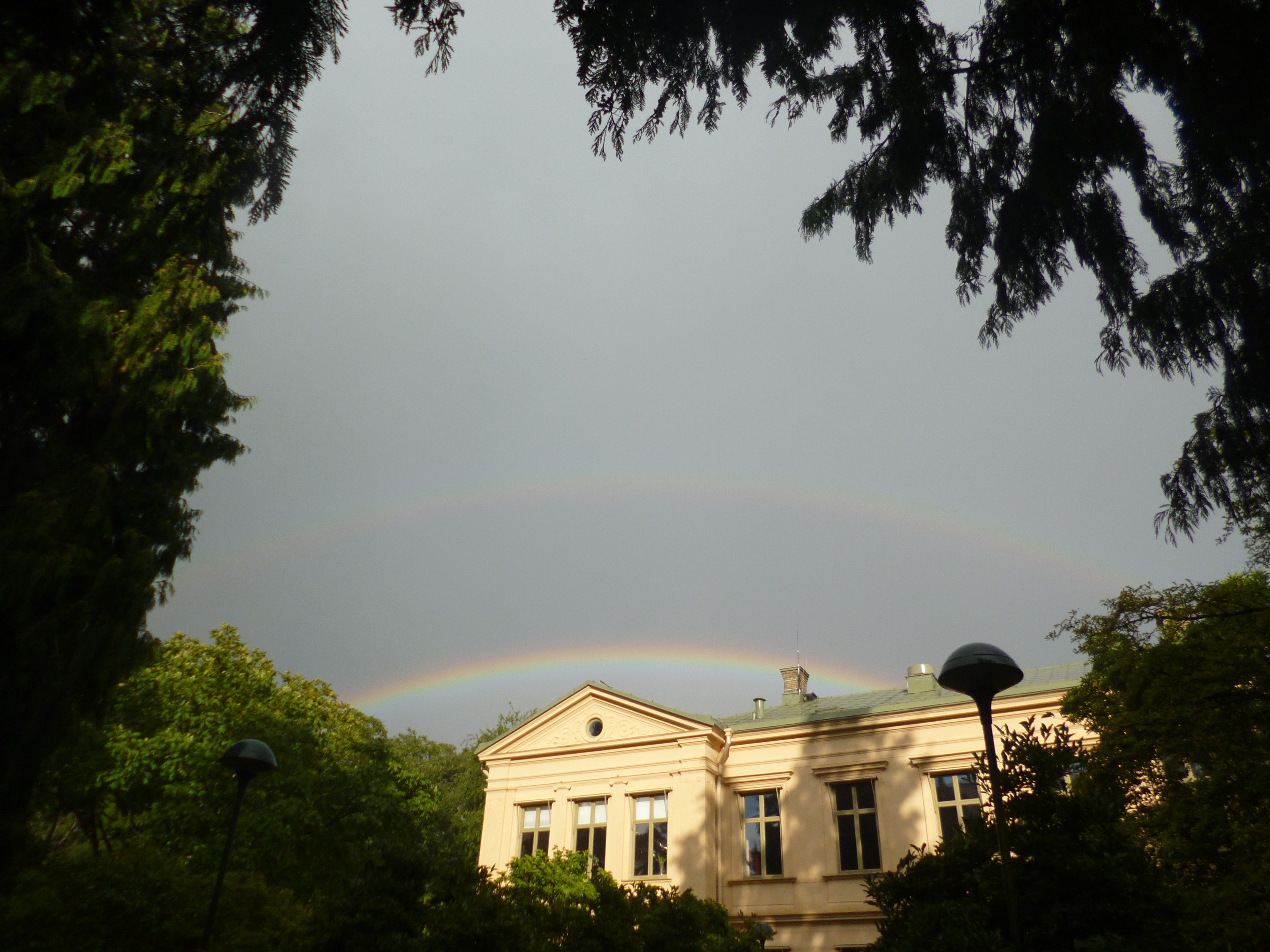
Double rainbow above park, with grey sky and sunlit building.

Amseln und Schwalben

Im Saum des bewimpelten Wipfels,
im Dämmer erquickenden Tröpfelns
entfalten die Amseln Voluten
von Flötentönen und Fluten
von Jubel in wechselnden Wind!

Und lauter und lauter schon pfeifen
und höher und höher schon streifen
die Schwalben in schwindende Wolken,
als warte der Morgen schon golden…
Ein Regenbogen erglimmt.

Christina Egan © 2017

Double rainbow in Lund, Sweden. Photograph: Christina Egan © 2017.