Durch uns durch / The Letter that was Never Sent

Durch uns durch

Der Baum des Lebens spannt sich himmelweit,
um uns herum und durch uns durch verzweigt.
Verwandt, verflochten sind wir,– Wirklichkeit,
die unterm windgepeitschten Widerstreit
niemand mehr wahrnimmt, niemand mehr bezeugt.

Die Menschenchronik spricht von Krieg und schweigt
von tiefverwurzelter Verbundenheit;
der mondenhelle Engelskodex schreibt
in Purpurlettern für die Ewigkeit
von durch und durch verwobner Menschenzeit.

Christina Egan © 2018

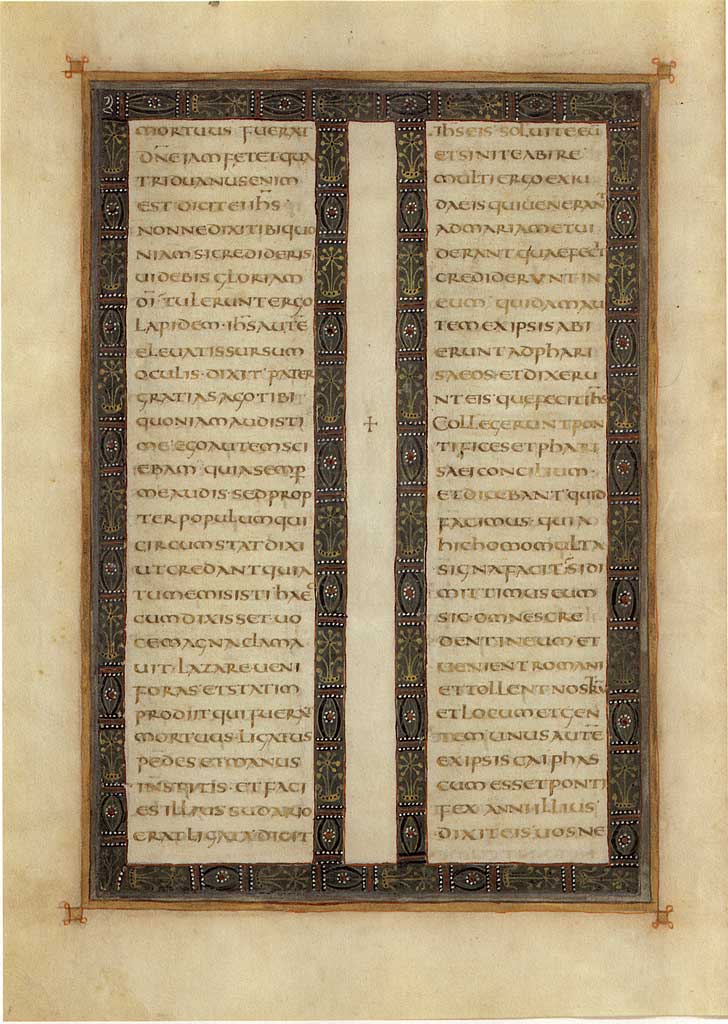
Ancient codex in neat rounded golden letters set in purple frames.


Codex Aureus of Lorsch, written around 810 AD in inks containing real gold or purple. Photograph: Wikimedia Commons.


The Letter that was Never Sent

It was of solid purple paper,
set out in blocks of golden ink,
an extract from a pagan gospel:
the letter that was never sent,

the letter that was never written,
but golden breathed in someone’s brain
and purple ran in someone’s veins –
the letter that was dreamt in vain.

Christina Egan © 2012

I’ve Caught a Star

I’ve Caught a Star

I’ve caught a star
and hold it tight,
it warms my heart,
it fills the night.

Yours is a kiss
as none before,
I know I need
now nothing more.

You are all men
and women, too,
the town, the land,
the earth are you.

You are the sun,
the sparkling day,
the magic moon,
the milky way.

You are the zest
upon my lip,
the only smile
that will unzip,

the only hand
that will hand back
each grain of corn,
each drop of sap.

Christina Egan © 2003

Purple Dusk (Bankside, London)

Nocturne in Purple and Grey
(Bankside, London)

Hemmed with the sequins of lamps
the silver carpet of the river,
the lilac scarves of the bridges, the buildings.

People are blown about like brown leaves.
A few boats float, dozing,
awaiting brighter days.

The hues of lily and lavender
rise, for a moment, and blend,
with a pale memory of their scents.

Great and grey, the river strides past,
great and grey, the moment slides past,
like a graceful line of wild geese.

Christina Egan © 2005

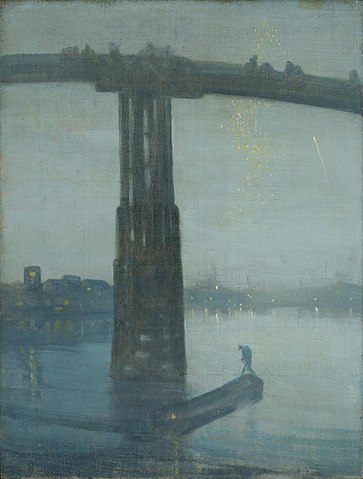
River scene in dreamy bluish hues: gigantic bridge pillar, man on small boat, city on shore.


An early-spring impression in pale lilac and silvery grey. Bankside is the southern shore of the Thames in London.

Many years after I wrote those lines, I noticed the similarity with Turner’s mesmerising Nocturnes and renamed the text!

For a German poem depicting purple dusk see ostseeschlaflied (Darß).


Nocturne in Blue and Gold. Oil painting by J. A. M. Whistler, showing Battersea Bridge in London, ca. 1872-1875. Tate Gallery, London.

Quintessence

Quintessence

I’ll fill a crystal flask
with silver melodies,
a magic drop to last
for years and centuries.

I shall distil my days
to mellow poetry,
and distant lands will taste
the quintessence of me.

I’ll fill a crystal flask
with pearls of memory:
my solitary task,
my faithful alchemy.

The five pure elements’
fifth essence, finally,
their forces and their scents:
as fresh as fiery!

Christina Egan © 2016

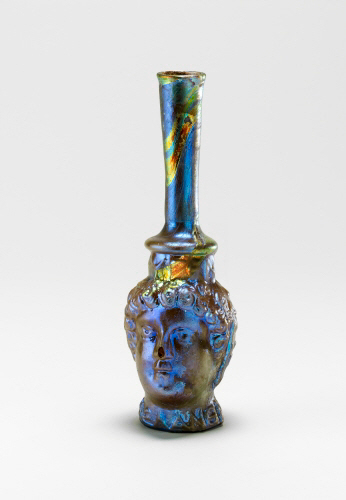
Photograph: Glass flask by Eugenes, found in Syria,
3rd c. AD. © The Trustees of the British Museum.
I  had similar flasks from the Roman era in mind
when I wrote the poem but did not know this one.

The Path of Luck

The Path of Luck

The burnished desk of the leader groaned
under the slap of his sturdy sandal:
he brandished it over the map of Europe,
as if he signed it, large, from the left.
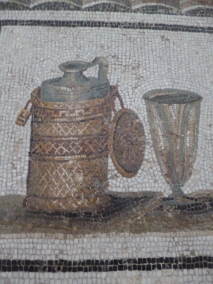
Roman mosaic of bottle and cupThe oil-lamp flickered, the officers frowned
and grinned and raised their cups of spiced wine:
“Don’t forge your luck while it’s hot and supple —

but fan your fate when you will it so!”
The earth would unroll like a scarlet carpet,
lavish her treasures before his feet:
the gold and the purple, sandalwood, snakeskin,
the pearl and the laurel, the wine from volcanoes.
His sandals mounting the snow-white steps,
he saw and saw not the pool of blood.

Christina Egan © 2008
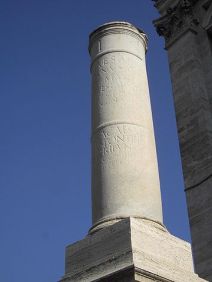
Massive smooth column with Latin inscription, including the name 'Caesar', against deep-blue sky.


Altae moenia Romae

Rome rose, looked round, and conquered all,
on loot and lies loomed square and tall,
and slowly crumbled towards its fall.
Time’s march defies the highest wall.

Christina Egan © 2008
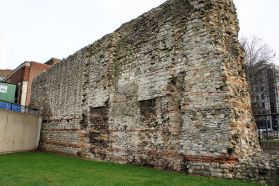
 

High wall of neatly piled stone and brick in the midst of the city

The first poem was written on the Ides of March and the second soon after. They reveal the dark side of Rome, the shadow of the imperial propaganda that the Empire had brought universal peace. Caesar is still celebrated as the greatest statesman ever; but he got to the top, and lifted Rome to the top, at a very great human cost.

For praise of ancient Rome, go to the narrative poem The City Lit Up about Roman London and the sonnets at The Hallowed City about the Eternal City itself.

The poem above follows the structure of an English sonnet, with three times four lines and then two in the end, with a conclusion or twist.


Illustrations: Roman mosaic, Bardo Museum, Tunis. Photograph: Christina Egan © 2014. — Milestone, Campidoglio, Rome. Photograph by Lalupa. — Roman city wall of London. Photograph by Mariordo (Mario Roberto Durán Ortiz) (Own work) via Wikimedia Commons.

The Hallowed City

The Hallowed City

I.

Aliusque et idem nasceris

When last I looked upon that golden hill,
the only coal-grey clouds along its crest
were pine-trees of Mediterranean zest,
clear-cut against the blue, timeless and still.
When I surveyed the city from the west,
beyond the river and the seventh hill,
my thirsty eyes rejoiced and drank their fill…
A pilgrimage it was and pagan quest.
Behind me passed the Sun on wheels of fire,
accompanied by Mnemosyne’s lyre.
Was this my long-lost and recovered home?
Born here and buried, had I now returned,
the same and not the same? My eye-lids burned.
This is the hallowed city. This is Rome.

Christina Egan © 2018

Drawing of curving Roman aqueducts crossing over

II.

Pulchrae loca vertor ad urbis

My eyes have seen the marble halls of Rome,
resplendent like the mighty mistress Moon
and multi-coloured like a field in bloom;
I’ve watched the buildings grow in brick and stone.
I’ve stood beneath the proud and perfect dome
which emulates the heavens’ sparkling room
and holds our destiny from dawn to doom.
I’ve roamed those hills and called a roof my home.
I’ve heard the chanting children, sighing harps,
the darting chariots and creaking carts,
the swish of virgin water, purple wine,
I’ve seen the aqueducts descend and curve,
the roads roll into Rome, unite, disperse —
I’ve tasted all that splendour. It was mine.

Christina Egan © 2018


The first blogpost of the year deals, as always, with Roman roads!

The impression of aqueducts, which illustrated one of my parents’ books about ancient civilisations, informed my entire life. Unfortunately, I do not know the artist, but there does not seem to be a copyright on it.

The quotes are from two Roman poems about Rome, Horace’s Carmen saeculare and Ovid’s Tristia.

I apply Horace’s idea that the sun is daily reborn, another and yet the same, to a person who feels he or she was reborn into this world many centuries later, another and yet the same; and I reinterpret Ovid’s lament about remembering his home from exile as a modern person’s longing for antiquity. Mnemosyne is the Greco-Roman divinity of memory, and the Sun and Moon, of course, are mighty gods, or at least representations of gods.

Mild Christmas Eve

Mild Christmas Eve

My heavy gate to heaven
has got a secret crack,
and sometimes sunlike flashes
steal through the sudden gap.

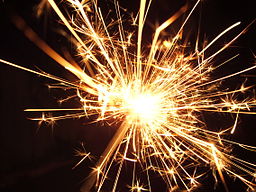
Burning sparkler on black background, looking like a supernova!There are no stars this Christmas
but those in your sweet face,
no snow and sparkling crystals
but those in your embrace.

You are my splendid banquet,
you are the birth of mirth,
you’ll be my earth in heaven –
my heaven here on earth.

Christina Egan © 2004

Photograph by Gabriel Pollard [CC BY-SA 2.5].
Featured picture on Wikimedia Commons. 

When the Snow Falls

When the Snow Falls

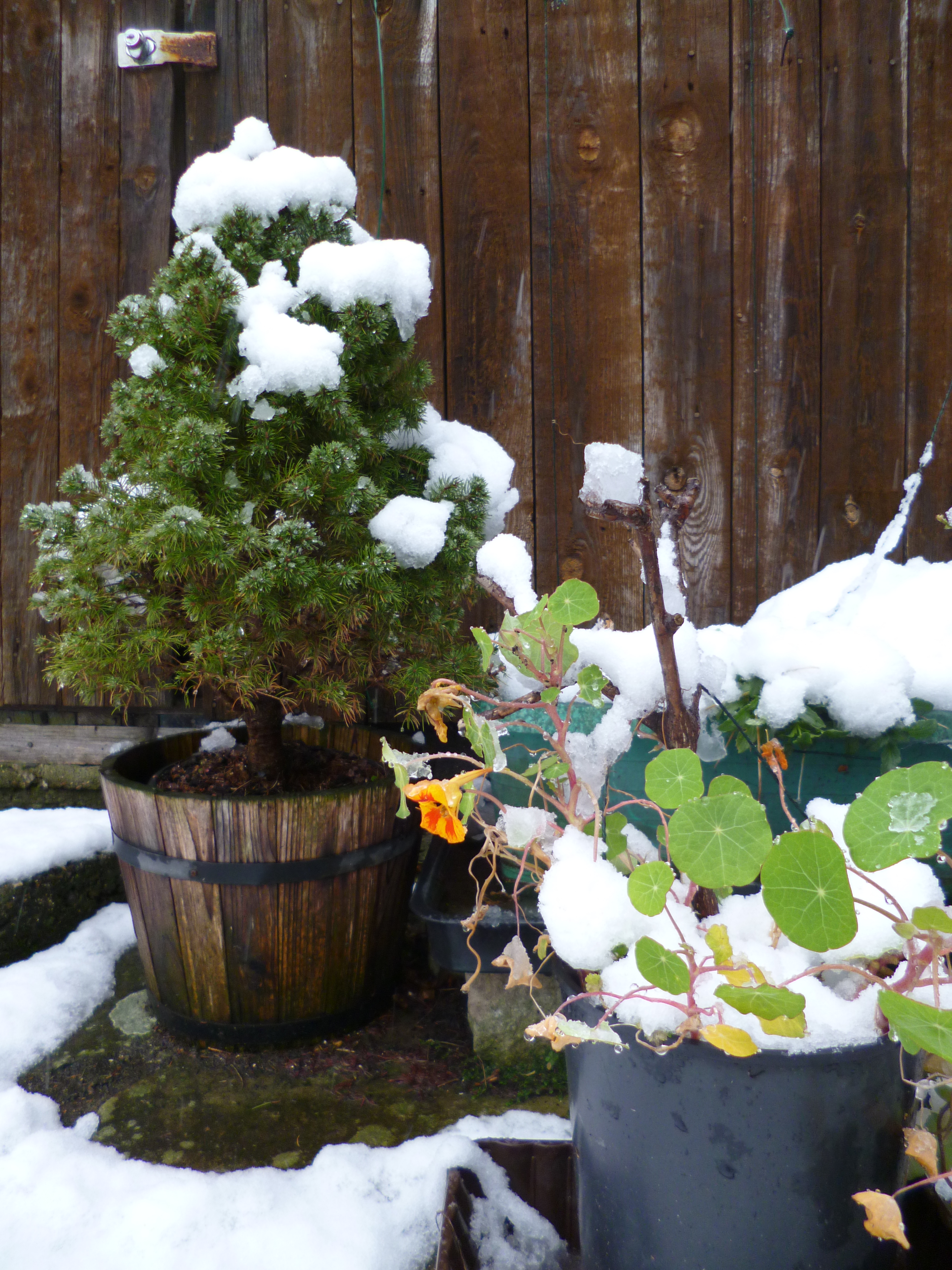
Tiny fir tree and orange nasturtium covered with thick melting snow.

When the snow falls,
when the snow calls
with its crystal-clear voice,
when the streets hum,
when the streets drum
with their boisterous noise,
when the fog shifts,
when the fog lifts
and the sun gilds the stone –
let your smile grow,
for a while know
you are never alone

Christina Egan © 2019

Photograph: Christina Egan © 2017.

This poem was commissioned for a Christmas card by a university library.
Feel free to write or print it in your cards, as long as acknowledge me as the author somewhere.

Wetterfahne / Weather-Vane

Wetterfahne

Delicate turret with weather-vane, on elegant curved roof with clockface.Jemand muß die Wolken jagen…
Jemand muß die Bäume fragen:
Seid ihr glücklich? Seid ihr satt?
Jemand muß den Regen ahnen,
eher als die Wetterfahnen,
eher als das Espenblatt.

Jemand muß die Sonne sichten,
Frost und Feuer in den Lüften
und den ungeheuren Sturm.
Jemand muß die Schwalben fragen:
Wird die Erde uns noch tragen?
Wetterfahne auf dem Turm!

Christina Egan © 2018

Weather-Vane

Turret painted in pink, with bright-blue clockface and golden weather-vane, under a blue sky.The weather-vane is turning,
the sinking sun is burning
and burnishing its gold.
The slender birch is swaying,
its golden veil is fraying…
The year is getting old.

The weather-vane is creaking,
the cold and damp are seeping
into the window-frames.
The golden flag is flashing,
the elements are splashing
their vigour into space!

Christina Egan © 2018


These two poems about weather-vanes were written on the same November day, but are not versions of the same text.

The first one alludes to a sensitive and at the same time sensible person, who keenly feels changes in weather and climate  — and asks how long we shall be able to live on this earth.

The second one describes sunset and autumn as images of ageing — and at the same time celebrating life!

Gut Hasselburg, Holstein, Germany; Bruce Castle, Tottenham, England. Photographs: Christina Egan © 2014/© 2017.

Remember November

Remember November

Eight times the leaves have paled,
been plucked and swept away,
eight times the sun has waned
and steeped the days in grey;
eight times the loom of spring
has woven rainbow rugs,
eight times made blackbirds sing
between the bursting buds;
eight times the fruit has swelled
and, in its turn, the fog,
eight times the frost has quelled
the sap’s impatient throb –
Eight years my heart has found
its breath and path in you;
eight years it’s watched your mouth
for words as warm as true.

Christina Egan © 2005

This anniversary poem goes through the seasons, with a focus on autumn. You could change the title and the number of years if you want it for your own anniversary, perhaps even swap the lines, starting with spring.