Venus and Mars

Venus and Mars

The darker the night,
the stronger the stars,
the fiercer the fight
of Venus and Mars.

They fight not each other
but darkness and cold,
they each hold a banner
embroidered with gold.

The later the hour,
the likelier dawn,
with fire and flower
in splendour reborn!

Christina Egan © 2016


This poem takes up my thoughts about the elements in the previous post: here, the male and female principles are involved in a common struggle rather than a struggle against each other.

‘Dawn’ refers to the dawn of the new year in early spring as much as to the time of the day; and springtime is even more unpredictable than daylight, precisely in a northern country.

The Spirits of Nimrod

The Spirits of Nimrod

The Spirits of Nimrod
stood tall and stood fast
to guard empty castles
of empires past.

The spirits of marble
were shaken at last:
their wings broken off,
their beards ground to dust.

The proud heads of Nimrod
are curls without face,
their eloquent pedestals
frames without phrase.

Yet some still have lips
to whisper by dusk
and some stir their wings
deep under the mud.

The Spirits of Nimrod
will rise like the sun,
invincible eagles:
beware when they come!

Christina Egan © 2016

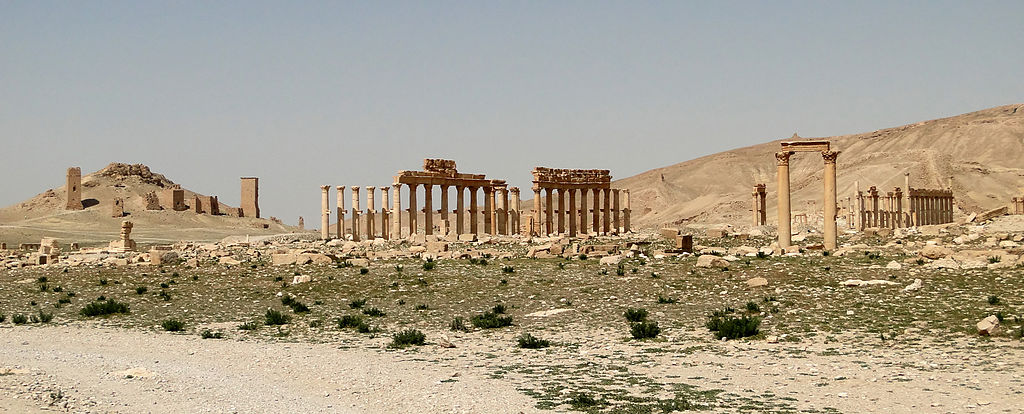
Ruins with many columns in arid, hilly land.

Invaluable buildings and sculptures of great antiquity and beauty have recently been destroyed by Daesh (so-called Islamic State). Nimrod was one place affected by those war crimes and Palmyra another.

These lines evoke the return of the gods — not as pagan deities but as statues: as witnesses of history and works of art, which we worship in our own way and will reconstruct, recreate, document, or remember.

Photograph: Diocletian’s camp in Palmyra, Syria (2010). By Bernard Gagnon (Own work) [GFDL], via Wikimedia Commons.

Paths from the Past

Paths from the Past

Flagstone on flagstone,
the pavement unrolls
beneath my eyes,
my resolute feet.

My steps seem to follow
irresistible tracks,
invisible traces,
uncharted faultlines.

Memory maybe
from before my birth?
Destiny maybe
beyond my death?

Flagstone on flagstone,
the story unfolds
beneath my breath,
my dexterous fingers.

Christina Egan © 2015

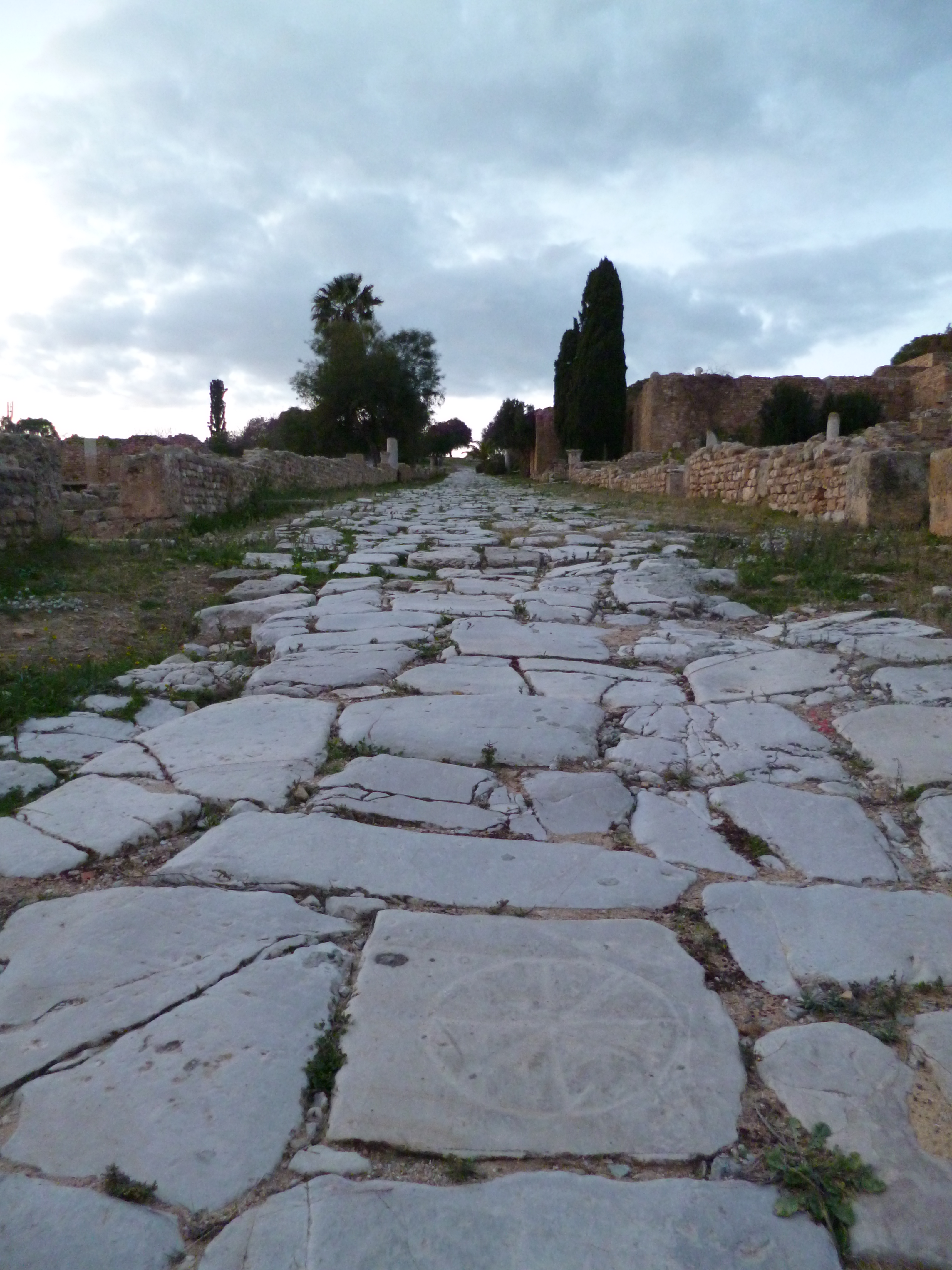
Straight Roman road with ruins and trees to the left and right, in the dusk

I begin the year with a Roman road for the third time round!

I do not speak of natural or magical force fields but of manmade structures; however, these are imbued with destiny, in that people were meant to build them, move along them, or return to them… perhaps even after thousands of years.

Roman road in Carthage, Tunisia. Photograph: Christina Egan © 2014

Palmenhaus / Palm House

Bright red koi fish coming out from underneath curved green bridge across pond

250 poems!


Palmenhaus am Wolfsweg –
Palm House at Wolves Lane

Huge banana leaf, bright green above bright green bridgeSattgrüne Segel,
wölben sich die Palmblätter
hier im Gewächshaus.

*

Green sails, filled with light,
with sap, the palm leaves billow
here in the greenhouse.

***

Tiny waterfall behind little red bridgeBlütentrompeten
antworten dem Wasserfall:
Kannst du’s vernehmen?

*

The flutes of flowers
answering the waterfall:
can you perceive it?

***

Turtle in pond under palm-trees

Dieser Tümpel ist
dem Schöpfer ein Tropfen,
der Schildkröte die Welt.

*

This round pond is
a drop to the Creator,
the world to the turtle.

***

Two koi fish in bright yellow and bright orange; dark water reflecting white sky and structure of glass-houseIm schwarzen Wasser
das Spiegelspiel des Himmels,
der Blitz des Goldfischs.

*

In the black water
quivering of heavens,
lightning of a goldfish.

***

Birght red koi fish coming out from underneath curved green bridge across pondAus nachtgleichem Naß
unter der grünen Brücke
schießt der rote Fisch.

*

From the night-like wet,
from under the bright-green bridge
the red fish shoots out.

***

Photographs: Christina Egan © 2013
German texts: Christina Egan © 2014
English texts: Christina Egan © 2015

December Date

December Date

The afternoon is royal blue,
Burning sparkler on black background, looking like a supernova!with tiny lights festooned,
I rush, I’m flushed, I look for you —
we never meet too soon!

The windows decked with evergreen,
with tinsel and with gold —
and there, my angel, genuine,
a candle in the cold!

Christina Egan © 2015

Photograph by Gabriel Pollard [CC BY-SA 2.5].
Featured picture on Wikimedia Commons.

Quest / Suche

Quest

The market swirls
like ocean’s foam –
The harbour bursts
to roam the blue –

Yet nothing’s real
if not dream –
And music too –
and music too!

Christina Egan © 2015Fest_des_Lebens_1970

Suche

Der Marktplatz quirlt
wie Wellenschaum –
der Hafen quillt
hinaus ins Glück –

Doch nichts ist wirklich
als der Traum –
und die Musik –
und die Musik!

Christina Egan © 2015

Very bright painting of mainly blue and red shapes on yellow.

This poem in German and English versions is dedicated to the painter Curt Echtermeyer, who for some of his work took on the pseudonym Curt Bruckner out of reverence for the composer Anton Bruckner. I hope Curt would appreciate the thought that dreams are more real than life…

Images: Das Fest des Lebens (The Feast of Life) by Curt Echtermeyer. Pastel, 1970. With thanks to Archiv Klaus Spermann.Max Ernst: Fish fight. Oil on canvas, 1917. – © Max Ernst. Distributed under FairUse at  WikiArt.

The City Lit Up

The City Lit Up

I lived between Ilex and Salix,
just north of Londinium Town,
and sometimes I climbed to the moss-well
between the oaks and looked down.

I looked at the thatch and the roof-tiles,
as red as the embers beneath,
I looked at the timber and marble,
the highways connecting the heath,

the gates, the walls and the broad bridge,
the fields afloat on the clay;
and I wondered if London would stretch
as vast as the valley one day,

Pond in park, surrounded by bare trees, with tiny island

as vast as Rome, which had risen
from marshes and slopes long ago,
with columns touching the heavens
because the gods willed it so;

and if Rome could ever be shrinking
and sinking into the bog,
or London be burning or flooding
and melting into the fog…

The city lit up in the sunset
and faded away in the dusk;
I felt the chill in the oak-wood,
and down to my villa I rushed.

I entered the gate by the willows
and strode through the dolphins’ yard,
I passed the flickering torches
and stopped by my forefathers’ hearth.

Roman mosaic of a mansion

My name was Appius Felix,
an heir to Aeneas of Troy;
I kept the seals and the idols
to pass them on to my boy.

I used the sword and the saddle,
I held the lyre and quill.
I lived between Ilex and Salix,
at the foot of the Moss-Well Hill.

Christina Egan © 2016


As you can see from the 100-metre-high summit of the Muswell Hill, London does stretch for many miles nowadays, filling the valley to both sides of the meandering River Thames.

You will also notice that there are large patches of green everywhere, some of them left over from ancient marshland and woodland. If you know your way, you can walk across London through woods and meadows, across hills and along rivers for miles!

My Roman observer lives in modern-day Wood Green or Bounds Green, near fictitious hamlets or villas called Ilex (holly or oak) and Salix (willow or osier).

This man firmly believes that gods guard his city and his country and that spirits guard his home and his family. He pursues some useful career in the service of the Empire, but he is also a bit of a poet.

I named him Appius after the statesman of the Republic who had contributed so much to Rome’s infrastructure as well as intellectual life, and Felix because he counts himself lucky.


You can find more on Londinium’s fortifications at Ode to London Wall  and more about its straight or winding highways at Quo vadis?

Photographs: Country villa, late Roman mosaic, Bardo Museum, Tunis. —  Pond in Tottenham, North London. Christina Egan © 2014

The First of December

The First of December

The ample, even, hand-like leaves
carelessly crumpled up by the frost
overnight,

the luscious colonies of moss
dusted with ice in the colourless light
of the day.

And we cannot deny this is still only autumn:
the yearly slow and sure descent
towards the cold.

This is the month of shrinking days,
of darkening hair and shivering skin
touched by damp.

This is the season of flickering lights,
some of them real, all of them glimmering
drops of hope.

Christina Egan © 2012

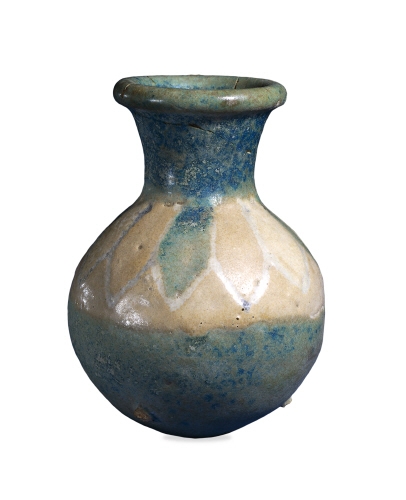
Glazed Clay

Jar, elegantly curved, with brown and blue glaze.Glazed Clay

Two mighty rivers’ ceaseless flow
beneath a high and cloudless sky;
to either side the ochre glow
of arid countries rolling by;

and here and there a golden maze,
the buildings’ cubes, the cities’ grid:
this jar with blue and brownish glaze
from Babylon still mirrors it.

Christina Egan © 2016

Mesopotamian jar (9th to 7th c. BC) Photograph: © The Trustees of the British Museum.

The city and country of ‘Babylon’ were under Assyrian rule at the time the little jar was made, but I just used the name as the most familiar for all the civilisations of Mesopotamia.

For a German poem about Babylon with the Euphrates and the Hanging Gardens, see Die Hängenden Gärten.

The perfect elegance of this tiny everyday object is an example for the simple beauty I call for in Fewer Things, where you can also see a red Roman bowl.