The Sun God’s Roads

The Sun God’s Roads

I saw them emerging from forest and fog,
the roads of the fiery barbarian god,
I saw them, I walked them, I measured them – but
I dragged on their slopes and I slipped in their mud.

They followed the creek, they followed the crest,
they followed the sun all the way to the west,
they lead to the market, they lead to the fort,
they lead all the way to the northernmost port.

My roads ran across their fords and their fields,
as smooth as a line of square Roman shields,
as straight as the flight of a sure Roman lance,
as hard as its tip, in a steady advance.

Some sauntering highways are right underneath
while others meander through meadow and heath.
I took what I needed, I bridged all the gaps,
I dropped all the rest off the Caesar’s clear maps.

Minerva brought wisdom and Mars announced peace:
we drained a few swamps and we parcelled the leas,
we left the round huts by the winding wet way
and stamped our rectangles into the clay.

My map showed a ragged and rugged old isle
with gridlines unrolling now mile after mile.
I marked it as Jove had commanded us – but
I still muse about the strange tracks in the mud…

Christina Egan ©2019

On this blog, the year always starts with a Roman road. Here, a civil engineer from antiquity reports how his straight highways and rectangular buildings cut right across the uneven and muddy terrain, winding paths, and round buildings of the native Britons. You can still observe this striking phenomenon in Stonehenge, Silchester, and many other places.

We may assume that enthusiasm for this turn of civilisation was not universal. The Celts thought, for instance, that it was silly to worship gods in temples, as if in boxes, instead of in nature. As regards the superb new roads, they were immensely useful for the transport of goods and ideas, but served first of all for the movement of the legions and of metals mined in Britain.

The Bricklayers

The Bricklayers

Die Spur des Mars / The Trace of Mars

Die Spur des Mars

Unbeirrbar rollt die Straße,
über Hügel, über Flüsse
schnurgerade hingebreitet
wie ein Strahl vom flammendroten
goldstückgroßen Himmelsboten:
Mars hat Rom hierhergeleitet.

Christina Egan ©2020

As ever, the first poem of the year admires the roads of the Romans. At Cassel in the north of France, you can see them radiate from a hill and run entirely straight, regardless of the landscape. They served very well to transport people, goods, and ideas, but were first of all laid to occupy and exploit regions. Mars in the poem above stands for war and aggression but also for courage and strength.

Northern Marsh

Northern Marsh

Beyond the Roman highway lay
the marshes, lush and veiled and vast,
on gravel and on sun-baked clay,
a northern, watery mirage.

The never-ending summer’s day
had lured me to a gentle ridge;
the brushwood seemed without a way,
the pools and brooks without a bridge.

And yet I knew that people dwelt
amidst the shimmering, shifting maze…
My flung-out road was but a belt
around an untamed country’s waist.

Christina Egan © 2020

The Path of Luck

The Path of Luck

The burnished desk of the leader groaned
under the slap of his sturdy sandal:
he brandished it over the map of Europe,
as if he signed it, large, from the left.
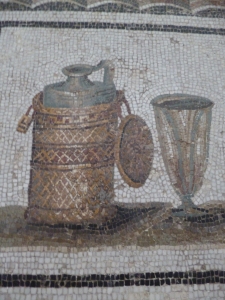
Roman mosaic of bottle and cupThe oil-lamp flickered, the officers frowned
and grinned and raised their cups of spiced wine:
“Don’t forge your luck while it’s hot and supple —

but fan your fate when you will it so!”
The earth would unroll like a scarlet carpet,
lavish her treasures before his feet:
the gold and the purple, sandalwood, snakeskin,
the pearl and the laurel, the wine from volcanoes.
His sandals mounting the snow-white steps,
he saw and saw not the pool of blood.

Christina Egan © 2008

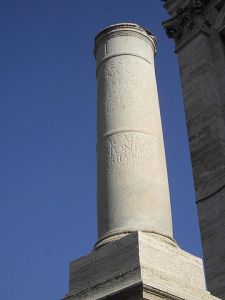
Massive smooth column with Latin inscription, including the name 'Caesar', against deep-blue sky.


Altae moenia Romae

Rome rose, looked round, and conquered all,
on loot and lies loomed square and tall,
and slowly crumbled towards its fall.
Time’s march defies the highest wall.

Christina Egan © 2008


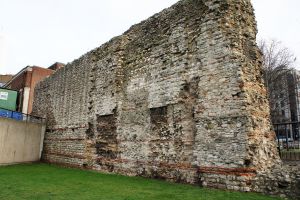
High wall of neatly piled stone and brick in the midst of the city

The first poem was written on the Ides of March and the second soon after. They reveal the dark side of Rome, the shadow of the imperial propaganda that the Empire had brought universal peace. Caesar is still celebrated as the greatest statesman ever; but he got to the top, and lifted Rome to the top, at a very great human cost.

For praise of ancient Rome, go to the narrative poem The City Lit Up about Roman London and the sonnets at The Hallowed City about the Eternal City itself.

The poem above follows the structure of an English sonnet, with three times four lines and then two in the end, with a conclusion or twist.


Illustrations: Roman mosaic, Bardo Museum, Tunis. Photograph: Christina Egan © 2014. — Milestone, Campidoglio, Rome. Photograph by Lalupa. — Roman city wall of London. Photograph by Mariordo (Mario Roberto Durán Ortiz) (Own work) via Wikimedia Commons.

The Hallowed City

The Hallowed City

I.

Aliusque et idem nasceris

When last I looked upon that golden hill,
the only coal-grey clouds along its crest
were pine-trees of Mediterranean zest,
clear-cut against the blue, timeless and still.
When I surveyed the city from the west,
beyond the river and the seventh hill,
my thirsty eyes rejoiced and drank their fill…
A pilgrimage it was and pagan quest.
Behind me passed the Sun on wheels of fire,
accompanied by Mnemosyne’s lyre.
Was this my long-lost and recovered home?
Born here and buried, had I now returned,
the same and not the same? My eye-lids burned.
This is the hallowed city. This is Rome.

Christina Egan © 2018

Drawing of curving Roman aqueducts crossing over

II.

Pulchrae loca vertor ad urbis

My eyes have seen the marble halls of Rome,
resplendent like the mighty mistress Moon
and multi-coloured like a field in bloom;
I’ve watched the buildings grow in brick and stone.
I’ve stood beneath the proud and perfect dome
which emulates the heavens’ sparkling room
and holds our destiny from dawn to doom.
I’ve roamed those hills and called a roof my home.
I’ve heard the chanting children, sighing harps,
the darting chariots and creaking carts,
the swish of virgin water, purple wine,
I’ve seen the aqueducts descend and curve,
the roads roll into Rome, unite, disperse —
I’ve tasted all that splendour. It was mine.

Christina Egan © 2018


The first blogpost of the year deals, as always, with Roman roads!

The impression of aqueducts, which illustrated one of my parents’ books about ancient civilisations, informed my entire life. Unfortunately, I do not know the artist, but there does not seem to be a copyright on it.

The quotes are from two Roman poems about Rome, Horace’s Carmen saeculare and Ovid’s Tristia.

I apply Horace’s idea that the sun is daily reborn, another and yet the same, to a person who feels he or she was reborn into this world many centuries later, another and yet the same; and I reinterpret Ovid’s lament about remembering his home from exile as a modern person’s longing for antiquity. Mnemosyne is the Greco-Roman divinity of memory, and the Sun and Moon, of course, are mighty gods, or at least representations of gods.

The Eagle’s Outpost

The Eagle’s Outpost

Gently, I lay my hand upon a stone:
it snuggles up to my pulsating palm.
The last time it enjoyed the sun god’s balm,
he gilded nimble chariots of Rome,
and legionnaires patrolled the city walls
above the river of a thousand miles,
while olives, dates and spices glowed in piles
and glittering fabrics flowed from shaded stalls.
The halls were fashioned of a thousand stones;
so were the roads rolled out to many lands;
and all were laid by many thousand hands…
This eagle’s outpost held ten thousand souls –
A dream of dreams, lifted into the light:
I was in Dura Europos last night.

Christina Egan © 2018

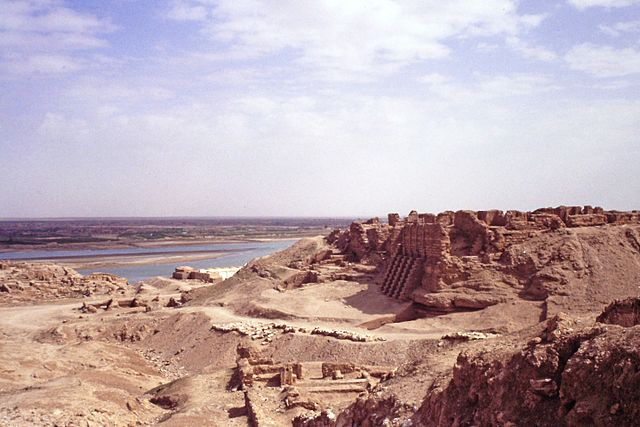
Runis of fortress on hilltop in arid land, above wide river with green fields.

The ruins of Dura Europos above the Euphrates, today in Syria, in 2016.
Photograph
 by Marina Milella [CC BY-SA 4.0], via Wikimedia Commons.


After 500 poems, the usual poem about a Roman Road to start the year!


War and Peace (Red Fog / Green Shoots)

War and Peace

I.

Red Fog

Red fog rose
from the bloody river
when Baghdad’s proud walls
crumbled to dust.

The sobbing, the gasping
rose with the fog,
scratched the blank sky
till it wept blood.

High soared the blinking blades,
higher the cries of triumph,
down on the broken timber,
the toys forlorn in the ash.

Red ran the Tigris,
bearing pots and books and bodies
down through the desert,
frayed crimson silk.

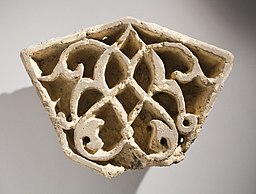
Decorative brick with symmetrical floral motiv, deeply incised.

II.

Green Shoots

Green shoots, vibrant,
blue buds, brilliant,
climbing the trellis
of ten thousand tiles.

The tall white walls,
the wide white courtyards,
the shimmering basins:
those were the flags of peace.

Not the carpets of ash
which the conquest leaves,
nor the polished parchment
where the truce is signed.

Peace is the pomegranate
in the smooth wooden bowl,
peace is the spinning-top
on the deep-green glaze.

Christina Egan © 2003 (I) / © 2018 (II)

These poems were inspired by the massacre of 1248 when the Mongols took Baghdad, but they can be applied to any war Mesopotamia has seen in the course of the millennia, or indeed to any other part of the world…

Brick from Baghdad, mid-13 century. Photograph: Los Angeles County Museum of Art.

By the River I was Sitting

By the River I was sitting

By the River I was sitting
Watching barges floating by
Like the clouds so full of promise
In the blue and burning sky

Bearing jewels, bearing silver
From the mountains crowned with snow
Bearing spices, sweet and fiery
From the jungles down below

By the River I was waiting
For a boat to pick me up
Till the oars were folded inward
And the city-gates were shut

On my roof-top I was watching
Night like lapis-lazuli
While the stars were slowly rolling
Round the tiny lonely me

By Two Rivers I was dwelling
In a house of golden bricks
In my dress of snow and silver
Waving to intrepid ships

When the stars had come full circle
Strangers broke my city-gate
And my boat lay by the palm-trees
Finest date-wine was its freight

And it flew against the current
And it floated with the storm
Till I climbed the purple mountains
Where the River Twins are born

Christina Egan © 2011

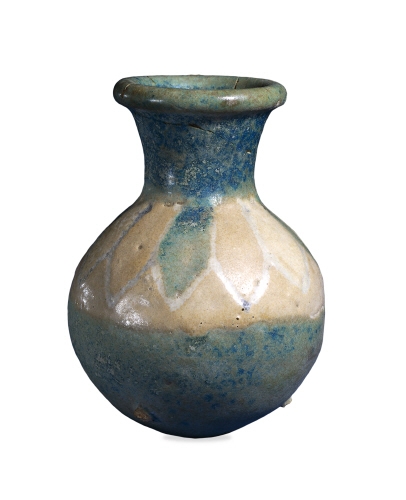
Jar, elegantly curved, with brown and blue glaze.


This song of the woman by the river is taken
from my stage play The Bricks of Ur  (© 2011).

Place: City of Ur, Mesopotamia — Time: 2000 B.C.

Photograph: Assyrian jar (9th to 7th c. BC).
© The Trustees of the British Museum.

Spätes Wiederfinden

Spätes Wiederfinden

I.

Die strohgedeckten Hütten sind verschüttet,
und in den Säulengängen haust der Wind.
Mir ist, als spürt’ ich unter meinen Sohlen,
wo eigne Schritte eingezeichnet sind.

Ich schliff das Pflaster unter den Sandalen,
ich legte jenes Pferd ins Mosaik;
ich wurde dort am Wegesrand begraben
mit meinem Krug voll Kummer und voll Glück.

Very irregular pavement.

II.

Mir scheint, ich hätt’ schon vor Jahrhunderten
in deinen Augen wie ein Gast gewohnt.
Und wenn ich nur den Schlüssel wiederfände,
dann hätt’ auch dieses Leben sich gelohnt…

Was zählen da die wenigen Jahrzehnte,
in denen wir einander jetzt versäumt?
Ein kleiner Aufenthalt in deinen Augen
bringt, was ich in Jahrtausenden erträumt.

Christina Egan © 2011


The fifth year of this poetry blog sets off, as always, with a Roman road or another ancient road!

In the first poem, someone finds the place where they lived and died in a former existence; in the second one, they think they have also found their former love…

The location is imaginary. The three images for the former life all have to do with the earth: the feet and shoes; the mosaics in the floor; the grave by the wayside. Two of the images also refer to wandering, our wandering on earth: the soles wearing the pavement down and the horse in the mosaic. The second poem mentions the status of guest; as the psalms express it, we are all guests on earth.


Photograph: Christina Egan © 2016.  International highway, Via Domitia, crossing the forum of Narbonne. I suppose this bit had been much damaged and patched up, since the Romans built entirely straight and smooth roads!