Sonett der drei Seen

Sonett der drei Seen
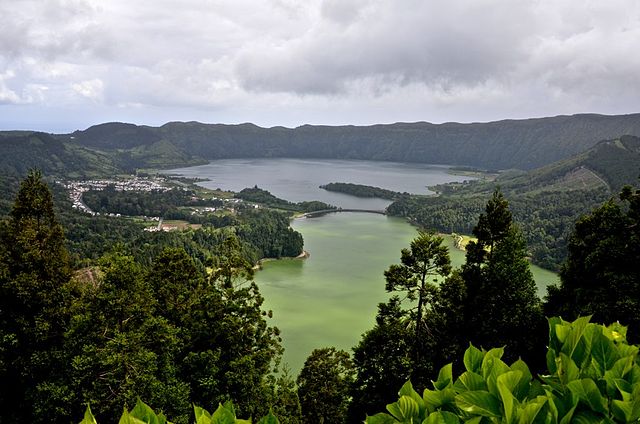
(São Miguel, Azoren)

Der Teich war gelb, und gelbe Dämpfe stiegen
ins heiße Blau, umringt von dunklen Ranken,
als müde Glieder sich im Gelb entspannten
mit Blättern, die wie Schlick im Strudel trieben.
Der See war grün, und grüne Schimmer hingen
in steilen Hängen und in flachen Tiefen,
worunter ungeheure Feuer schliefen,–
zur rechten grün und himmelblau zur linken.
Und um die gelben, grünen, blauen Kessel
und buntbestickten Ufer lief ein Band
von schwarzen Felsen und von schwarzem Sand;
und darum – ohne Grenze, ohne Fessel
und ohne Form – das Meer, das Element…
O selig, wer die sanften Inseln kennt!

Christina Egan © 2016

Sete_cidades_(14267780070)


Sete Cidades, (São Miguel, Azores). Photograph by Aires Almeida from Portimão, Portugal, via Wikimedia Commons.


The colours of the water are really like in the photo! See also my verse Acherons Mund  for the darker aspects of these isles.

These poems may work in a translation software, although you only get the meaning, not the sounds, which are like music and like the sounds of nature itself!

You Want to Read This Poem

You Want to Read This Poem

You want to read this poem
time or no time
rhyme or no rhyme.

You want to know
that your face is a flame
in the hidden temple
of someone else’s heart
trembling and steady.

You want to dwell
on the deep-blue dusk
of her dress
of her eyes
of her soul.

You want to believe
one last time
that three hours are enough
to fuel three years of delight
and from there three thousand.

You want to be sure
she will never be too close
never too far
like surges of birdsong
like surf.

You want to read this poem
as if it were a prayer
as if it were a promise.

Christina Egan © 2011


You Do Not Want to Read this Poem

You do not want to read this poem
however much sunlight
however much midnight.

You do not want to plough
through luminous ciphers
of your own beauty
you want to hear it in someone’s voice
you want to see it on someone’s lips.

You want to lift your eyes from the paper
onto her face
you want to lift your hand from the paper
onto her arm
let it rest.

You want to step through this poem
as if it were a secret gate
to the tiered garden
of an ancient manor house
you heard of in a novel.

You do not want a host of poems
a pavement of paper
a quilt of hopes
you want a host of moments
a quilt of memories.

You do not want to read this poem
you want sudden life
before the sun has sunk.

Christina Egan © 2011

Oktoberbilder

Oktoberbilder

I.

Die weiche Luft wie weißes Brot…
Das erste volle Herbstesrot
hängt überm frischgetränkten Gras.
Die Sonne bleibt durch Dunst versperrt,
doch Astern sprühn ihr Feuerwerk,
und Rosen quellen ohne Maß –
O erdgeborne Sternenpracht,
die uns am hellen Tage lacht,
o buntes Bild auf grauem Glas!

II.

Der Himmel ist mit Blau behaucht,
die Gärten neu in Gold getaucht,
mit Gelb getränkt schon manches Laub;
und selbst das Blatt, das sterbend schwebt,
ist kupferrot wie frischerregt.
Noch einmal kost das Licht die Haut…
Das Windrad saust, die Wolke fliegt,
ein weißer Blütenball zerstiebt –
Zuletzt wird jedes Ding zu Staub.

Christina Egan © 2015

This poem has meanwhile been published in the Rhönkalender 2017.

Ein Muster aus Muscheln / Greek Islands

Ein Muster aus Muscheln

Ein Muster aus Muscheln und Bernstein und Bein,
mit Karneol und Koralle durchsetzt,
auf lapislazuliblauem Grund:
So leuchten die Inseln im Sonnenschein,
vor dreitausend Jahren… und letzthin… und jetzt:
ein Mosaik, ein vollendeter Fund.

Vors Fenster des sinkenden Flugzeugs gespannt,
vom Guckloch des finsteren Turmes gerahmt
– nur einen Moment – nur einen Moment –
das Muster aufs wartende Auge gebannt,
die Farben ins wache Gedächtnis gemalt:
ein Bild, das nach dreißig Jahren noch brennt.

Christina Egan © 2016

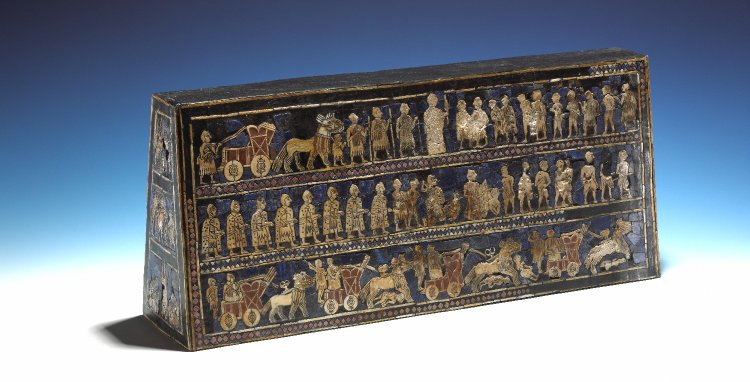
Standard_of_Ur_BM_121201

Standard of Ur (2500 BC). – Photograph© The Trustees of the British Museum.

I am showing this ancient object – twice as old as our classical antiquity – because it must have inspired my poem about Greece. The images on the box are made of shell, lapis lazuli, and red limestone, but I did not remember those details or  even think of the thing. When you have the chance to go to London, do not miss out on the Sumerian galleries of the British Museum!

The longing for a return to Greece, both for the Mediterranean environment and for the ancient civilisation, is also expressed in On Eating Olives / Beim Olivenessen  and in Greek Islands  (below). There are a number of poems about Crete in German and English on this website.


Greek Islands

There is more blue in the air
between here and the horizon,
between morning and evening,
than the cup of the eye can hold.

So my soul may flow over
into the sky,
into the sea,
into this scattered paradise…

Christina Egan © 2012 


On the topic of the blue Mediterranean Sea, see also Meine blaue Mauer  and O Heimatland aus Stein und Licht. On the manifold colours of the same sea, see The Purple Sea / Das lila Meer.

Mer de miel

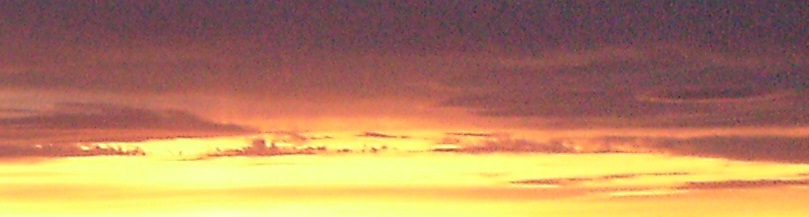
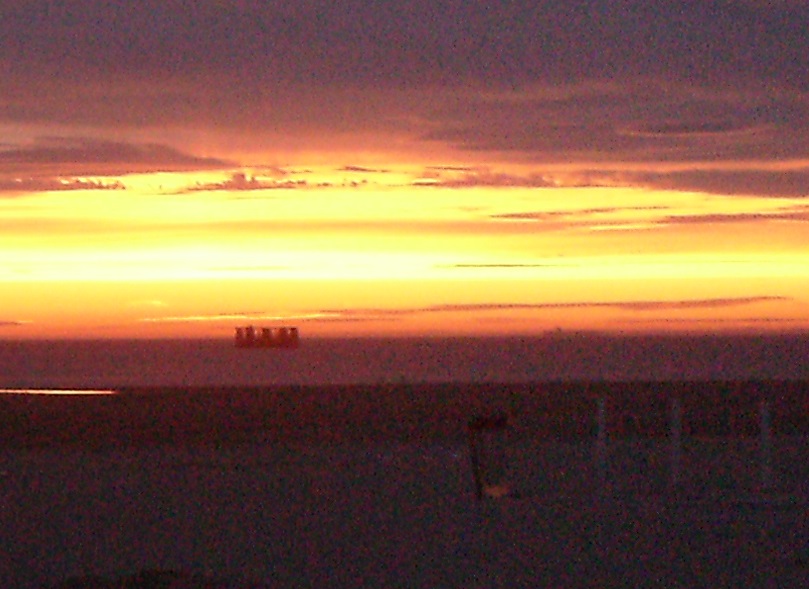
 Clouds in hte sunset, looking like a bright yellow sea, an orange coast and purple sky. An optic illusion above a real coast (not visible here).

Mer de miel
(Sète)

Levez vos yeux vers ce vitrail doré,
d’un jaune plus doux, d’un jaune plus pâle possible :
une baie cernée de hauts rochers
d’un bleu brumeux… Un crépuscule paisible.

Clignez vos yeux à ce vitrail distant,
mer de miel, montagne mauve, sauvage :
tout flotte au dessus de l’horizon –
des eaux de feu, une terre de nuages !

Ce paysage d’un or incomparable
s’évanouit et passe, une image…
Ou serait ça la côte impérissable
et notre terre et mer le grand mirage ?

Christina Egan © 2016


This poem takes up an idea from ancient pagan and Christian philosophy: our world may be only a pale reflexion of a higher, perfect, world. Those ‘heavens’, however, are an inaccessible and unimaginable place — beyond our universe — for which the visible sky is only an image.

The fiery sunset which took me quite literally ‘out of this world’ occurred in midwinter on one of the northernmost beaches of the Mediterranean, at the outskirts of Sète. For a daytime poem and photograph on the sea around Sète, see La Mer, enfin.

Clouds in the sunset, looking like a bright yellow sea, an orange coast and purple sky. An optic illusion above a real coast (also visible here).

Photographs: The sky above the coast in Sète, France. Christina Egan © 2016

Orange Beads

Orange Beads

I.

I nod to the flower
the colour of dark wine
stalks and spikes that tower
above my legs and spine

twin doors an orange spill
the only one in town?
why is my own door still
an ordinary brown?

O sweet day!

II.

All these parallel roads
the orange doors are where?
again the suburb soaks
in sunshine hello there!

they smile and say hello
all else though stays behind
their sturdy frames and so
I keep my orange find

two bright beads

III.

The hawthorn turns orange
the blackberry turns black
mingling at the park’s fringe
behind the cycle track

the sky is blue as if
this were a normal state
as if we could just live
beyond the iron gate

of summer

Christina Egan © 2016


In London, you can find many front doors painted in red, blue, or green, but I had never spotted an orange one. I have mentioned a striking yellow door elsewhere. I usually go out without a camera, but I capture impressions with my pen!

There are so many green spaces in London that you can walk through parkland for hours. To find blackberries and hawthorns tucked between a duck pond and a little copse is quite normal in this vast city of over eight million people.

The verse pattern is borrowed from the French poet, Jean-Yves Léopold, who does not have a website. Eight short rhymed lines, almost without punctuation, are followed by a ninth line which is even shorter and does not rhyme at all, so it stands out.

Hochsommerhimmel

Hochsommerhimmel

Himmel, wolkenlos
schon am Morgen. Schwalbenflug
bestickt das Hellblau.

*

Himmel, weich und warm
über Mittag. Seidentuch,
endlich einfach blau!

*

Himmel, licht und sanft
noch am Abend. Holzspanduft
umwebt die Rosen.

Christina Egan © 2015

Word Weaver

Word Weaver

More purple clouds than I can count
or weigh or paint for you
or snatch and send them underground
with some surrounding blue…

To one whose windows do not stretch
to spy the heaving sky,
I’ll weave my syllables to fetch
the purple passing by.

To one whose dusk and marble moon
are filtered through a rail,
I must thread silver on my loom
to leave a shiny trail.

I must request the best black silk
to mark the balmy dark…
By day I’ll stitch a roaring quilt
to catch the city’s heart!

Christina Egan © 2016

Drawing of the mechanics of a loom (yarn on rolls, without the frame)The poet describes the world to a prisoner who can barely see the majestic ever-changing sky and the bright busy city surrounding them. The sound and rhythm of the lines emulate the warp and weft of life, so that the words reflect the world — read the poem aloud and you will see!

The other person may be imprisoned by a totalitarian state or indeed by a democratic state, or locked up by their employers or indeed their own family, behind walls and perhaps under a garment. There are many millions of human beings who de facto are prisoners or slaves without being called so.

For poems about time (for instance ensuing generations) and space (for instance a big city) as a tissue, see my post Geflecht / Geflechte. All of civilisation and all of humanity is one web.

Augustfest

Augustfest

August.
Klangvolles,
sattgoldnes Wort,
beinah orangerot.

Abend.
Wort voll blauer Ruhe,
verborgener Kraft
und süßer Verheißung.

Norden.
Ein weites graues Feld
im Winter… im Sommer aber
ein ganz grüner Horizont.

Augustabend im Norden.
Ein Fest ist uns bereitet,
herrlich wie ein Hochzeitstag.
Schau dich doch um.

Christina Egan © 2016


Some more thoughts on the north of the planet… In winter all is grey, sky and land and water alike; but in summer, the world shines in blue and green and golden. This is before you look at the flowers and fruits, and the places and things whose colours show again, and the people who have come outdoors again. Winter lasts six months in Southern Europe, like in the myth of Persephone, but seven months in Central Europe and perhaps nine in Northern Europe… All the more do we enjoy the glories of summer!

This is one of many poems I wrote for my wedding anniversaries in August; I hope plenty of other people will be able to use it for their engagements, weddings, and anniversaries! The little poem I read at my wedding is simply called I Love You.

Views of North Sea Islands

Views of North Sea Islands Ansichten von Nordseeinseln

White cottage, steep thatched roof, covered with moss


Thick patches of moss
clustering on rippled thatch
like verdant islands,
like the islands we stand on:
growing in the rough grey sea.

Diagonal horizon, entirely flat between green and blue, with house in middle

Dicke Moospolster
auf dem welligen Reetdach,
gleich grünen Inseln,
gleich diesen Inseln hier,
wachsend im wilden grauen Meer.

Thatched roof, covered with moss

Red clover blossom:
tiny magenta lanterns
in the green and blue,
feeding on the salty floods
across these flat floating disks.

Diagonal horizon, entirely flat between green and blue, with house in middle


Rosaroter Klee:
winzige Laternen
in all dem Grün und Blau,
genährt von Salzfluten
über schwebende Scheiben hin.

Thatched roof, covered with moss


Huge ships approaching,
or space-ships – or are they hills,
or houses on stilts?
They are houses, hamlets, islets…
a necklace of glass beads.


Satellite image of a cluster of small emerald green islands


Da – Riesenschiffe –
Raumschiffe – oder Hügel,
Häuser auf Stelzen?
Häuser, Dörfchen, Inselchen…
eine Glasperlenkette.

English texts: Christina Egan © 2015
German texts: Christina Egan ©2016

Photographs: Christina Egan © 2014
Galerie Nieblum on Föhr; Hallig Hooge.
Satellite picture: NASA via Wikimedia.


From the flat, small, oval island of Föhr, you spot the even flatter, even smaller islands known as ‘Halligen’: their clusters of houses and trees on little dells are visible on the horizon far across the ocean.

The Halligen still get regularly flooded and are occasionally menaced by devastation. All these islands change shape over time, when the forces of wind and water eat away at their edges or add new land.

I wrote about a similar phenomenon observed on the Baltic Sea island of the Darss in Schöpfung (Darß).