The Sun God’s Roads

The Sun God’s Roads

I saw them emerging from forest and fog,
the roads of the fiery barbarian god,
I saw them, I walked them, I measured them – but
I dragged on their slopes and I slipped in their mud.

They followed the creek, they followed the crest,
they followed the sun all the way to the west,
they lead to the market, they lead to the fort,
they lead all the way to the northernmost port.

My roads ran across their fords and their fields,
as smooth as a line of square Roman shields,
as straight as the flight of a sure Roman lance,
as hard as its tip, in a steady advance.

Some sauntering highways are right underneath
while others meander through meadow and heath.
I took what I needed, I bridged all the gaps,
I dropped all the rest off the Caesar’s clear maps.

Minerva brought wisdom and Mars announced peace:
we drained a few swamps and we parcelled the leas,
we left the round huts by the winding wet way
and stamped our rectangles into the clay.

My map showed a ragged and rugged old isle
with gridlines unrolling now mile after mile.
I marked it as Jove had commanded us – but
I still muse about the strange tracks in the mud…

Christina Egan ©2019

On this blog, the year always starts with a Roman road. Here, a civil engineer from antiquity reports how his straight highways and rectangular buildings cut right across the uneven and muddy terrain, winding paths, and round buildings of the native Britons. You can still observe this striking phenomenon in Stonehenge, Silchester, and many other places.

We may assume that enthusiasm for this turn of civilisation was not universal. The Celts thought, for instance, that it was silly to worship gods in temples, as if in boxes, instead of in nature. As regards the superb new roads, they were immensely useful for the transport of goods and ideas, but served first of all for the movement of the legions and of metals mined in Britain.

Tree Haiku (Bloomsbury)

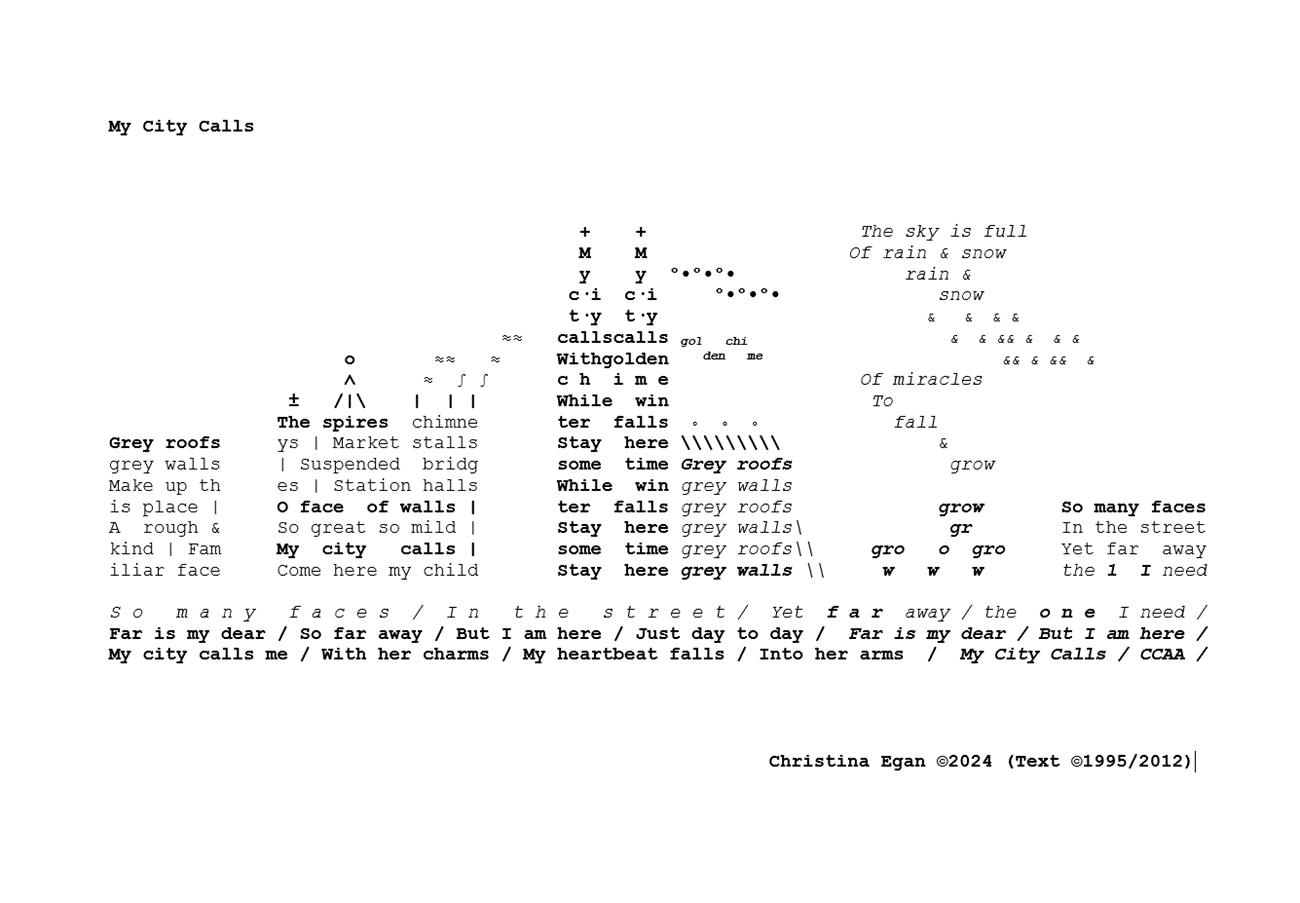
My City Calls (Visual poetry)

Poem "My City Calls" typed up in the shape of a city, including a Gothic Cathedral. In the sky, chimes, smoke, snow or rain, typed in special characters.
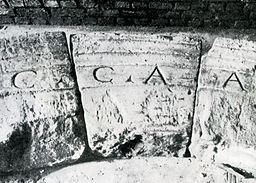
Inscription "C.C.A.A.", very clear, on old broken stone monument.
Poem "My City Calls" typed up in the shape of a church bell, with some ornaments of special characters.

Visual poems My City Calls (Cityscape) and My City Calls (Church Bell). Christina Egan ©2024. Developed from the text My City Calls (1995/2012).

Overcast (I took the bus)

Overcast

I did not read the book
I took
I did not cast a glance
not once
I took the bus and dreamt
no end
I wrote some verse of love
and stuff
I dreamt that in the street
we’d meet
and summer would return
and burn
and that would be the date
from fate:
the sun and you and me
all three

Christina Egan ©2023

There is evidently a lot of waiting for sunshine in northern latitudes, as in Warten ist der Winter and Hinter dem Olivenbaum

This playful verse from a London double-decker bus was actually written in mid-August, when it should be bright and hot everywhere; yet the weather has always been unpredictable and is now turning seriously unstable. In this poem, the summer is not returning after the period of winter but after a long, dull, cool break between early and late heatwaves.

The Keystone of the Sky

Showers (Haiku)

Showers

*

Snow

A thousand snow-flakes,
sent from the moon to the lake
like little kisses.

*

Rain

The rain is dancing
on the skylight through the night.
We are wrapped in sleep.

*

*

Christina Egan ©2002

Raindrops on window, with pink flowers showing in the lens of each drop.
Raindrops on window, with flowers showing in each drop.
Photograph by Kumiko Shimizu on Unsplash.


Hinweisschilder

Hinweisschilder

I.

Dies Gedicht hat keine Bilder,
denn die Welt ist ein Gedicht!
Überall sind Hinweisschilder,
überall Scheinwerferlicht!

Doch wir tappen durch die Tage,
rumpeln, rempeln, fallen hin.
Sehn wir je, dann ohne Farbe,
ohne Muster, ohne Sinn.

II.

Manches wird herbeigeschafft,
anderes herbeigeschaffen.
Manches wird herangerafft,
anderes herangelassen.

Manches wird herbeigeredet,
anderes herbeigeschrieben,
manches auch herbeigebetet
oder gar herbeigeschwiegen.

Christina Egan ©2024

You may wonder why I label philosophical musings “Religion” or why my poems on “Religion” do not refer more to a certain creed. Yet for me personally, there is no philosophy without religion. God is present everywhere, whether we feel it or not, and our life is a search for God, whether we know it or not.

As regards Christianity, my poetry is very much inspired by the Scriptures, the hymns, the liturgy, the imagery. I probably owe more to Martin Luther than to any other writer. All German speakers do. It also seems to me that in this secular society, I would most put people off by mentioning that I am a Catholic.

rosengarten (II. sprühendgrau)

rosengarten

II.

sprühendgrau

die ungeahnten sonnenglanz vergießen
die regenschauer und den regenbogen
zu einem milden meeresgrau verwoben
die augen sollen meine verse grüßen.
dem nebelland das immerkalte wogen
in ungestümem reigentanz umschließen
den inseln voller sprühendgrüner wiesen
sind jene augen ursprünglich enthoben.
drum frag ich nicht nach lilien und lavendel
die flammen sprühen auf gebeugtem stengel
noch nach des südens uferlosem blau
nichts brauche ich als meinen kleinen garten
wo alle wunder lächelnd meiner warten
die bunte welt geballt in sprühendgrau.

Christina Egan ©2023

This sonnet is part of a cycle of 14 poems, whereby each line of the first one (rosengarten I. tiefversteckt) furnishes the first line of a new sonnet.

The island described here is Ireland, but the cycle takes you to other islands, as well as to the palace gardens of Würzburg, Germany, which first inspired me.

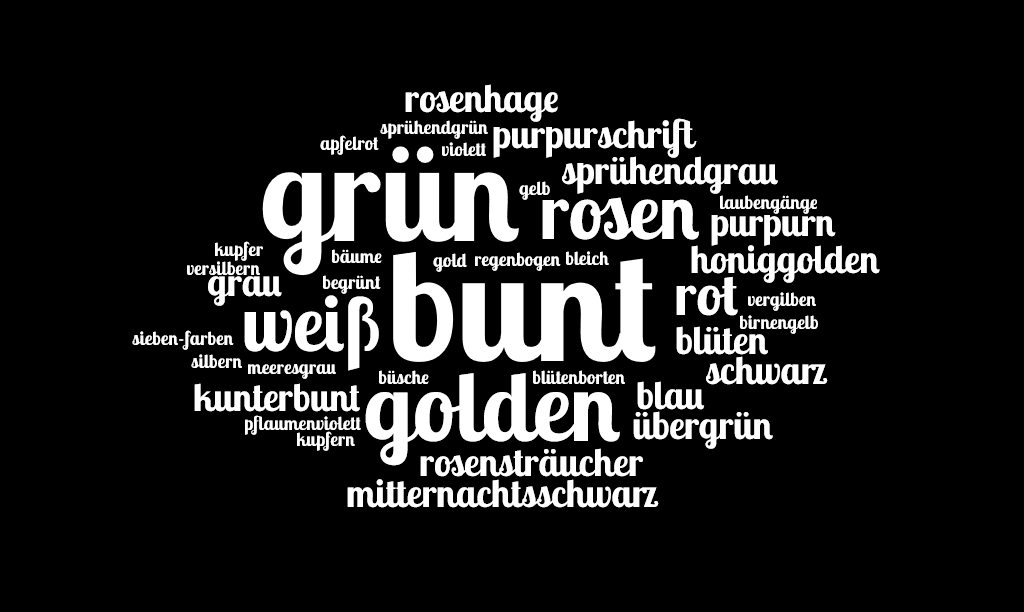
Word cloud of colours and flowers and in white on black; in the middle, "multi-coloured", "green", "golden".

Word cloud of colours in the German sonnet cycle (rosengarten I-XIV), generated on the Simple Word Cloud Generator. In the middle are “colourful”, “green”, and “golden”. Since the colours of the roses are not described, the roses themselves are added.

glanztanzend / dazzle-dancing

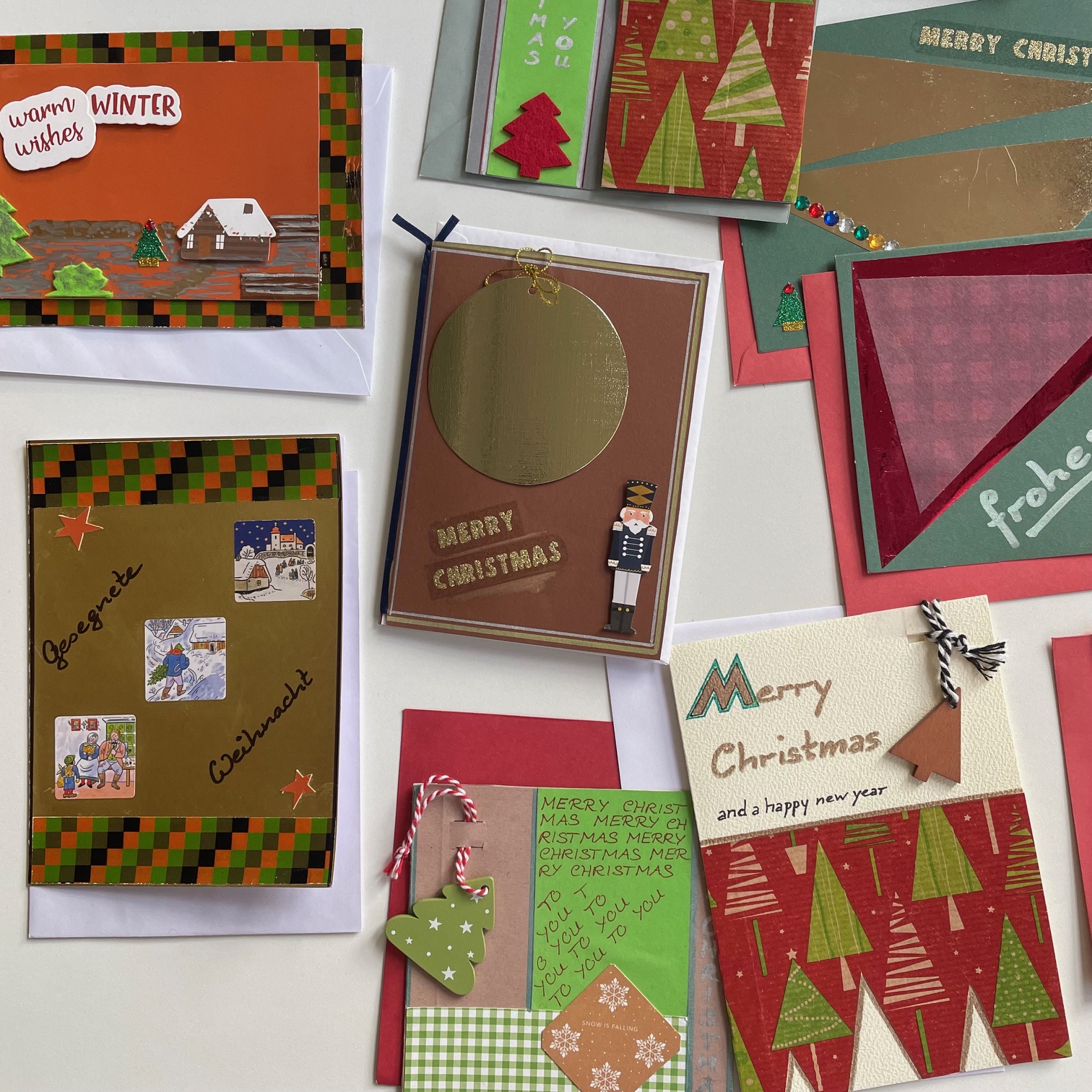
A handful of hand-crafted Christmas cards in different styles and colours.

The poem does what it describes: inventing words, lining them up, and sending them to others to greet them and cheer them up!

The newly coined terms had to be re-created in English – where they do of course not look as impressive. “lindwurmwörter”, for instance, really sounds and looks as long as a dragon, while “dragon’s tail words” looks like three words, even though I added the tail in to get a similar effect in meaning and length.

In England, many people hang Christmas cards up on golden strings. During the festive seasons of 2022/23 and 2023/24, I crafted many greeting cards myself, each of them unique.

Seasonal greeting cards. Artwork: Christina Egan ©2022/©2023/©2024. Photographs: Miriam Hornsby ©2024.

Shooting-stars (Damp Wood)

Shooting-stars

Damp wood, damp walls: the world smells of decay.
The scented roses are resurgent, yet
too many leaves are falling, fallen, wet
across the spotless lawn, the winding way.
Above Bruce Castle’s reddish parapet
and wayward weather-vane, the veil of grey
is torn apart to let a dazzling ray
caress the clock-face, still for summer set.
The light is fierce and will not be subdued,
the clock smiles sky-blue with a rim of gold,
the grass is glittering and fresh and bold,
and then the sky itself triumphs, renewed.
All this eclipsing, flash on flash, they pass:
the parakeets, a dozen shooting-stars.

Christina Egan ©2020

Turret painted in pink, with bright-blue clockface and golden weather-vane, under a blue sky.
Bruce Castle, Tottenham, England.
Photograph: Christina Egan ©2017.

This sonnet was read at an
event of Tottenham Trees
at Bruce Castle Museum
in November 2024, together
with Thought Bench and
Hollow Oak (Anglo-Saxon spell).