I did not read the book I took I did not cast a glance not once I took the bus and dreamt no end I wrote some verse of love and stuff I dreamt that in the street we’d meet and summer would return and burn and that would be the date from fate: the sun and you and me all three
This playful verse from a London double-decker bus was actually written in mid-August, when it should be bright and hot everywhere; yet the weather has always been unpredictable and is now turning seriously unstable. In this poem, the summer is not returning after the period of winter but after a long, dull, cool break between early and late heatwaves.
Du bist die Hand, die mein Gebetbuch hält in aller Frühe, wenn die laute Welt noch schlummert wie ein müdgetobtes Kind und wir die Stimme ihrer Träume sind. Wir sind der Psalm, der aus der Erde steigt, wenn Nachtwind noch die Wiesenblumen neigt, das erste Wechsellied im Weizenfeld… Du bist die Hand, die mein Gebetbuch hält.
At dawn, the noisy and unruly world, just like a tired child, has not yet stirred. We are the voice of all its dreams: we stand, my hymnal lifted by your distant hand. We are the psalm arising from the earth while night wind is still bending blooming herbs. We are the chant across the ripening land… My hymnal lifted by your distant hand.
These lines describe the early-morning prayer of Christian monks and nuns: standing up and bowing, chanting and responding to each other… They also imagine an invisible connection between two of them — good friends perhaps, close relatives, or former lovers — who feel that they are praying together across the distance between them.
Is this moon new or young, a sliver or a crescent, silver or golden in the deep blue, the newly deep sky, is it striking or dazzling or mesmerising?
Is this a late spring, belated and all the more welcome, bursting with life, with green, bright green, saturated with rain and sunshine, saturated with colour and heat, heat unfamiliar and all the more welcome, or is it sudden summer?
Is this life at last, is this joy, is this joy of life, is it zest, is it just new life-force or is it happiness or elation or bliss?
Reality, as it laps up against the shores of your eyes and your ears and your nose, reality as it washes over the leas of your skin and seeps beneath, cannot be captured in words, not even in verse: reality, so dense it feels like a dream, is not a dream cloud nor a word cloud.
Although this poem would make a good one, with the message of sudden summer sounding out like birdcall, flooded with light and colour, steeped in joy, as if words were written from life and for life, as if words were part of life, of the wide earth and the deep sky and the reality beyond, of the ever-flowing life-force.
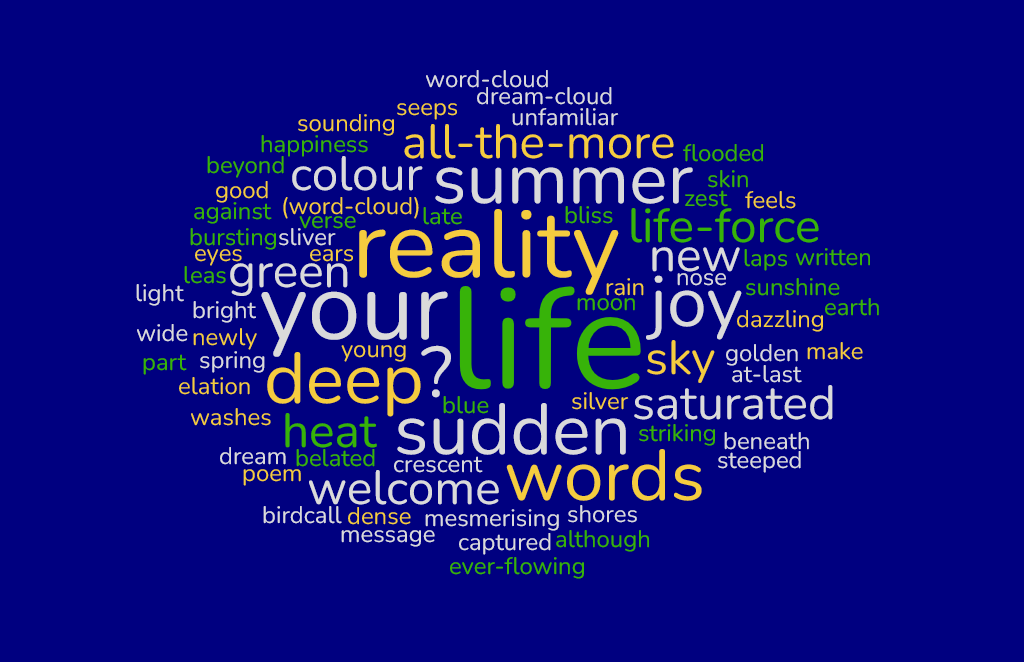
Word cloud of the poem Sudden Summer (colours edited but randomly allocated).
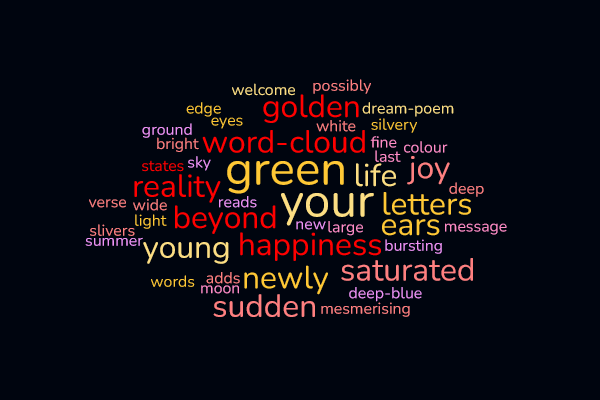
Happiness Beyond (Word Cloud)
Your life is a green reality, it reads in large green letters, and newly young; the sky is golden at last, it states in fine golden letters, and saturated with joy; eyes and ears are bursting with wide bright light, it adds in silvery white; and at the edge there is happiness beyond colour on deep-blue ground.
These are welcome words, sudden and possibly deep, a mesmerising message from slivers of verse in your ears, from the new dream poem, from the word cloud of Sudden summer: Your life is a green reality saturated with joy under the newly young moon.
Im Dämmer schwebt der neugeborne Mond, ein unhörbares Gutenachtgeläute. Die Amsel, die auf der Antenne thront, ruft sternenklar… Mein Herz zerspringt vor Freude.
II.
Pflücken
Und immer wieder Amsel, Mond und Rose, und immer wieder Wehmut und Entzücken… Und unterm Abendstern das grenzenlose Verlangen, diesen Augenblick zu pflücken.
III.
Xylophon
Ich brauche nichts als diese Vorstadtstraße, den Blattgoldhimmel und den Vogelruf,– und dann das klare Xylophon der Sprache, die Hunderte verklärter Verse schuf.
Noch ist nicht aller Tage Abend, der Sommer noch nicht ausgebrannt, noch will die Feige Frucht dir tragen, entfaltet sich dir ohne Fragen die Erde ohne Riß und Rand.
Noch ist nicht aller Nächte Morgen, noch paßt der Mond in deine Hand! Noch ziehen Störche gegen Norden, noch will der Wildbach überborden… Noch harrt die Perle dir im Sand.
Nur einen seligen Sommer, einen zweiten und dritten tanzten du und ich inmitten einer buntbetupften Wiese unter dem Summen der Hüpfer und Hummeln, unter des Bussards hoher Wacht. Und keiner von uns beiden wußte, was bliebe, und keiner nannte es Liebe. Aber das Leben war gegeben, wie es nur Kindern ist, Heiligen oder Toren oder eben Liebenden, und die Freude war stark wie die Pracht der Mittsommersonne. Die Erde war rund und bunt, und ihre Haut duftete uns! Wir drehten uns schnell, alles drehte sich um uns, es war ein Heute, hell.
wieviele monde sind uns noch beschieden die ungeahnten sonnenglanz vergießen wieviele rosen werden uns noch sprießen aus blut und duft als wäre leben lieben? wieviele strände dürfen wir genießen im wilden norden und im kargen süden wo winde endlos sich mit wellen wiegen wieviele sommer sind uns noch geblieben? du bist der tiefversteckte rosengarten den ich nach langem suchen langem warten betrübt doch immer hoffnungsvoll betrat. du bist der mond der gleich der sonne leuchtet du bist die brandung die den sand befeuchtet du bist die erde wie am ersten tag.
This sonnet forms the basis of a cycle of 14 poems, whereby each line furnishes the first line of a new sonnet (Continental pattern). Watch this space for the rose garden project (ROSENGARTEN).
This cycle is not about gardens alone or about islands, although many far-flung places will be reflected in these lines: it is about finding love and happiness, going through life together, finding liveable spaces…
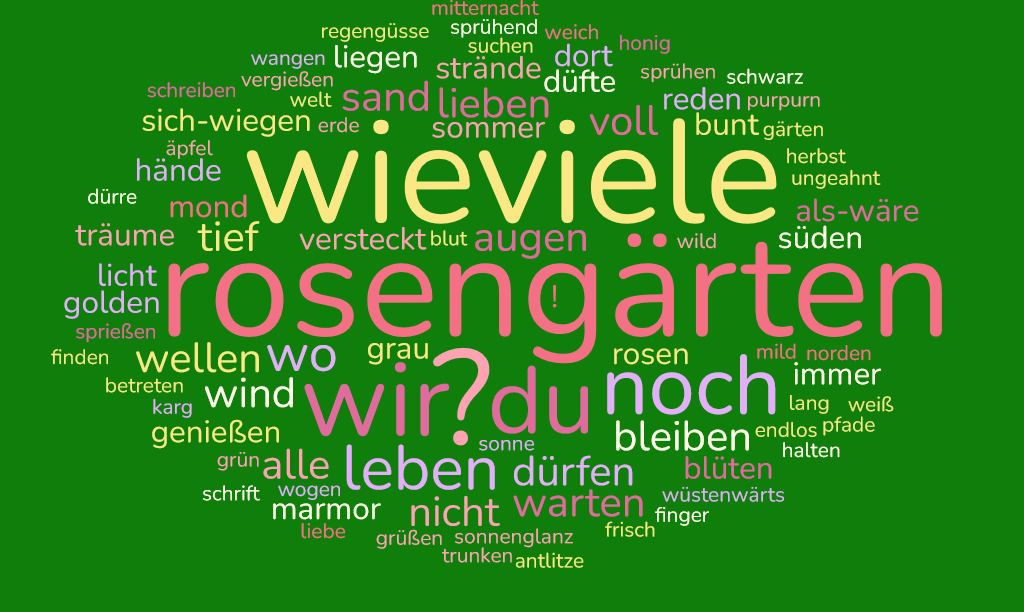
Word cloud of ten German sonnets (rosengarten I-X), generated on the Simple Word Cloud Generator. In the chance arrangement, words picked out by size and colour form the sentence: “how many rose gardens where we, (O) you, may yet live?”
P.S.: You can now view a word cloud of all 14 sonnets at WordItOut and have it printed on a mousemat or mug or fridge magnet!
Aus Scheiterhaufen, ungeheuer, glimmt an den Säumen lautlos Feuer: Die finstern Wolken sind durchlichtet, als Sonnwendfeuer aufgeschichtet! Ein Rosenhag, verhundertfacht an Anmut und an Farbenpracht… Und dann erstrahlt am Horizont ein feingeschliffner neuer Mond.


 Christina Egan