The Sun God’s Roads

The Sun God’s Roads

I saw them emerging from forest and fog,
the roads of the fiery barbarian god,
I saw them, I walked them, I measured them – but
I dragged on their slopes and I slipped in their mud.

They followed the creek, they followed the crest,
they followed the sun all the way to the west,
they lead to the market, they lead to the fort,
they lead all the way to the northernmost port.

My roads ran across their fords and their fields,
as smooth as a line of square Roman shields,
as straight as the flight of a sure Roman lance,
as hard as its tip, in a steady advance.

Some sauntering highways are right underneath
while others meander through meadow and heath.
I took what I needed, I bridged all the gaps,
I dropped all the rest off the Caesar’s clear maps.

Minerva brought wisdom and Mars announced peace:
we drained a few swamps and we parcelled the leas,
we left the round huts by the winding wet way
and stamped our rectangles into the clay.

My map showed a ragged and rugged old isle
with gridlines unrolling now mile after mile.
I marked it as Jove had commanded us – but
I still muse about the strange tracks in the mud…

Christina Egan ©2019

On this blog, the year always starts with a Roman road. Here, a civil engineer from antiquity reports how his straight highways and rectangular buildings cut right across the uneven and muddy terrain, winding paths, and round buildings of the native Britons. You can still observe this striking phenomenon in Stonehenge, Silchester, and many other places.

We may assume that enthusiasm for this turn of civilisation was not universal. The Celts thought, for instance, that it was silly to worship gods in temples, as if in boxes, instead of in nature. As regards the superb new roads, they were immensely useful for the transport of goods and ideas, but served first of all for the movement of the legions and of metals mined in Britain.
O Land of Ice and Fire

rosengarten (II. sprühendgrau)

rosengarten

II.

sprühendgrau

die ungeahnten sonnenglanz vergießen
die regenschauer und den regenbogen
zu einem milden meeresgrau verwoben
die augen sollen meine verse grüßen.
dem nebelland das immerkalte wogen
in ungestümem reigentanz umschließen
den inseln voller sprühendgrüner wiesen
sind jene augen ursprünglich enthoben.
drum frag ich nicht nach lilien und lavendel
die flammen sprühen auf gebeugtem stengel
noch nach des südens uferlosem blau
nichts brauche ich als meinen kleinen garten
wo alle wunder lächelnd meiner warten
die bunte welt geballt in sprühendgrau.

Christina Egan ©2023

This sonnet is part of a cycle of 14 poems, whereby each line of the first one (rosengarten I. tiefversteckt) furnishes the first line of a new sonnet.

The island described here is Ireland, but the cycle takes you to other islands, as well as to the palace gardens of Würzburg, Germany, which first inspired me.

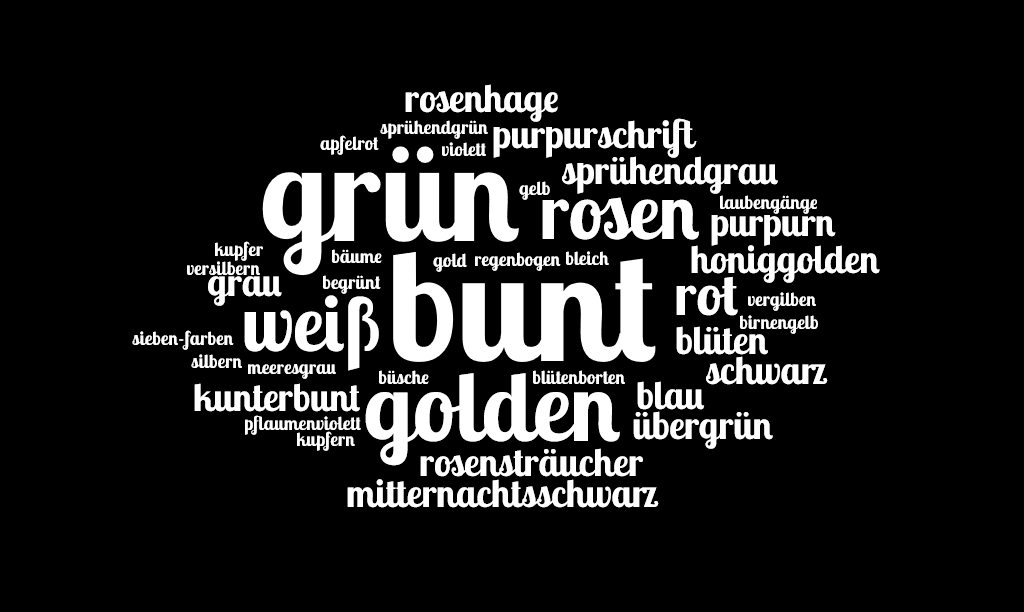
Word cloud of colours and flowers and in white on black; in the middle, "multi-coloured", "green", "golden".

Word cloud of colours in the German sonnet cycle (rosengarten I-XIV), generated on the Simple Word Cloud Generator. In the middle are “colourful”, “green”, and “golden”. Since the colours of the roses are not described, the roses themselves are added.

A New Poem is Being Born

Der Nebel hebt sich

Der Nebel hebt sich

(Schloß Fasanerie bei Fulda)

Der Nebel hebt sich,
und der Rauhreif auf den Weiden,
feine Spitze, glitzert auf.

Aus dichten Fichtenschirmen sprühn
kapellenglockenhelle
Stimmen ohne Zahl.

Ein Vöglein folgt, dort oben, sieh,
mit dunklen Flügeln, gelber Brust,
ein Sonnenstrahl!

Ein niedrer Wolkenstreif muß weichen,
und der bleiche Mond, des Dunkels Geist,
desgleichen.

Der ausgelaugte Himmel blaut,
der federnd-feste Boden taut,
gurgelt und gärt…

Noch wehrt der Winter sich,–
bezwungen ist er schon.
Die Erde atmet wieder tiefer…

Und wer nur auf den Hügel steigt
und schaut und hört und spürt,
kriegt neue Kraft und Lust!

Christina Egan © 2017

A new poetic form: three lines in each stanza, with irregular lenght and irregular rhymes — but each stanza having ten stressed syllables, with one unstressed syllable in between, making the flow of the language regular, natural and musical at the same time!

The poem was written on February 14th. The Rhön mountains have a harsh climate with long winters characterised by cold and snow and fog. All the more is spring welcome, even the early signs of it…

Northern Marsh

Northern Marsh

Beyond the Roman highway lay
the marshes, lush and veiled and vast,
on gravel and on sun-baked clay,
a northern, watery mirage.

The never-ending summer’s day
had lured me to a gentle ridge;
the brushwood seemed without a way,
the pools and brooks without a bridge.

And yet I knew that people dwelt
amidst the shimmering, shifting maze…
My flung-out road was but a belt
around an untamed country’s waist.

Christina Egan © 2020

Notnormal

Notnormal

Lightningwhite
vast rib vaults
suspended
in brilliantblue
and a rainbow frame
dazzling and doubling and
tripling
around Broadwater Farm.

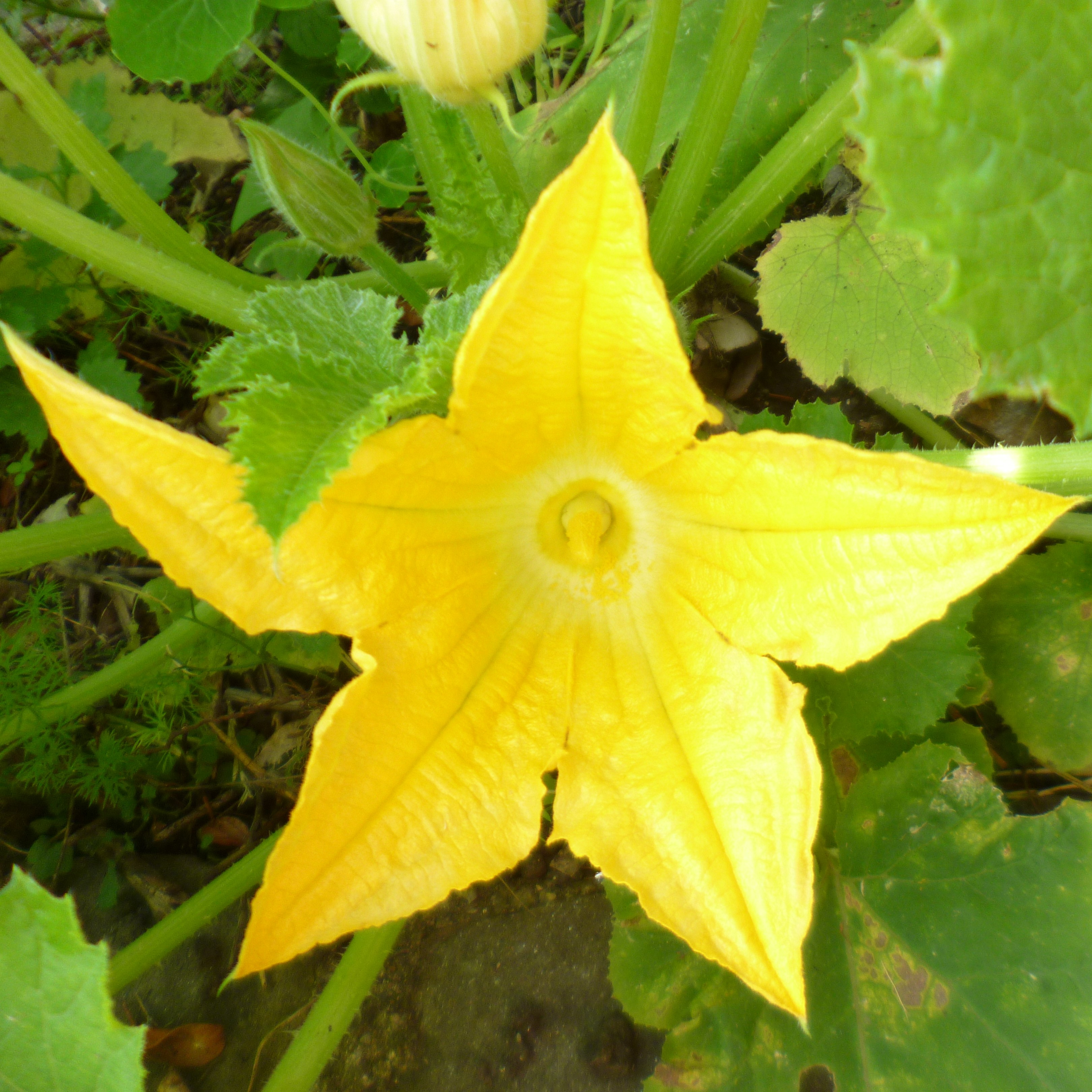
Large deep-yellow flower shaped like a star with five points.Four feet tracing
pavements pathways
the brooks underground
the trains underground
with the windinyourhair
and the sunonyourskin.

Fivefoldflame flowers
dancing for joy
rolling up into fruit
while ivory butterflies
and bumblebees feed
on lavender forests.

Time to cook
food and eat
food
Time to talk
into a telephone
time to talk
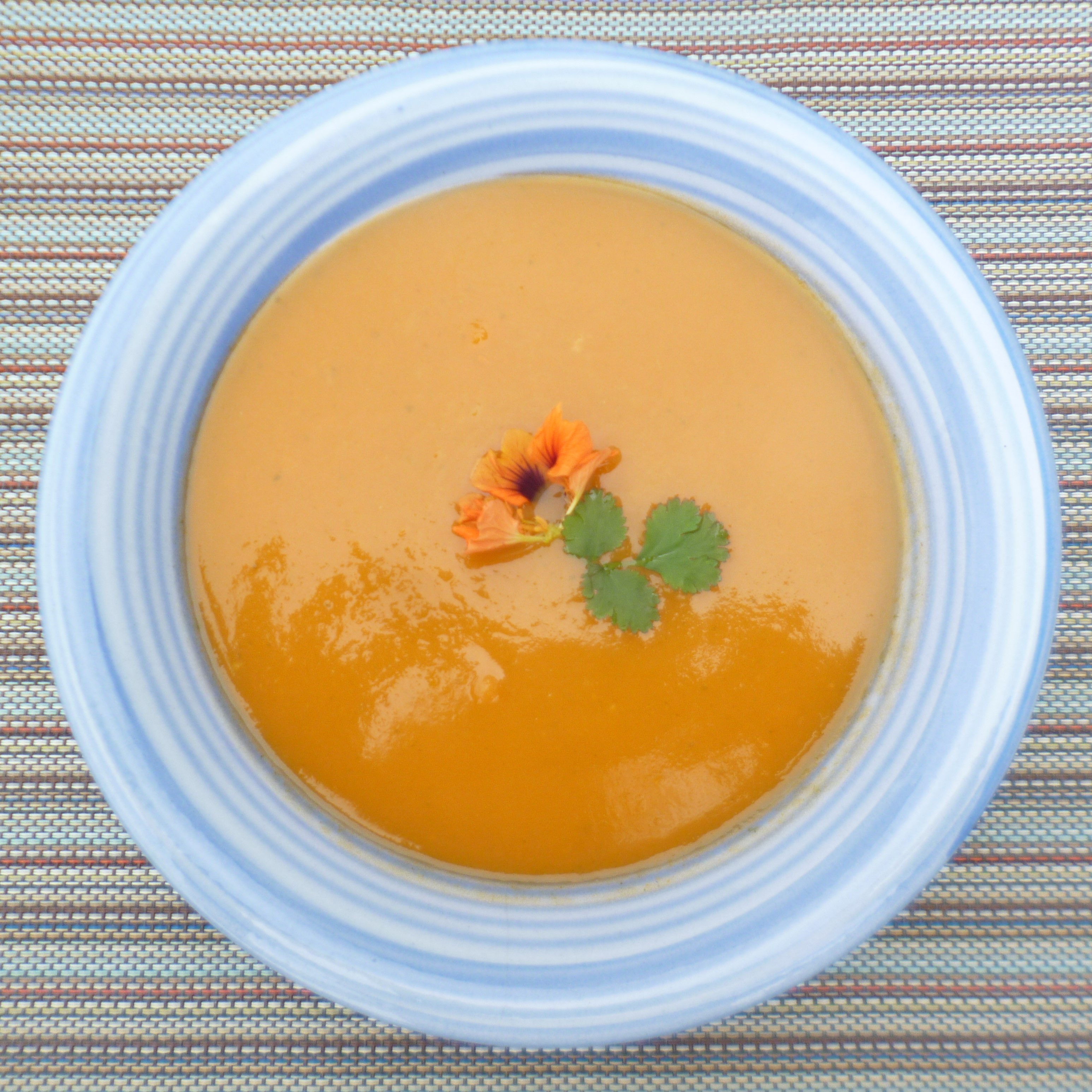
Orange soup in blue bowl on placemat striped orange and blue.talkandlisten
Timetogether.

All this is not normal.

All this is mental
detrimental
to your output
to your outfit
on all platforms
detrimental
to your attitudes
to your platitudes
diametrical
to the narrative.

This is the new
Notnormal.
This must stop
fullstop.

Kestrel egg, quite round, buff and dappled.Otherwise
more stained statues will fall
and heads of heads will roll
and skyscrapers skygraters
surveying the Thames
will be kestrels’ apartments
their amenities reclaimed
by the reeds and the weeds
by the swans and the swifts
by the songs in the dusk
and the
silence
under the crystal crescent.

Christina Egan © 2020

Hoping for a revolution in the suspended time of the C-19 pandemic…

Under the lockdown, the air had become so clear that on May 1st, 2020, I did see a triple rainbow around the apartment blocks of Broadwater Farm.

For more thoughts from the first phase of the pandemic in London in spring 2020, see Hidden Rivers / Verborgne Flüsse.

Courgette flower / Carrot soup. Photographs: Christina Egan © 2020. — Kestrel egg at the Muséum de Toulouse. Photograph by Didier Descouens via Wikimedia. Copyright: CC BY-SA 3.0.

Strandkorb Song

Strandkorb Song

What happened to the beach-seat
we found in Germany,
the bench within a basket
beside the Baltic Sea?

The land was lush and sunlit,
the air was pure and free,
the dusk was full of magic,
the surf a mystery.

White hooded beach seats, in dunes of fine white sand, with fresh plants growing.What happened to the beach-seat
placed there for you and me?
What happened to the footsteps
along the singing sea?

You said you won’t forget it,
the dusk, the moon, and me.
Where has it gone, the moment
of blue eternity?

We cannot leave the basket,
in space and time so far:
it is a secret casket
which holds a sparkling star.

Christina Egan © 2017

‘Beach baskets’ in Ahlbeck on Usedom.
Photograph: Christina Egan © 2017.

Strandkörbe, ‘beach baskets’, or hooded beach seats, are an alluring feature of German beaches on both seas. 

The story refers to the Midsummernight Far North I have described before on this website. I have developed Strandkorb Song further as lyrics.

Hidden Rivers / Verborgne Flüsse

Hidden Rivers

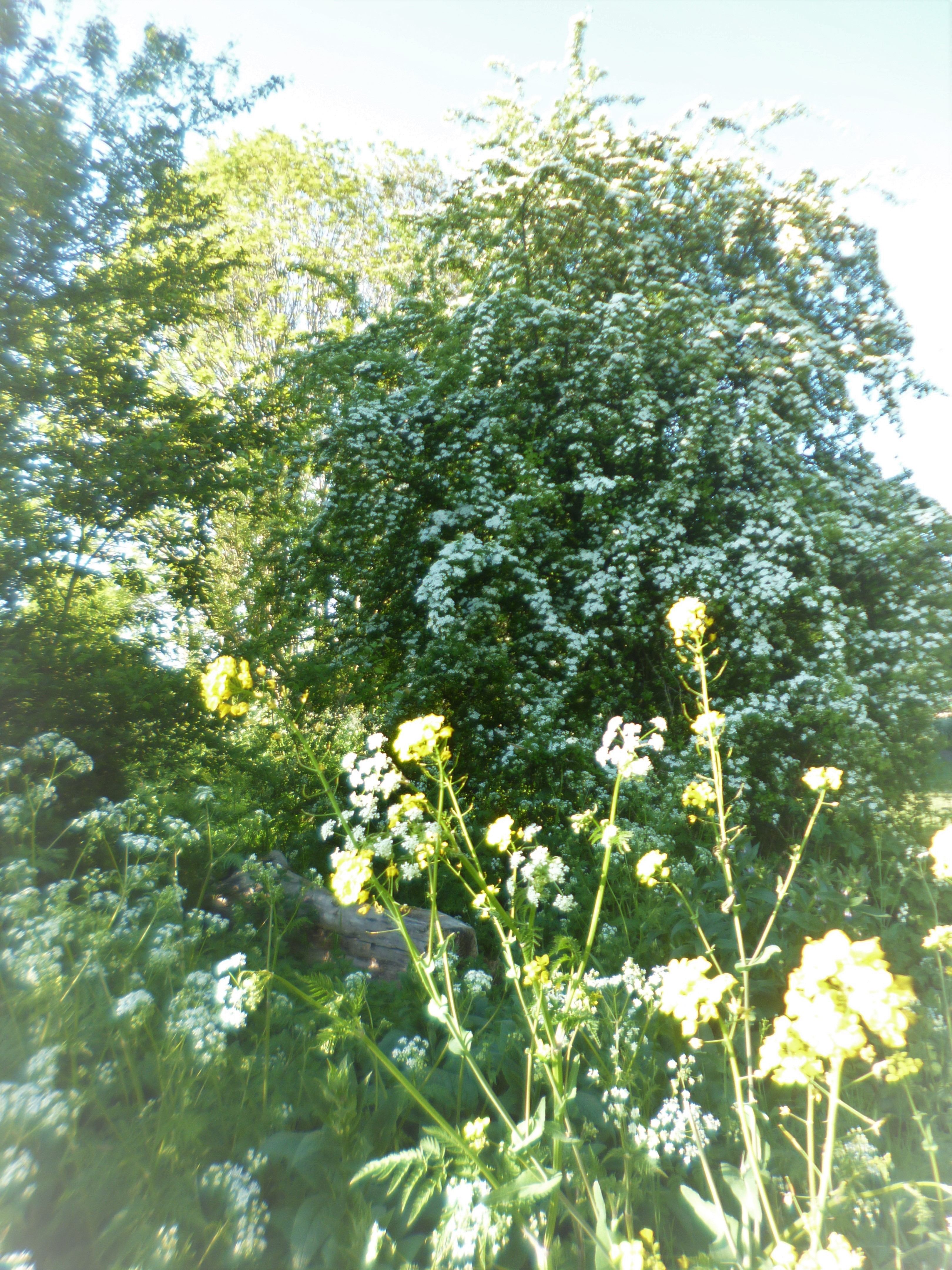
Meadow with white and yellow blossom in bright lightThis is the time to walk along
the hidden rivers hand in hand;
this is the time to write a song
out of a strangely quiet land.

This is the time to breathe again,
to stand and stare, to skip and run…
The water rippled by the rain,
the water dappled by the sun.

This is the time to dance across
the sea of sorrel and of yarrow,
to sink into the gilded grass
without a worry of tomorrow.

This is the time to hear the heart
of the neglected earth rejoice,
to find the long-forgotten lark
in your beloved’s humming voice.

Christina Egan © 2020

Verborgne Flüsse

Dies ist die Zeit, das Tal zu sichten
verborgner Flüsse, Hand in Hand;
dies ist die Zeit, ein Lied zu dichten
aus einem seltsam stillen Land.

Dies ist die Zeit, die Brust zu heben,
zu springen, stillzustehn, zu spürn…
Gewellt das Wasser unterm Regen,
beglänzt das Wasser vom Gestirn.

Durch Wogen weißer Blütenschäume
und roter Rispen laß uns schreiten,
um sorglos in der späten Wärme
ins sonnengoldne Gras zu gleiten.

Das Herz der unbetretnen Erde
scheint jubelnd dir ins Ohr zu dringen,
das Lied der fastvergeßnen Lerche
aus dem geliebten Mund zu klingen.

Christina Egan © 2020


A happy impression from the coronavirus crisis…

Photograph: Lea Valley. Christina Egan © 2020.

Die Steine sprechen

Die Steine sprechen

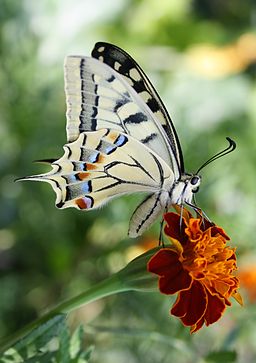
Swallowtail butterfly, cream-coloured with graceful pattern in sky-blue and burnt-orange, on a flower in burnt-orange.Die Steine künden von der jungen Braut
im dunklen buntbestickten Sonntagsstaat,
die strahlend auf die alte Schwelle trat,
und von dem Schwalbenschwanz im hohen Kraut.
Die Höfe sind auf karges Land gebaut,
wo zwischen Weizenfeld und Waldesrand
schon vor Jahrtausenden ein Flecken stand.
Die Steine sprechen, und sie sprechen laut.
Die Kannen klappern, und der Wagen knarrt,
die Gänse schnattern, und das Zugpferd scharrt.
Mit Engelsstimme schallt die Glocke hin.
Das Spinnrad schnurrt; am Brunnen seufzt der Wind;
am Feuer schreit der Bäuerin zehntes Kind.
Die Steine sprechen; hörst du aber hin?

Christina Egan © 2017


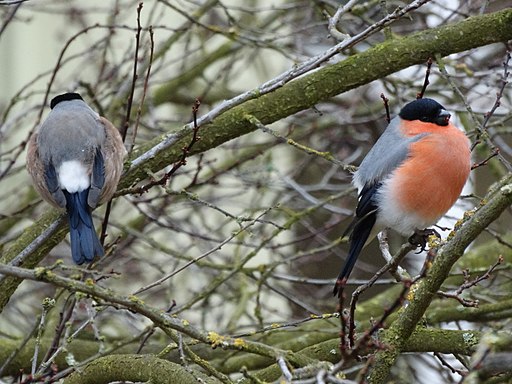
Bullfinch couple on wintry twigs; deep-blue tails and heads, the male with a bright-red breast.


This sonnet is dedicated to the farmers Maria Gutermuth and Paul Jordan, whose tenth child (not the last one) was my grandmother. I can only imagine this type of peasant life from books and pictures, but my father witnessed the very last of it.

In my great-grandparents’ village Dalherda in the Rhön mountains, where harsh conditions of soil and weather prevented prosperity through agriculture, the inhabitants had excelled at two particular crafts, carving wooden utensils and breeding bullfinches as songbirds.


Photographs: Swallowtail Butterfly (German name: ‘Schwalbenschwanz’). By Werner Pichler (Vom Autor) [CC BY-SA 3.0], via Wikimedia Commons (Featured picture). – Bullfinch couple (German name: ‘Dompfaff’ or ‘Blutfink’.) By Ἀστερίσκος (Own work) [CC BY-SA 4.0], via Wikimedia Commons.