Magical Chimes

Magical Chimes

A silver box with coral lid,
the wintry summer palace glows
atop the steep and even hill.

The pleasure ponds are frozen still;
a thousand windows in neat rows
blink one by one and drink their fill.

A haze hangs in the copse of firs
and birdsong floats, a silver web…
Among the shades, a buzzard stirs.

The clockface on the tower shows
ten in the morning; then it throws
its golden chimes into the wind

like golden coins! The treasure rolls
across the grounds, down to the walls,
across the fields, down to the mill,

where in the yard, a cockerel crows –
as if the land were now awake,
as if today the ice might break.

Christina Egan ©2017


This poem was inspired by walks through the grounds of 18th century palace Schloss Fasanerie, (Eichenzell near Fulda, Germany), which are freely accessible to the public.

One of my best German poems, Aprilabend (Der Tag ist hoch), describes the view across the highlands from there.

You will find another clock tower at Himmelblaue Uhr (Tottenham)  and May Haiku (Bruce Castle); the latter post is in English.
The Path of Luck

The Path of Luck

The burnished desk of the leader groaned
under the slap of his sturdy sandal:
he brandished it over the map of Europe,
as if he signed it, large, from the left.
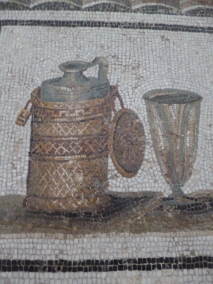
Roman mosaic of bottle and cupThe oil-lamp flickered, the officers frowned
and grinned and raised their cups of spiced wine:
“Don’t forge your luck while it’s hot and supple —

but fan your fate when you will it so!”
The earth would unroll like a scarlet carpet,
lavish her treasures before his feet:
the gold and the purple, sandalwood, snakeskin,
the pearl and the laurel, the wine from volcanoes.
His sandals mounting the snow-white steps,
he saw and saw not the pool of blood.

Christina Egan © 2008

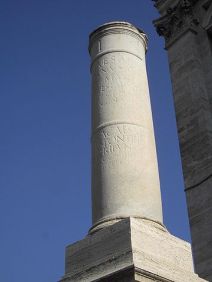
Massive smooth column with Latin inscription, including the name 'Caesar', against deep-blue sky.


Altae moenia Romae

Rome rose, looked round, and conquered all,
on loot and lies loomed square and tall,
and slowly crumbled towards its fall.
Time’s march defies the highest wall.

Christina Egan © 2008


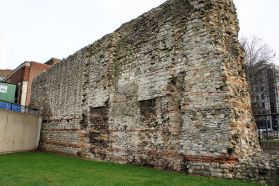
High wall of neatly piled stone and brick in the midst of the city

The first poem was written on the Ides of March and the second soon after. They reveal the dark side of Rome, the shadow of the imperial propaganda that the Empire had brought universal peace. Caesar is still celebrated as the greatest statesman ever; but he got to the top, and lifted Rome to the top, at a very great human cost.

For praise of ancient Rome, go to the narrative poem The City Lit Up about Roman London and the sonnets at The Hallowed City about the Eternal City itself.

The poem above follows the structure of an English sonnet, with three times four lines and then two in the end, with a conclusion or twist.


Illustrations: Roman mosaic, Bardo Museum, Tunis. Photograph: Christina Egan © 2014. — Milestone, Campidoglio, Rome. Photograph by Lalupa. — Roman city wall of London. Photograph by Mariordo (Mario Roberto Durán Ortiz) (Own work) via Wikimedia Commons.