Sonnenuhrzeiger / Sundial Garden

Sonnenuhrzeiger

Die Sonne gleißt auf grüner Flur:
Ein jeder wird zur Sonnenuhr.
Der Schattenmensch liegt lang im Gras,
der Abend schrumpft in gleichem Maß.

Die hingestreute Sternenzier
ist mürbes Laub wie Packpapier.
Die weißen Blumen tanzen stumm
um einen dicken Stamm herum.

O trink das Licht mit Haut und Haar:
Noch ist der Himmel hoch und klar!
O trink das Licht mit Aug und Sinn:
Es liegt die Kraft des Alls darin.

Christina Egan © 2016

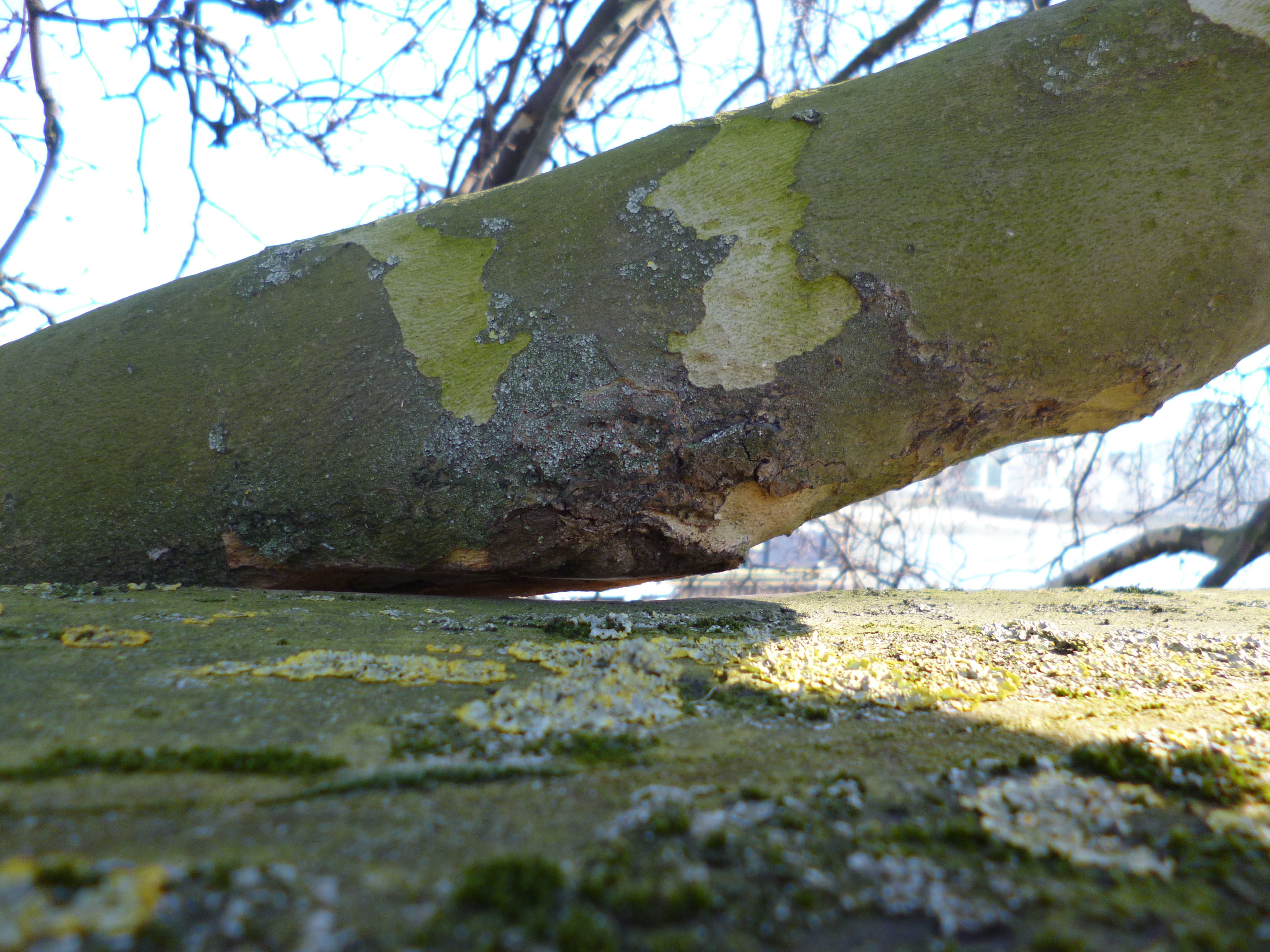
Top of wall covered with lichen and tree with patchy bark, mirroring each other.

Sundial Garden

The sun will gain ground,
conquer inches of lichen,
of leaves and of lawn.
Across the square garden creeps
the shade of the steep gable.

Christina Egan © 2005


In these poems, a whole gardens turns into a sundial: in the first one, each person in the park is a sundial hand, and in the second, a house with a pointed roof fulfils this function, casting its shadow over a north-facing yard.

The first poem is set in late summer or autumn and in the late afternoon or evening, the second one in late winter or spring and possibly in the morning. The yearly and daily descent of the light is as inevitable as its subsequent rise.

Photograph: Christina Egan © 2016.

Early July (The vast transparent vessel)

Early July

I.

The vast transparent vessel of the sky
is filled at last with light up to the rim.
The twigs and leaves and petals wave and cry:
“The feast of heat and harvest can begin!”

II.

The days are still long, the sky is still light
and already strong the glorious heat,
the grass is still lush, the flowers still bright
and already ripe the sweet golden wheat!

Christina Egan © 2015


Those magical weeks just after summer
solstice are also captured in the German
poems Erster Juli / Eimerrand.

Erster Juli / Eimerrand

Erster Juli

Die Erde atmet durch ein jedes Blatt,
von Sonne, Wind und Regen rund und satt.
Die Kletterpflanze streckt sich aus und birst
in weiße Kreise bis zum Schuppenfirst.
Die Nelkenwurz erbebt im Hummelflug,
die Beeren filtern dunkelblaues Blut.
Und selbst die totgeglaubte Nelke glüht
in einem starken Rosa, das genügt.

Christina Egan © 2014


Eimerrand

So mit Sonne vollgesogen
ist das nördlich schöne Land
funkelndbunter Wassertropfen
an des Schöpfers Eimerrand!

Christina Egan © 2015

Red geraniums, pink verbena, blueberries around lawn

Photograph: Christina Egan © 2014

I have also written English poems about the magical time of Early JulyThere are more plants bursting with life at Green Blood: four German and English poems for the four seasons.

What must be the shortest poem on this website, other than haiku, is a powerful one: a whole stretch of land is only a sparkling drop on God’s bucket. The lines were inspired by a verse in Isaiah claiming that the nations are just drops on a bucket and grains of sand.

kairos (eben im zenith)

kairos

eben im zenith des tages
tret ich in ein helles haus
und ich folge seinen stufen
und ich find nie mehr hinaus

eben im zenith des jahres
fällt dein flammendes gesicht
in den brunnen meines auges
mit dem hohen sonnenlicht

eben im zenith des lebens
flutet sanft mein goldnes haar
in die schale deiner hände
und die liebe wird uns wahr

denn du findest meinen namen
den geheimen dachtürknauf
und im purpurroten buche
deines schicksals scheint er auf

Christina Egan © 2015


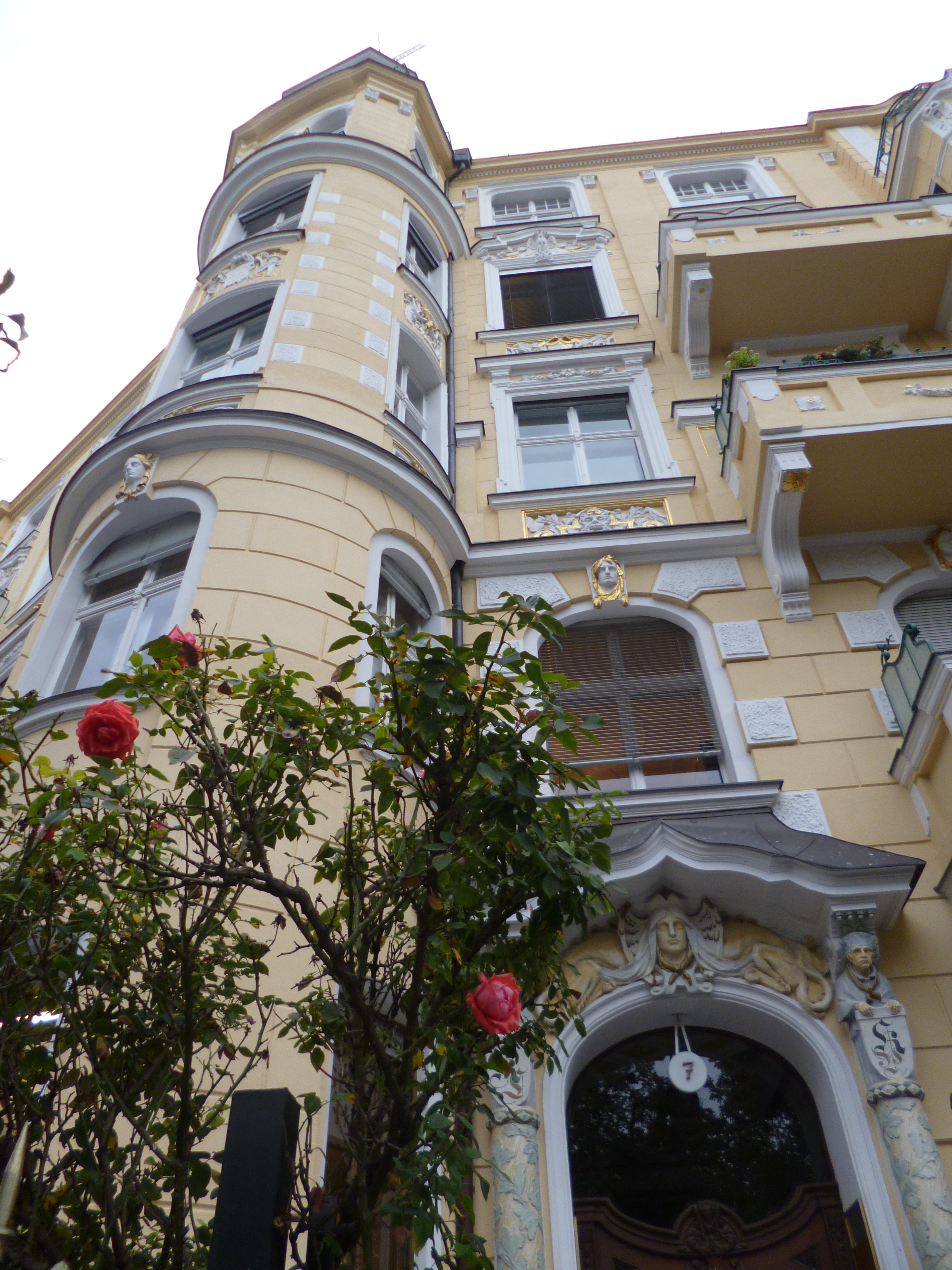
Noble townhouse with rich stucco ornaments and rose-tree.In Greek philosophy, the kairos is the moment — the right moment or the destined moment. The incident takes place at a triple zenith: at twelve noon, around midsummer solstice, and at the highest point of life. The latter, if it exists, will be different for everyone…

Possibly, the story happens only in the narrator’s mind: she imagines that one day in June, she steps into an unknown building and “never leaves again”, because her name was written in someone else’s book of destiny — so they fall in love at first sight.

Photograph: Christina Egan © 2016.

King Spring / König Frühjahr

King Spring

The highway under my window is suddenly flooded with sun.
I see a strange person passing – his face is greenish and long,
his hat is purple and pointed – and followers thronging, hatless.
Is it a pharaoh? A druid? A dancer in fancy-dress?
I’ve spotted a spearhead of petals, magenta pushed up into blue,
the first magnolia flower: King Spring and his retinue!

Christina Egan © 2016

Large long buds above a road, with one opening in bright magenta, the folded petals looking like a hight hat.

König Frühjahr

Die Landstraße unter dem Fenster liegt plötzlich im Sonnenlicht.
Da geht ein fremder Geselle mit grünlichem langem Gesicht
und purpurner spitzer Mütze; Barhäuptige folgen ihm.
Ein Pharaoh? Heidenpriester? Ein Tänzer im Narrenkostüm?
Es ist eine Lanzenspitze, rosenrot hochgereckt,
die erste Magnolienblüte: Ich hab’ König Frühjahr entdeckt!

Christina Egan © 2016

Photograph:  Magnolia buds (England, February). Christina Egan © 2016.

Moment dans la mare

Moment dans la mare
(Boulogne-sur-Mer)

À la plage immense, vidée de la mer,
le vent est trempé du soleil et du sel :
caresse chanceuse de l’univers,
regard maternel rempli d’étincelles.

La mare autour des chevilles surprises,
le sable mouillé, moulé de soleil :
tout ça – l’océan et la boue et la brise –
tout est mêlé et tout est pareil.

Tout est tiède et tout est limpide,
tout est liquide autour des doigts…
Tout est un rêve réel, et le vide
commence à se combler de joie.

Il n’y a pas de bataille, il n’y a pas de triage
de quatre ou cinq éléments lumineux :
plutôt une étreinte éternelle, mariage
de plage et marée, bénit des cieux.

Christina Egan © 2016


The poem refers to the four or five elements which make up the universe, an ancient philosophical concept found in variations in many civilisations.

Greek philosophers held that war, or conflict, between the forces of nature generate everything and challenge us to greatness. I propose that the Greek elements of fire, air, water, earth — and spirit — exist, but work through interaction and union, and that humans grow most when working within and with nature.

This makes harmony instead of conflict the driving force of the universe. It is also a female philosophical approach rather than a traditional male one.

In French literature, the ‘void’ is essential, marking loneliness, mortality, and the pointlessness of life; I want to hold up the ‘void’ or ‘silence’ as an experience of peace and fulfilment, communion with the universe, and a foretaste of eternal life.

When I stood on the beach of Boulogne at sunset, the sky and the sea and the sand were gleaming in streaks of otherworldly purple and orange.

An automatic translation into English may convey the sense of these lines well, but in the original French, they are conceived to sound like music… like waves.

Steigt später Morgen

Steigt später Morgen

Im nackten Gehölz
am Horizont gen Osten
steigt später Morgen:
das schwächste, stillste Feuer,
der dennoch gleißende Kreis.

Christina Egan © 2015


Laub leuchtet auf

Durch die Wolken bricht
Glanz, Gleißen. Laub leuchtet auf,
rührt sich und flüstert.
Nur diesen Augenblick
haben wir, aber auf ewig.

Christina Egan © 2015


The first tanka celebrates the sunrise 
in midwinter; the second conjures up
a flare of sunshine in midsummer.

Eternity can be experienced in this life:
in the moment — and perhaps in the
moment alone.

For another experience of tranquillity 
through light and dark in midwinter, go to
In Praise of Darkness / Lob der Stille.

Ein Muster aus Muscheln / Greek Islands

Ein Muster aus Muscheln

Ein Muster aus Muscheln und Bernstein und Bein,
mit Karneol und Koralle durchsetzt,
auf lapislazuliblauem Grund:
So leuchten die Inseln im Sonnenschein,
vor dreitausend Jahren… und letzthin… und jetzt:
ein Mosaik, ein vollendeter Fund.

Vors Fenster des sinkenden Flugzeugs gespannt,
vom Guckloch des finsteren Turmes gerahmt
– nur einen Moment – nur einen Moment –
das Muster aufs wartende Auge gebannt,
die Farben ins wache Gedächtnis gemalt:
ein Bild, das nach dreißig Jahren noch brennt.

Christina Egan © 2016

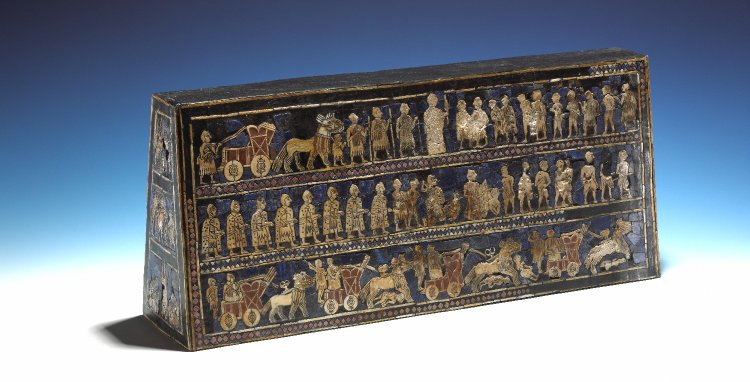
Standard_of_Ur_BM_121201

Standard of Ur (2500 BC). – Photograph© The Trustees of the British Museum.

I am showing this ancient object – twice as old as our classical antiquity – because it must have inspired my poem about Greece. The images on the box are made of shell, lapis lazuli, and red limestone, but I did not remember those details or  even think of the thing. When you have the chance to go to London, do not miss out on the Sumerian galleries of the British Museum!

The longing for a return to Greece, both for the Mediterranean environment and for the ancient civilisation, is also expressed in On Eating Olives / Beim Olivenessen  and in Greek Islands  (below). There are a number of poems about Crete in German and English on this website.


Greek Islands

There is more blue in the air
between here and the horizon,
between morning and evening,
than the cup of the eye can hold.

So my soul may flow over
into the sky,
into the sea,
into this scattered paradise…

Christina Egan © 2012 


On the topic of the blue Mediterranean Sea, see also Meine blaue Mauer  and O Heimatland aus Stein und Licht. On the manifold colours of the same sea, see The Purple Sea / Das lila Meer.

Orange Beads

Orange Beads

I.

I nod to the flower
the colour of dark wine
stalks and spikes that tower
above my legs and spine

twin doors an orange spill
the only one in town?
why is my own door still
an ordinary brown?

O sweet day!

II.

All these parallel roads
the orange doors are where?
again the suburb soaks
in sunshine hello there!

they smile and say hello
all else though stays behind
their sturdy frames and so
I keep my orange find

two bright beads

III.

The hawthorn turns orange
the blackberry turns black
mingling at the park’s fringe
behind the cycle track

the sky is blue as if
this were a normal state
as if we could just live
beyond the iron gate

of summer

Christina Egan © 2016


In London, you can find many front doors painted in red, blue, or green, but I had never spotted an orange one. I have mentioned a striking yellow door elsewhere. I usually go out without a camera, but I capture impressions with my pen!

There are so many green spaces in London that you can walk through parkland for hours. To find blackberries and hawthorns tucked between a duck pond and a little copse is quite normal in this vast city of over eight million people.

The verse pattern is borrowed from the French poet, Jean-Yves Léopold, who does not have a website. Eight short rhymed lines, almost without punctuation, are followed by a ninth line which is even shorter and does not rhyme at all, so it stands out.