rosengarten (II. sprühendgrau)

rosengarten

II.

sprühendgrau

die ungeahnten sonnenglanz vergießen
die regenschauer und den regenbogen
zu einem milden meeresgrau verwoben
die augen sollen meine verse grüßen.
dem nebelland das immerkalte wogen
in ungestümem reigentanz umschließen
den inseln voller sprühendgrüner wiesen
sind jene augen ursprünglich enthoben.
drum frag ich nicht nach lilien und lavendel
die flammen sprühen auf gebeugtem stengel
noch nach des südens uferlosem blau
nichts brauche ich als meinen kleinen garten
wo alle wunder lächelnd meiner warten
die bunte welt geballt in sprühendgrau.

Christina Egan ©2023

This sonnet is part of a cycle of 14 poems, whereby each line of the first one (rosengarten I. tiefversteckt) furnishes the first line of a new sonnet.

The island described here is Ireland, but the cycle takes you to other islands, as well as to the palace gardens of Würzburg, Germany, which first inspired me.
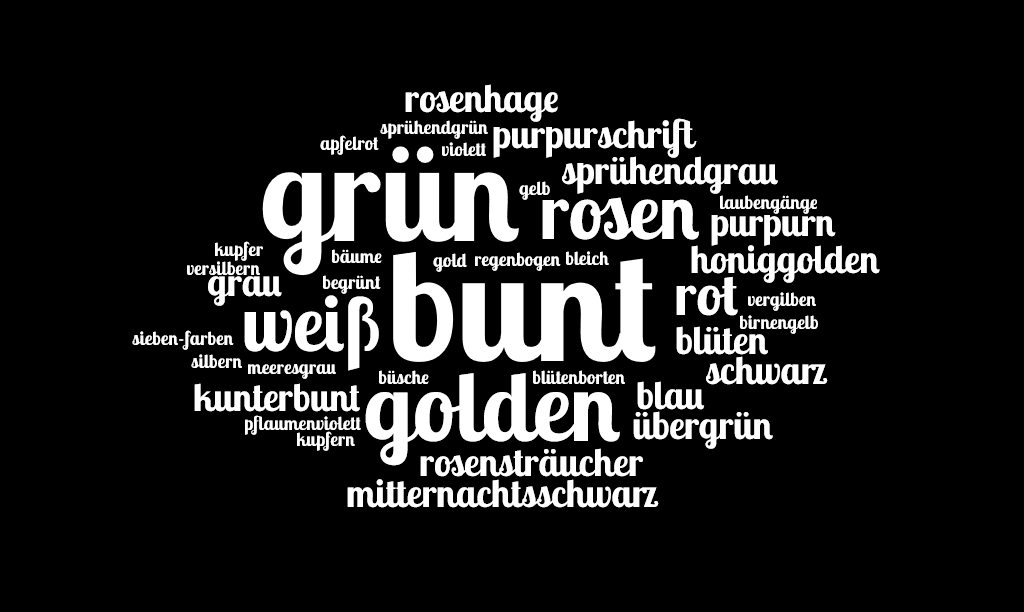
Word cloud of colours and flowers and in white on black; in the middle, "multi-coloured", "green", "golden".

Word cloud of colours in the German sonnet cycle (rosengarten I-XIV), generated on the Simple Word Cloud Generator. In the middle are “colourful”, “green”, and “golden”. Since the colours of the roses are not described, the roses themselves are added.
rosengarten (I. tiefversteckt)

rosengarten

I. tiefversteckt

wieviele monde sind uns noch beschieden
die ungeahnten sonnenglanz vergießen
wieviele rosen werden uns noch sprießen
aus blut und duft als wäre leben lieben?
wieviele strände dürfen wir genießen
im wilden norden und im kargen süden
wo winde endlos sich mit wellen wiegen
wieviele sommer sind uns noch geblieben?
du bist der tiefversteckte rosengarten
den ich nach langem suchen langem warten
betrübt doch immer hoffnungsvoll betrat.
du bist der mond der gleich der sonne leuchtet
du bist die brandung die den sand befeuchtet
du bist die erde wie am ersten tag.

Christina Egan ©2023

This sonnet forms the basis of a cycle of 14 poems, whereby each line furnishes the first line of a new sonnet (Continental pattern). Watch this space for the rose garden project (ROSENGARTEN).

This cycle is not about gardens alone or about islands, although many far-flung places will be reflected in these lines: it is about finding love and happiness, going through life together, finding liveable spaces…

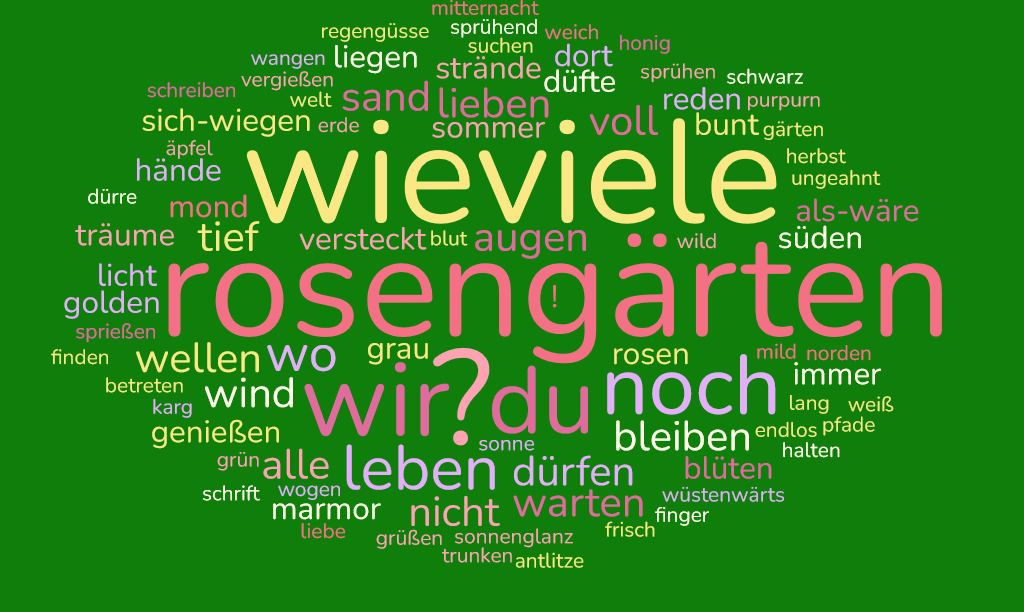
Word cloud in reddish and yellowish colours on green; in the middle, "how many" "rose gardens", and a question mark.

Word cloud of ten German sonnets (rosengarten I-X),
generated on the Simple Word Cloud Generator.
In the chance arrangement, words picked out
by size and colour form the sentence:
“how many rose gardens where we,
(O) you, may yet live?”

P.S.:
You can now view a word cloud of all 14 sonnets at WordItOut
and have it printed on a mousemat or mug or fridge magnet!

Obsidian Mirror / Orangenzweig

Obsidian Mirror Mirror made of a deep-black polished stone, on a wooden base.

The moonless night, the iron gate,
between the trees the winding path,
the nameless pond: a polished plate,
obscure and truthful looking-glass –

The moonless night, the nameless pond,
the outline of a cruel fate:
the leaves are shed, the blossom gone –
It is too late – It is too late.

Christina Egan © 2015


Orangenzweig

O Traum von Liebe, Traum von Licht
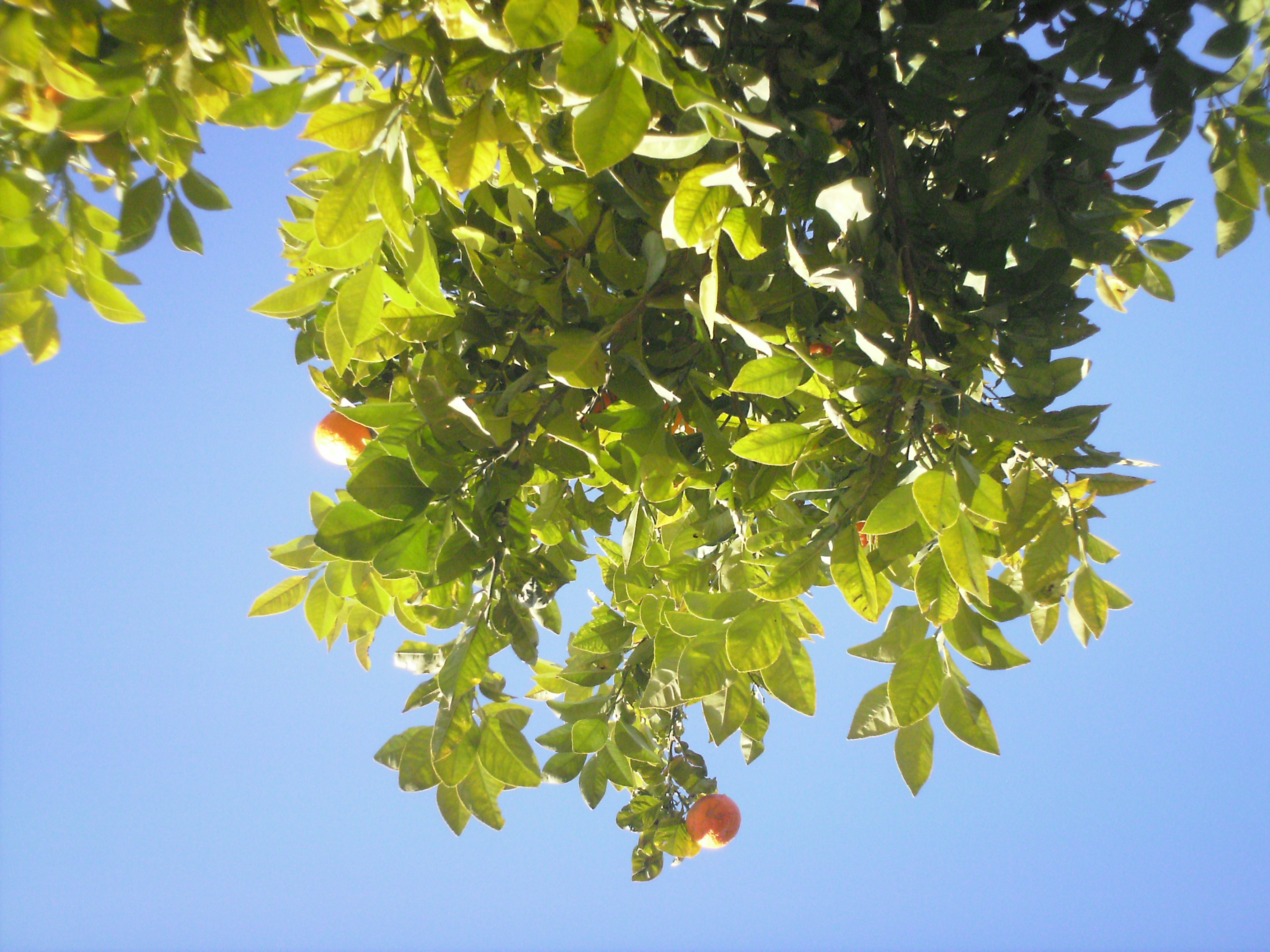
Oranges hanging from branches against blue skyauf einem duftenden Gesicht,
vom kleinen Rosengartenglück
aus einem mächtigen Geschick,
vom Dasein als Orangenzweig,
an Blüte reich und Frucht zugleich,
vom ganz bescheidnen Paradies,
das dir und mir ein Gott verhieß…
O Traum, der niemals untergeht –
Es ist zu spät. Es ist zu spät.

Christina Egan © 2016


The two poems contain an echo, and echo each other, in the phrase ‘It is too late’ — ‘Es ist zu spät’, which emphasises the futility of wishes and plans when fate is irrevocably against them.

Obsidian is a very dark and very hard stone. Some ancient civilisations used polished slabs as mirrors. Apparently, they were also employed for fortune-telling!

Photograph: Aztec mirror, Museum of the Americas, Madrid. – Simon Burchell via Wikimedia Commons. – Orange branch: Christina Egan © 2012.