dream laundry

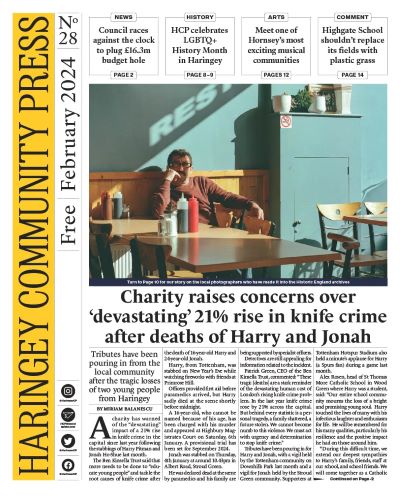
Front page of newspaper

This poem is also published in a local paper today, in print and online: Haringey Community Press, February 2024 (circulation 15,000).


The title is taken from Ingeborg Bachmann’s poem Reklame (1956), where she coins the word “Traumwäscherei” (dream laundry, laundry of dreams or through dreams?). The omnipresent publicity and cheerful music soothe your worries and questions – until they stop and leave you in “Totenstille” (deadly silence, or silence of the dead?).

The idea of downloading memories and dreams comes from science-fiction such as Ridley Scott’s movie Blade Runner (1982), M. T. Anderson’s novel Feed (2002), and Kazuo Ishiguro’s novel Klara and the Sun (2021). All three are superb and thoroughly disquieting.

The line “boots on the beach” comes from a particularly stupid – and sexist – video advertising hard drink by showing a young woman in a very scanty dress and very heavy boots. It played on a loop on several screens in a railway station so that there was no escape from it.

The line “music on the pillow” is inspired by Ray Bradbury’s novel Fahrenheit 451 (1953), where he predicts ceaseless entertainment broadcast onto our walls, even inviting participation, and into our ears, continuing into our sleep. The result is isolation and despair.

Die Welt ist still

Die Welt ist still

Ich sitze unter einem Baum
im Blätterzelt, im Schattenkreis;
die Welt ist still und bunt und heiß,
hoch oben wölbt sich weißer Flaum…
Ein Sommertraum.

Der stolze Pomp war Schall und Schaum,
die rasche Mode Funkenflug,
das Tretradtreten war Betrug!
Ich sitze unter einem Baum,
man glaubt es kaum.

Das Bildgewebe war ein Zaun,
ein Katzengold der ganze Schatz,
ein Karussell die ganze Hatz –
Die Ruhe schafft dem Atem Raum:
Frag’ nur den Baum.

Christina Egan © 2020

For English poems from the Covid-19 lockdown,
see Notnormal and the parallel texts Hidden Rivers /
Verborgne Flüsse
.

For those who were not ill with the terrible virus, 
the key experience may have been, paradoxically:
I can breathe… For once,
there was time to breathe —
and air to breathe!

regenbogenlied

regenbogenlied

in meinem herzen geht die sonne auf
man sieht es nicht auf meinem lebenslauf
ich bin gekettet an denselben platz
ich bin verwickelt in dieselbe hatz

doch fällt ein lächeln mir aufs angesicht
wie wenn das licht sich bunt am regen bricht
wie wenn das licht
wie wenn das licht
sich bunt am regen bricht


in meinem leben geht die sonne auf
ich setz es nicht auf meine karten drauf
ich pflüge weiter auf demselben feld
ich mache schulden und ich mache geld

doch fällt ein lächeln mir aufs angesicht
wie wenn das licht sich bunt am regen bricht
wie wenn das licht
wie wenn das licht
sich bunt am regen bricht


in meinen augen geht die sonne auf
und scheucht den nebel und den frost hinaus
die matten haare glänzen silbern auf
und kunterbunt kurvt nun mein lebenslauf

doch liegt ein lächeln mir im angesicht
wie wenn das licht sich bunt am regen bricht
wenn mein gemüt
wenn mein gemüt
sich bunt am segen bricht

Christina Egan © 2011


Is the blissful encounter which has invisibly changed a life one with another person or with God? As in Im Inneren des Regenbogens / Inside the Rainbow, it is left open.

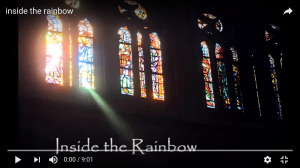
Inside the Rainbow inspired Francis Logan to this beautiful piece of music, available on SoundCloud and YouTube:Image: Still from Inside the Rainbow on YouTube. Music and video: Francis Logan © 2018.

The Odd Word

The Odd Word

In this noise this dust this waste
of the traffic the toil
the relationships the part-time
part-heart commitments
the remorseless rap from the radio
the news of murder and treason the trash
worth millions of dollars the scraps
of subtle philosophy the divine
passionate percussion solos
something went missing
and the problem is
we don’t miss it.

In a café full of words and music
like lightning
somebody mentions Hölderlin
(a poet who went mad
after they had treated him
in a lunatic asylum)
and I remember his odd expression
‘the God’
odd isn’t it
‘the’
must be Classical Greek
I’ll clarify that.

Christina Egan © 1998

The phrase ‘words and music’ allude to 
a poetry event where I met my partner!
At a later reading, I presented this poem.

The Dance of the Sacks

The Dance of the Sacks

There’s the war tax and the peace tax
There’s the core tax and the fleece tax
There’s the fish tax and the spice tax
There’s the poll tax and the vice tax!

There’s the whisper of a tax-plan
There’s the whistle of the tax-man!

There’s the old tax and the new tax
There’s the wool tax and the wheat tax
There’s the old tax for the new sacks
And the new tax for the old sacks!

There’s the tax-man with his tablet
It’s a state-protected racket!

Christina Egan © 2011

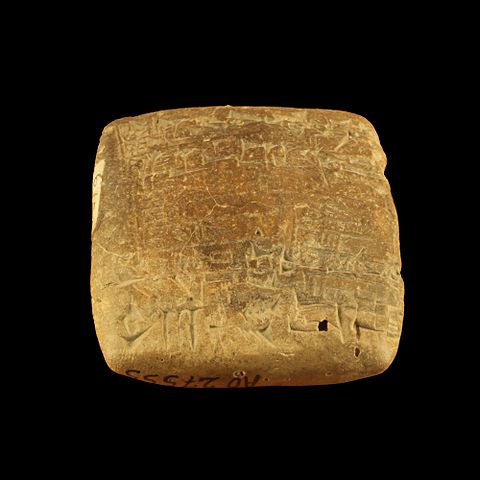
Small clay tablet with cuneiform text.

This comical song for a jig is taken from my stage play The Bricks of Ur  (© 2011) set around 2000 BC.

The tax collectors could wield either Sumerian clay tablets or 21st century electronic tablets!

I must have been inspired by a hilarious jig in one of the first seasons of Shakespeare’s Globe in London…

Receipt for 13 woolen garments, ca. 2038 BC. Photograph by Rama, Cc-by-sa-2.0-fr [CeCILL or CC BY-SA 2.0 fr] via Wikimedia Commons.