The Sun God’s Roads

The Sun God’s Roads

I saw them emerging from forest and fog,
the roads of the fiery barbarian god,
I saw them, I walked them, I measured them – but
I dragged on their slopes and I slipped in their mud.

They followed the creek, they followed the crest,
they followed the sun all the way to the west,
they lead to the market, they lead to the fort,
they lead all the way to the northernmost port.

My roads ran across their fords and their fields,
as smooth as a line of square Roman shields,
as straight as the flight of a sure Roman lance,
as hard as its tip, in a steady advance.

Some sauntering highways are right underneath
while others meander through meadow and heath.
I took what I needed, I bridged all the gaps,
I dropped all the rest off the Caesar’s clear maps.

Minerva brought wisdom and Mars announced peace:
we drained a few swamps and we parcelled the leas,
we left the round huts by the winding wet way
and stamped our rectangles into the clay.

My map showed a ragged and rugged old isle
with gridlines unrolling now mile after mile.
I marked it as Jove had commanded us – but
I still muse about the strange tracks in the mud…

Christina Egan ©2019

On this blog, the year always starts with a Roman road. Here, a civil engineer from antiquity reports how his straight highways and rectangular buildings cut right across the uneven and muddy terrain, winding paths, and round buildings of the native Britons. You can still observe this striking phenomenon in Stonehenge, Silchester, and many other places.

We may assume that enthusiasm for this turn of civilisation was not universal. The Celts thought, for instance, that it was silly to worship gods in temples, as if in boxes, instead of in nature. As regards the superb new roads, they were immensely useful for the transport of goods and ideas, but served first of all for the movement of the legions and of metals mined in Britain.
Northern Marsh

Northern Marsh

Beyond the Roman highway lay
the marshes, lush and veiled and vast,
on gravel and on sun-baked clay,
a northern, watery mirage.

The never-ending summer’s day
had lured me to a gentle ridge;
the brushwood seemed without a way,
the pools and brooks without a bridge.

And yet I knew that people dwelt
amidst the shimmering, shifting maze…
My flung-out road was but a belt
around an untamed country’s waist.

Christina Egan © 2020

Cimmerian Summer

Cimmerian Summer

This lifeless gloom: is it the dusk?
This pale white disc: is it the moon?
Is this a mild day in November?
No: in the land of ceaseless mist
this is the sun; the afternoon;
the lightless first day of September.

Christina Egan © 2015


“ἔνθα δὲ Κιμμερίων ἀνδρῶν δῆμός τε πόλις τε,
ἠέρι καὶ νεφέλῃ κεκαλυμμένοι.”

There are the land and city of the Cimmerians,
wrapped in mist and cloud.”  

Homer, Odyssey, 11:14-15


“Britain is set in the Sea of Darkness.
It is a considerable island. This country is most fertile,
its inhabitants brave, active and enterprising….
but all is in the grip of perpetual winter.”

Muhammad al-Idrisi of Sicily, ca. 1154


Homer never ceases to inspire us. Incidentally, I saw a retelling of the Odyssey  last night, at a London playhouse, or rather, amphitheatre! (On this first day of September, the weather is in fact glorious.)

The memory of four clearly marked seasons, full of bright leaves and fruits, and the sorrow about the apparent confusion of the climate are depicted in My Pack of Cards.

Ode to London Wall

Ode to London Wall

Moss is conquering your broken stones,
weeds are rooting between your bricks;
but you still stand tall, Wall,
facing the winds, the seasons, the years.

The round foundations of your towers
harbour herbs now, neatly labelled;
but your walkways bore watchmen once,
to guard the goods going round and the people.

You lie at my feet now, tall Wall,
I look down from the walkway above you;
but when I step down by two thousand years,
I see you could shelter me still or crush me.

And then I seem to remember –
we have met before, Wall –
you guarded me indeed –
and I guarded you!

On the treacherous clay we erected you,
in the obnoxious fog and sleet:
even and straight and strong as a rock,
forming a line in the marshy meadow,

forming a square along the vague river,
forming a knot in the net of roads,
from London to Chester and York,
from Paris to Sousse and Palmyra.

O Wall of soldiers and explorers,
O Wall of merchants and accountants:
yes,
you still stand tall and you talk,
you tell me to tell your story to all.

Christina Egan © 2015

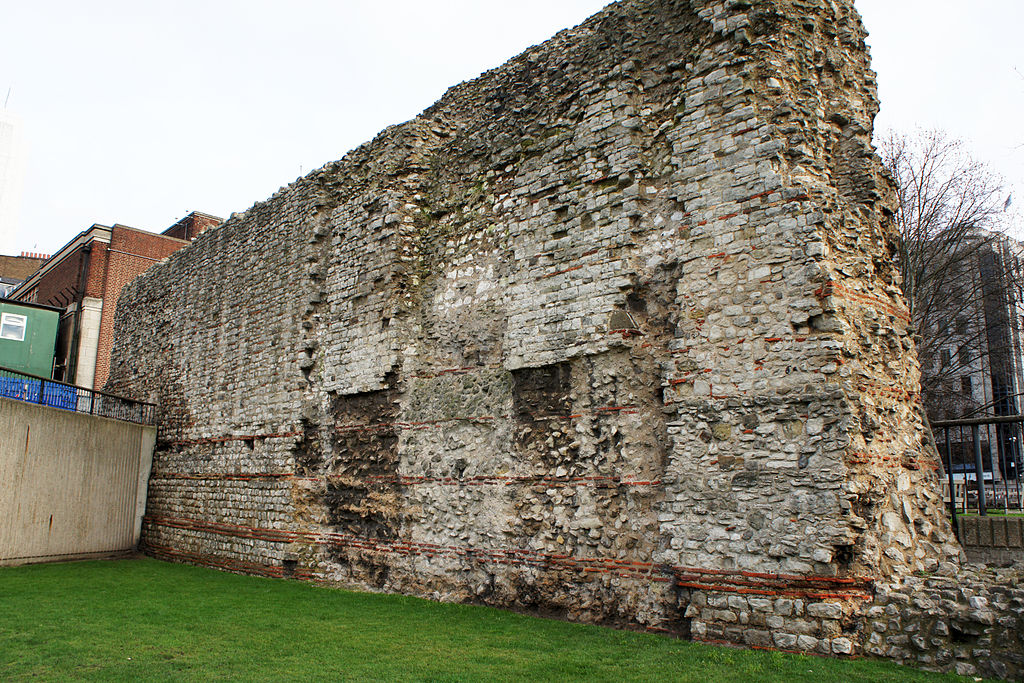
High wall of neatly piled stone and brick in the midst of the city

You can see a section of the Wall of London and learn more about it in the Roman Galleries of the Museum of London. A visit there inspired me to write these lines. I talk to the stones as they talk to me; and I pass their story on.

Photograph: Roman city wall near Tower Hill Tube station,
by Mariordo (Mario Roberto Durán Ortiz).

London Wall Had Fallen Down

London Wall had fallen down,
brick by brick and stone by stone;
in the crenellation’s crown,
storks and starlings built their home.

London Wall stood in the mud,
but we fixed it brick by brick,
and we filled the wasteland up
with new lanes across the grid.

London Wall was melting down,
but we used it stone by stone;
and we built a bigger town
on the ground of proud old Rome!

Christina Egan © 2015

After the end of the Roman Empire, the Roman City of London was left uninhabited for generations, while a new city sprung up next to it; later, the original precincts became the centre again. This area is now known as ‘The City of London’, although it forms only a small part of the centre of town.

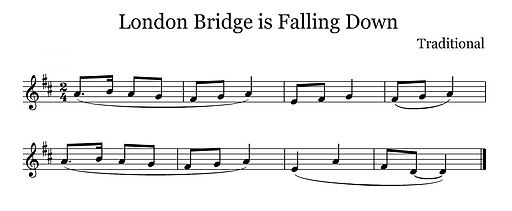
Musical score of 'London Bridge is falling down'


This little song alludes to the nursery rhyme London Bridge is falling down.

Clustering

Clustering

The world has gone weird:
When you switch the screen on,
any time, the news
contain news, the speeches
convey meaning, and the people
speak into the cameras as if
there were a point in speaking.
Can you see their smiles form dimples?

Like fog used to fill the roads,
so rumours waft and can’t be dispelled
that some representatives of the people
represent the people.
Like flocks of birds used to cover the squares,
so citizens cluster and can’t be dispersed,
until they witness those colours rising
which they have proudly painted themselves.

 Christina Egan © 2015

Outrage

Outrage

Every day now, someone
amongst the suits and ties
gets up and
says something.

Something
simple,
sensible,
and inconceivable.

Something
obvious,
overdue,
and improbable.

Someone sensible,
someone overdue,
someone outrageously
decent.

People lift up their heads and
listen as if
life
were meant to grow and thrive.

Christina Egan © 2015

For Jeremy Corbyn MP

“Jeremy Corbyn does not need to be theatrical because he is charismatic.

He makes a few simple statements and a thousand people jump off their sofas. It is not his policies that got him to the top but his personality!”

Christina Egan

Letter to the Editor, Evening Standard (London), 22. September 2015

(Please note I had written: “not his policies alone”!)