Kreuzung / Vollmondtraum

***


One poem has a person with dark hair and a person with fair hair falling in love at first sight. In German, the words for ‘junction’ and ‘to cross’ come from the same root: ‘Kreuzung’ and ‘kreuzen’.

The other poem describes a beautiful beloved man (or, by changing one word, a woman) with greying hair. The stars write the lover’s delight onto the sky, and the beloved one’s soul shines like a star.

zugefallen


Playing with the words
“Zufall” (conincidence)
and “zugefallen” (destined).
Is love written in the stars?

See my poem Zugewogen
about longing for love,
happiness, and destiny,
or rather, providence.

The Mooness Grows / Die Mondin rollt

The Mooness Grows

The Mooness grows: she’s almost round.
She steps out of a wooded mound.
She knows:
The sea will swell, the sap will well,
a thousand creatures will give birth.
The earth
is restless, waiting for Queen Moon
and for King Sun to round her girth,
her life.
The fruit is red, the fruit is ripe.
The Mooness strews her silent spell:
She glows.

Christina Egan © 2016


Die Mondin rollt

Die Mondin rollt, ein Bronzegong,
vom vielgezackten Horizont
das königsblaue Rund empor.
Ihr hoheitsvoller Ruf erschallt,
bis alles bebend widerhallt
in Stein und Blatt, in Bein und Ohr.

Noch einmal steigt, noch einmal loht
nach Mittagsglut und Abendrot
des vollen Sommers Vollmondschein.
Der Bronzegong um Mitternacht
hat neues Leben angefacht
in Ohr und Bein, in Blatt und Stein.

Christina Egan © 2016


These two poems about the ‘Mooness’ are very similar (and written at the same time) but not translations of each other.

In Greek and Latin, the moon is linguistically and mythologically female, and we should have such a word in English and German.

As a woman, I feel instinctively related to the powerful moon and all life cycles — irrespective of reproductive capacity or activity.

As Limpid as the Moon / Alabasterschale

As Limpid as the Moon

Some people are as luminous,
as limpid as the moon:
with truthfulness amidst the lies
or happiness in gloom.

They float and glow across the road
or mesmerise a room;
they never fade, and when they’ve died,
they leave a shining tomb.

Christina Egan © 2016


Alabasterschale

Überm schwarzen Heer der Bäume,
überm grauen Heer der Gräber
ruft durch dunkelblaue Räume
eine Glocke unbeirrt.
Balanciert auf spitzem Pfahle,
schimmert ferne feingeädert
eine Alabasterschale:
fremdes riesiges Gestirn.

Überm schwarzen Heer der Bäume,
blätterlos und blütenträchtig,
überm grauen Heer der Steine
lädt die Glocke zum Gebet.
Überm hingestreckten Tale
steigt gemessen, schlicht und prächtig,
jene Alabasterschale,
bis sich uns das Herz erhebt.

Christina Egan © 2017


As Limpid as the Moon remembers my radiant parents-in-law.

Alabasterschale compares the full moon to a bowl of alabaster; the scene is the vast old Tottenham Cemetery in London. The poem integrates awe before Nature and faith in God (as worshipped in church etc.).

This text will be printed in the Münsterschwarzacher Bildkalender 2019.

Die Fluten der Stadt

Die Fluten der Stadt

I.

Vor meinem Fenster rauscht die späte Stadt
und glitzert auf im Vollmond, schwarzes Meer;
sie spült Millionen Menschen hin und her,
spielt Fangen, nimmermüd und nimmersatt.
In ihrem Brausen höre ich Willkommen
und lasse mich auf ihren Wellen treiben.
Die Sternbilder der Leuchtreklamen schreiben
sich unter meine Lider… schon zerronnen.
Und nie allein: weil ich alleine bin,
zu Haus im selben Sehnsuchtsleitmotiv
wie jeder andre aufgewühlte Sinn.
Was immer schon in meinen Gliedern schlief,
schäumt ungebärdig zu den Sternen hin:
Ich will dich, will dich wild und meerestief.

II.

Auf vielen Brücken stand ich, ausgespannt
von Stahl und Stein an Themse, Rhein und Main,
und unter allen Himmeln stets allein:
stets einem Unsichtbaren zugewandt.
Es wandeln ja mit jedem neuen Strand
die Menschen wie die Häuser ihr Gesicht,
erstehen anders schon im Morgenlicht;
und immer wieder scheint mir eins verwandt.

Die Fluten wechseln – braun, blau, grau und grün –
die Augen ebenso, die mich gebannt,

sie füllen meine Augen – und entfliehn.
Doch deine, die ich nur von ferne fand,
die kaum mich streiften, seh ich weitersprühn…
Und ihre Farbe hab ich nie gekannt.

Christina Egan © 1995 / 1996

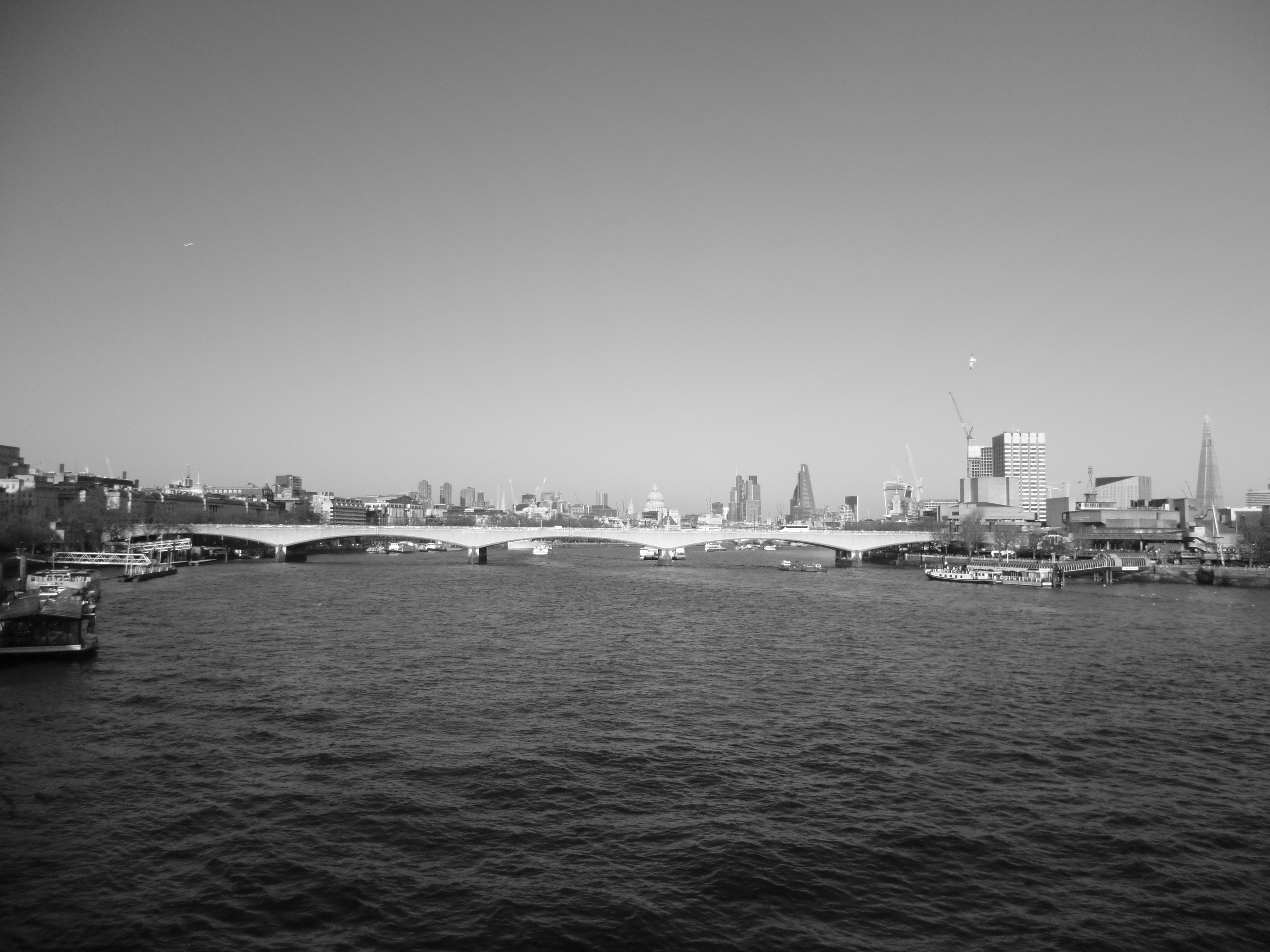
Black and white panorama of London skyline from a Thames bridge, with another bridge, boats, skyscrapers, St Paul's.

London. Photograph: Christina Egan © 2014


The narrator looks for love amidst the masses of the big city by the big river, where the star constellations consist of neon advertisements. She or he adores someone whom she has only seen from afar so that she does not even know the colour of his or her eyes.

Each sonnet makes a paradoxical statement about loneliness: This person is never lonely because many other people in this city share her loneliness; and she is always lonely because she is in the presence of a beloved one who is absent.

ich liebe dich

ich liebe dich

ich liebe dich
ich suche dich
am apfelbaum
der geißblattbusch
umduftet mich
mit weiß und gold
ich liebe dich
ich finde dich
im fiebertraum
ein runder mond
verschwendet sich
verheißungsvoll
ich liebe dich

Christina Egan © 2015

These lines were inspired by my favourite poem ever,
the magical
Ich liebe dich by Adelheid Bienmüller, which
once struck me
 on a calendar. Unfortunately, I have not yet
found this poet and her poem on the world wide web!

Later, I translated these lines as I love you well (I look for you).