August Night / Nur Asche zu essen

August Night

The night is short and moist and sweet,
with secret sprouting life replete…
and stark and bitter all the same.

There is no peace on golden wings,
there is no peace from silver limbs…
only a tiny steady flame.

Christina Egan © 2012


In the midst of abundant midsummer,
the narrator has not found peace — neither
through prayer or meditation nor through
the presence of a beloved person.

The following poem laments the unborn dead,
whose graves are nameless and forgotten and
who never saw the light of the sun although
angels may have taken them elsewhere…


Nur Asche zu essen

Nur Asche zu essen,
nur Lehm statt Brot,
nur Erde zu wissen:
der bitterste Tod.

Den Leib ohne Atem,
das Aug ohne Licht,
das Grab ohne Namen:
das schärfste Gericht.

Die niemals Gebornen,
fast ohne Gewicht,
von Engeln Verborgnen:
Vergesset sie nicht.

Christina Egan © 2018
The Mooness Grows / Die Mondin rollt

The Mooness Grows

The Mooness grows: she’s almost round.
She steps out of a wooded mound.
She knows:
The sea will swell, the sap will well,
a thousand creatures will give birth.
The earth
is restless, waiting for Queen Moon
and for King Sun to round her girth,
her life.
The fruit is red, the fruit is ripe.
The Mooness strews her silent spell:
She glows.

Christina Egan © 2016


Die Mondin rollt

Die Mondin rollt, ein Bronzegong,
vom vielgezackten Horizont
das königsblaue Rund empor.
Ihr hoheitsvoller Ruf erschallt,
bis alles bebend widerhallt
in Stein und Blatt, in Bein und Ohr.

Noch einmal steigt, noch einmal loht
nach Mittagsglut und Abendrot
des vollen Sommers Vollmondschein.
Der Bronzegong um Mitternacht
hat neues Leben angefacht
in Ohr und Bein, in Blatt und Stein.

Christina Egan © 2016


These two poems about the ‘Mooness’ are very similar (and written at the same time) but not translations of each other.

In Greek and Latin, the moon is linguistically and mythologically female, and we should have such a word in English and German.

As a woman, I feel instinctively related to the powerful moon and all life cycles — irrespective of reproductive capacity or activity.

This is the Northern Land

This is the Northern Land

This is the northern land
of loose and juicy ground
where fern and forest glow
and wheat and fruit abound.

This is the continent
where mound responds to mound
and wind resounds on rock –
this is the home we found.

This is the realm of dusk
and star-embroidered night,
of fog caressing lakes…
and then the roaring light!

Christina Egan © 2013

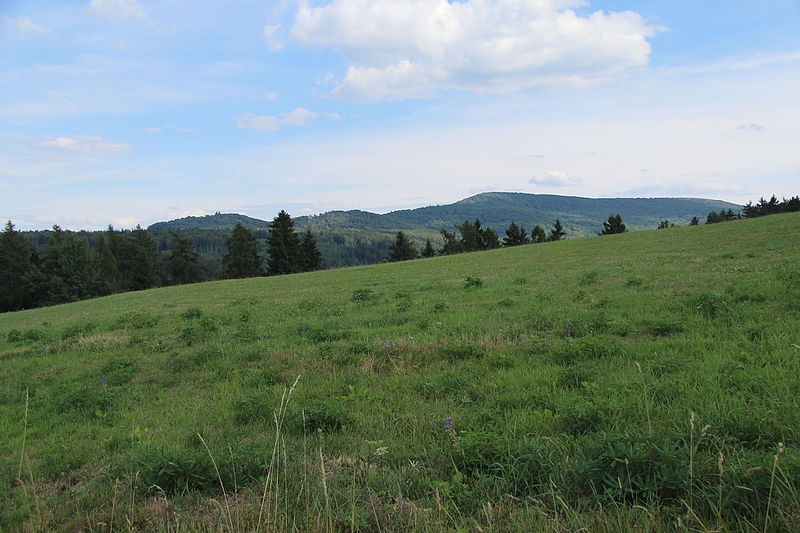
Mountain meadow filling lower half of picture, high trees right behing and mountain range in the distance along the middle, pale blue sky above.

Dammersfeld mountain ridge, Rhön (Central German Highlands).
Two of my great-grandparents grew up with precisely this view. —
Photograph
 by GerritR via Wikimedia Commons.


This poem was inspired by the Czech national anthem, Kde domov muj, which entirely refrains from politics and warfare and mainly describes the lush landscape of Central Europe. The Czech Republic abounds with hills and lakes, forests and fields.

My lines cover the whole of Central Europe or the whole continent (including the British Isles): my home is my region, or my country, or Central Europe, or all of Europe — none more so than the other.

The claim that even those who were born there ‘found’ their land may sound strange: yet their ancestors did immigrate one day, even if it was a thousand years or two thousand ago. No one just grew out of the ground. Moreover, most people are arguably of mixed ethnic origin, in our case, Celtic, Germanic, Slavic, Jewish, Hungarian, and more. No nation is an island.