Der Erde Auge / Dragon Island

Der Erde Auge
(Kaali, Estland)

Hier ist der Wald nur Wimpernkranz
um jadegrünen Augenglanz,
der immer träumt
und immer wacht,
der nimmer weint
und nimmer lacht.

Der Erde Auge schaut hinauf
in tausendfachen Sternenlauf:
Ein schwarzer Stein
mit Feuerschweif
schlug donnernd ein
und schuf den Teich.

Und um den runden Kraterrand
gehn hundert Menschen still gebannt:,
Sie schlendern her
zu eitlem Schaun
und schreiten schwer
in grünem Traum.

Berührt vom fernen Sternenschlag
sind tausend Jahre wie ein Tag.
Die Sonne fülllt
das Himmelsrund,
und urgrün quillt
der Augengrund.

Christina Egan © 2016


Dragon Isle
(Iceland)

Dark is the mid-morning sky,
shaded the treeless land,
granite the road of the sea,
burnt the abandoned strand.

Dragons looming like hills
have stirred from a century’s daze
to spew some sparks and some ash
before they set glaciers ablaze.

Christina Egan © 2010


The first poem, ‘The Earth’s Eye’ describes a startlingly green and perfectly circular lake in Estonia — a timeless, mythical place, caused by a meteorite crashing several thousand years ago, but within human memory.

The second poem was inspired by the news of a volcanic eruption on Iceland. Mythical creatures take on real life: not that hills look like dragons, no, dragons disguise themselves as hills…

I have also written a sonnet about the twin crater lakes of Sete Cidades (Azores). and a number of poems about the volcanoes of Lanzarote (Canaries).
A Window will be Thrust Open

A Window will be Thrust Open

A window will be thrust open
where you forgot there was one,
a glow as of noon will be thrown
over your working hands, over your tired face.

You will look into the mirror
and find upon yourself the gaze of an absent one,
you will look into the eyes of a stranger
and find there your face as if steeped in sunset.

halkett_1938_ohnetitelYou will run down the road
to overtake your shadow,
you will push through all your doubts
to hold that hand, to clasp it tight.

Christina Egan ©2003

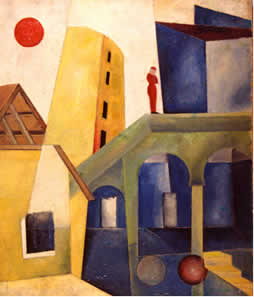
No title. René Halkett (1938).
Image with kind permission
of Galerie Klaus Spermann.

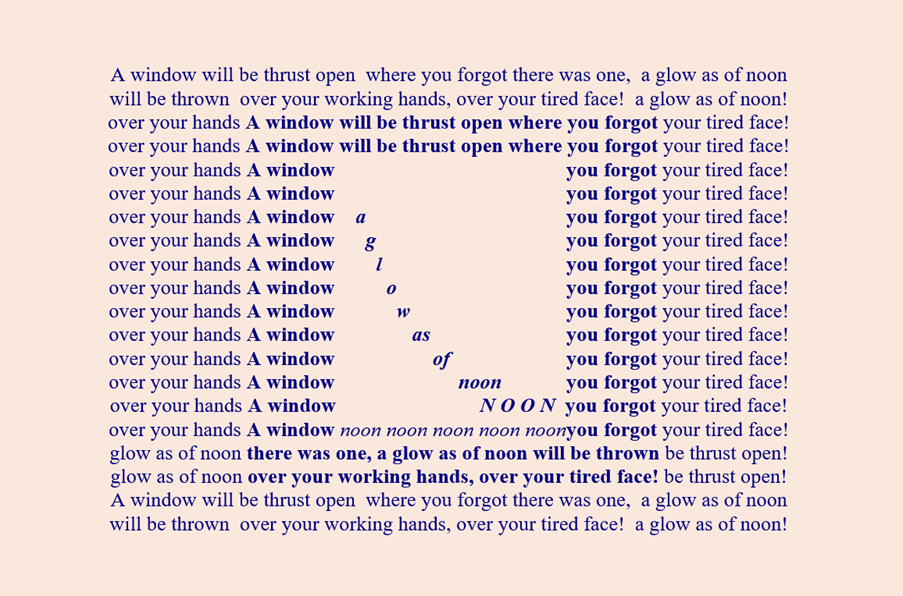
Text "A Window will be Thrust Open", 1st stanza, typed up in the shape of a window with a ray of sunshine coming in.


Visual poetry: 1st stanza of A Window will be Thrust Open. Christina Egan ©2024 (Text ©2003). (Click on the image to enlarge it).

Offnen Augs

Offnen Augs

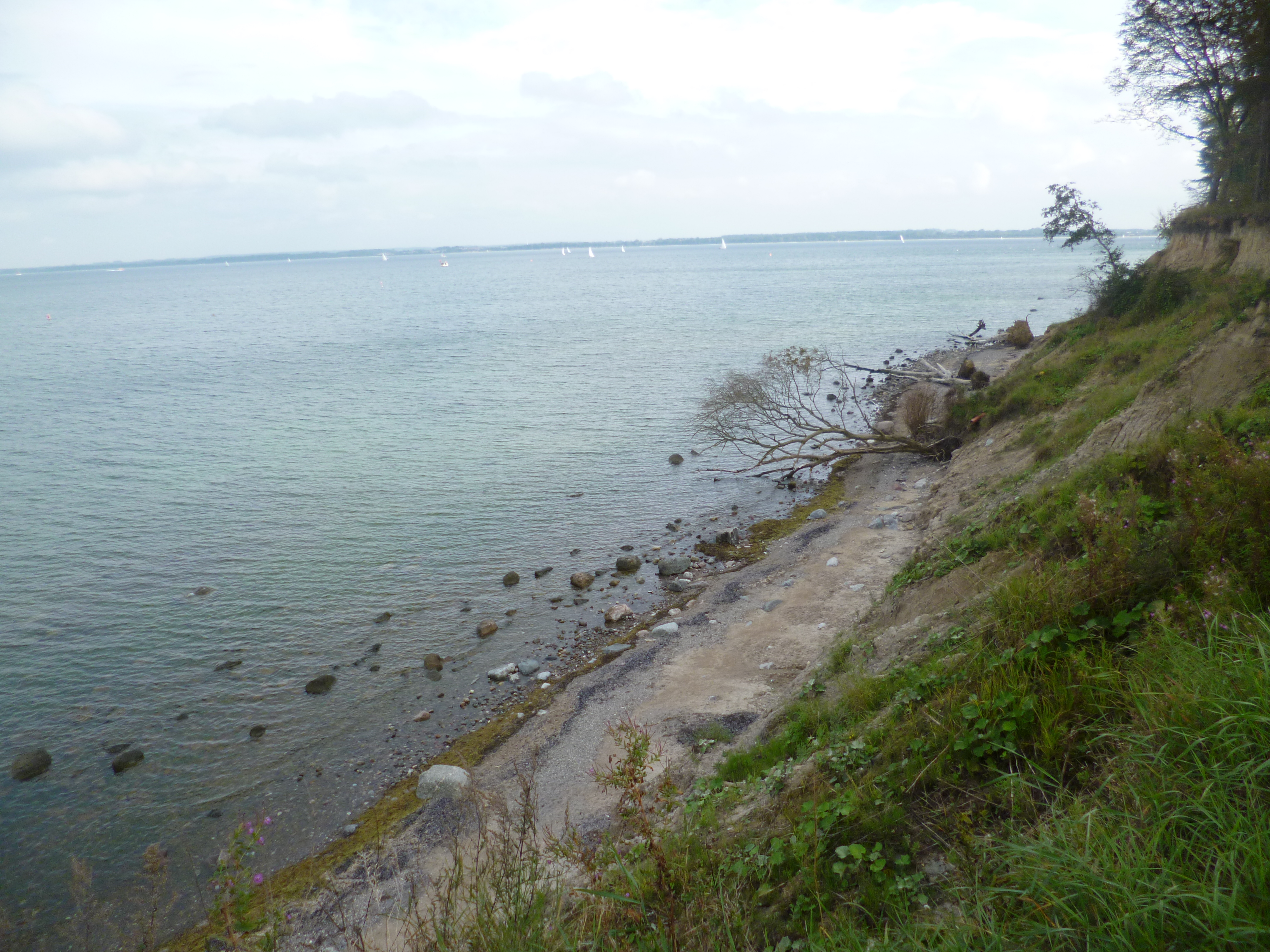
View down a cliff, with trees felled by the elements lying across the path beneath; the water is calm and turquoise.

Dem unverhofften
Verwitterten Warnschild
„Steile Klippen,
Hohe Brandung“
Folgte ich eilends.

Und stand da und schaute
Und wusste: Ich war.
Alles Blaugrüngrau
Saugte ich ein
Offnen Augs.

Christina Egan © 2003

 Couple holding on to a warning sign above the sea (which is calm and bluish).

Brodtener Ufer, near Travemünde on the Baltic Sea. Photographs: Christina Egan © 2014.

The couple are holding on to a sign warning of the cliff; the view downwards proves how dangerous the lower path is, where hikers have indeed got killed.

This is not a poem about Nature alone, though: it could be about life, about love, about faith… The colours of the sea, for instance, could also refer to a pair of eyes. I do not think I had seen such a sign when I wrote the poem!

kairos (eben im zenith)

kairos

eben im zenith des tages
tret ich in ein helles haus
und ich folge seinen stufen
und ich find nie mehr hinaus

eben im zenith des jahres
fällt dein flammendes gesicht
in den brunnen meines auges
mit dem hohen sonnenlicht

eben im zenith des lebens
flutet sanft mein goldnes haar
in die schale deiner hände
und die liebe wird uns wahr

denn du findest meinen namen
den geheimen dachtürknauf
und im purpurroten buche
deines schicksals scheint er auf

Christina Egan © 2015


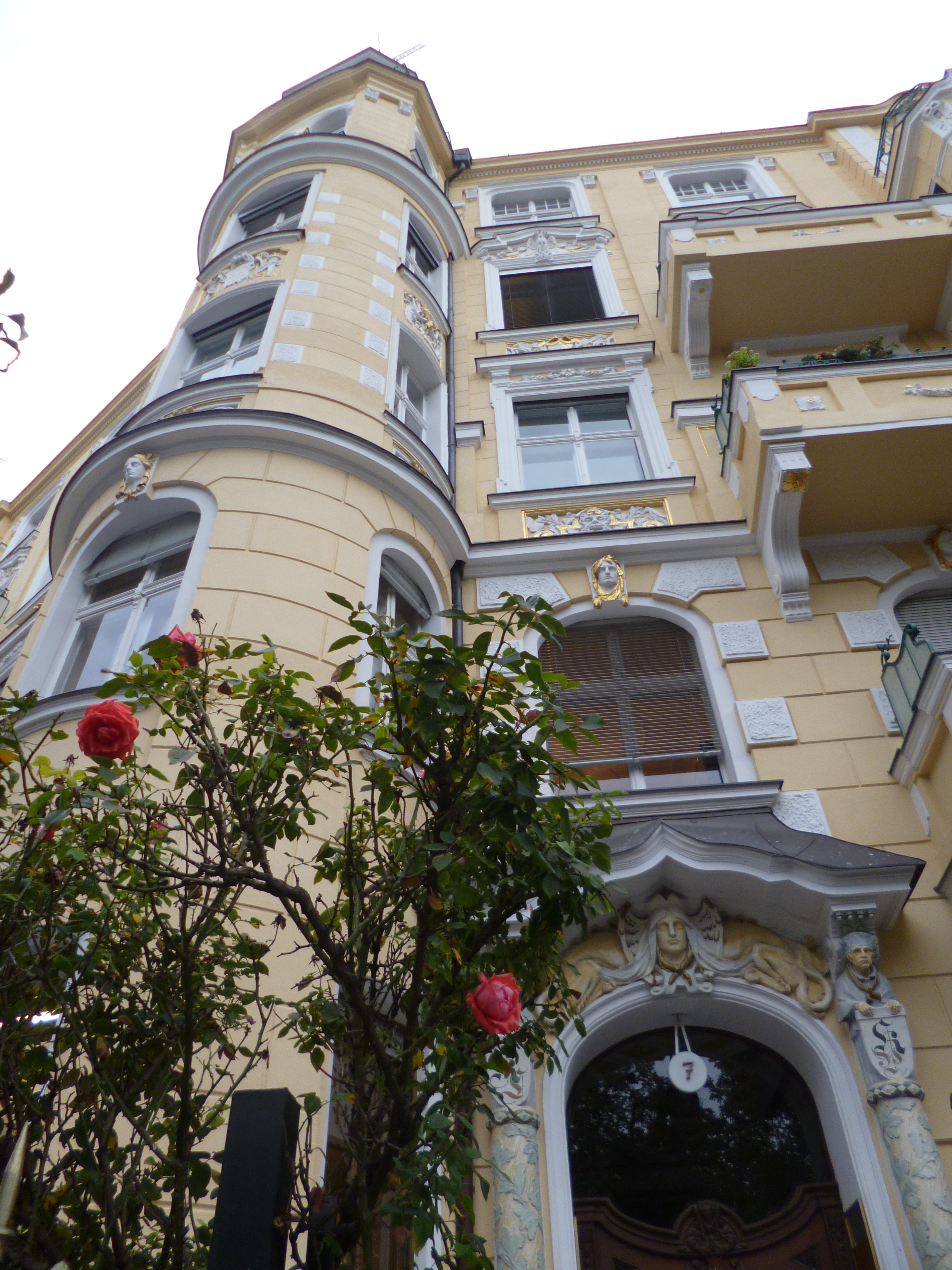
Noble townhouse with rich stucco ornaments and rose-tree.In Greek philosophy, the kairos is the moment — the right moment or the destined moment. The incident takes place at a triple zenith: at twelve noon, around midsummer solstice, and at the highest point of life. The latter, if it exists, will be different for everyone…

Possibly, the story happens only in the narrator’s mind: she imagines that one day in June, she steps into an unknown building and “never leaves again”, because her name was written in someone else’s book of destiny — so they fall in love at first sight.

Photograph: Christina Egan © 2016.

Water-Lilies and Reed

Water-Lilies and Reed

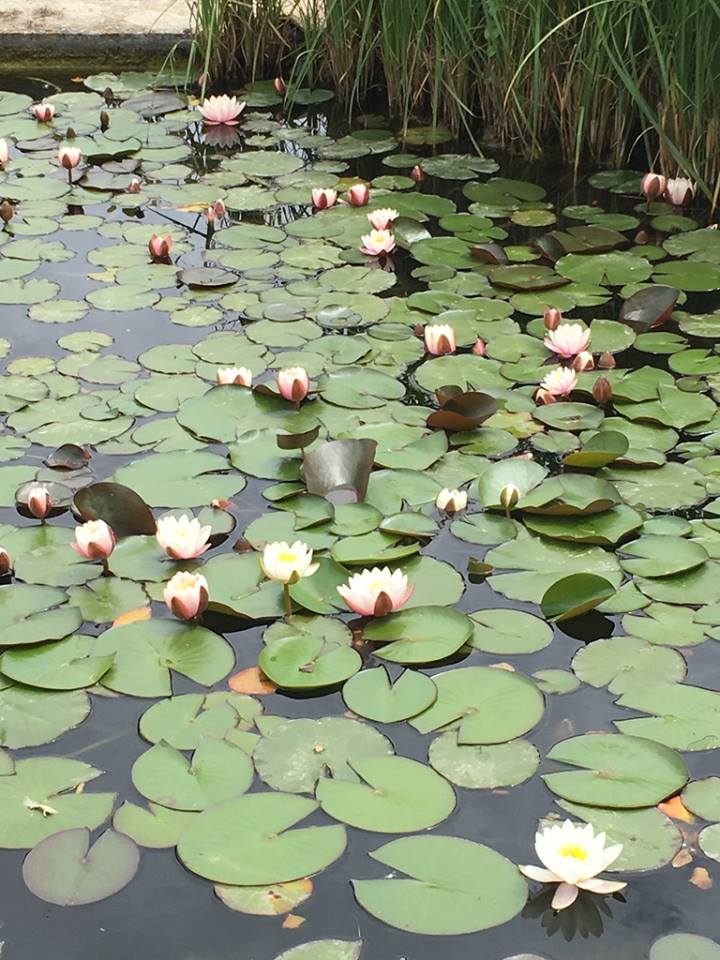
Waterlilies with half-open luminous pink and white flowers.White water-lilies,
opening with a pink glow,
like eyes of new-borns,
like the dawn rising and
looking at itself in wonder.

*

The reed unfolding,
tall green screen, finely woven,
around green water.
A forest of reed, towering
above ducks, children, yourself.

For Liu Sun Ye

Christina Egan © 2016

Photograph: Liu Sun Ye (Ye Liu) © 2016.

Ich fülle das Papier

Ich fülle das Papier

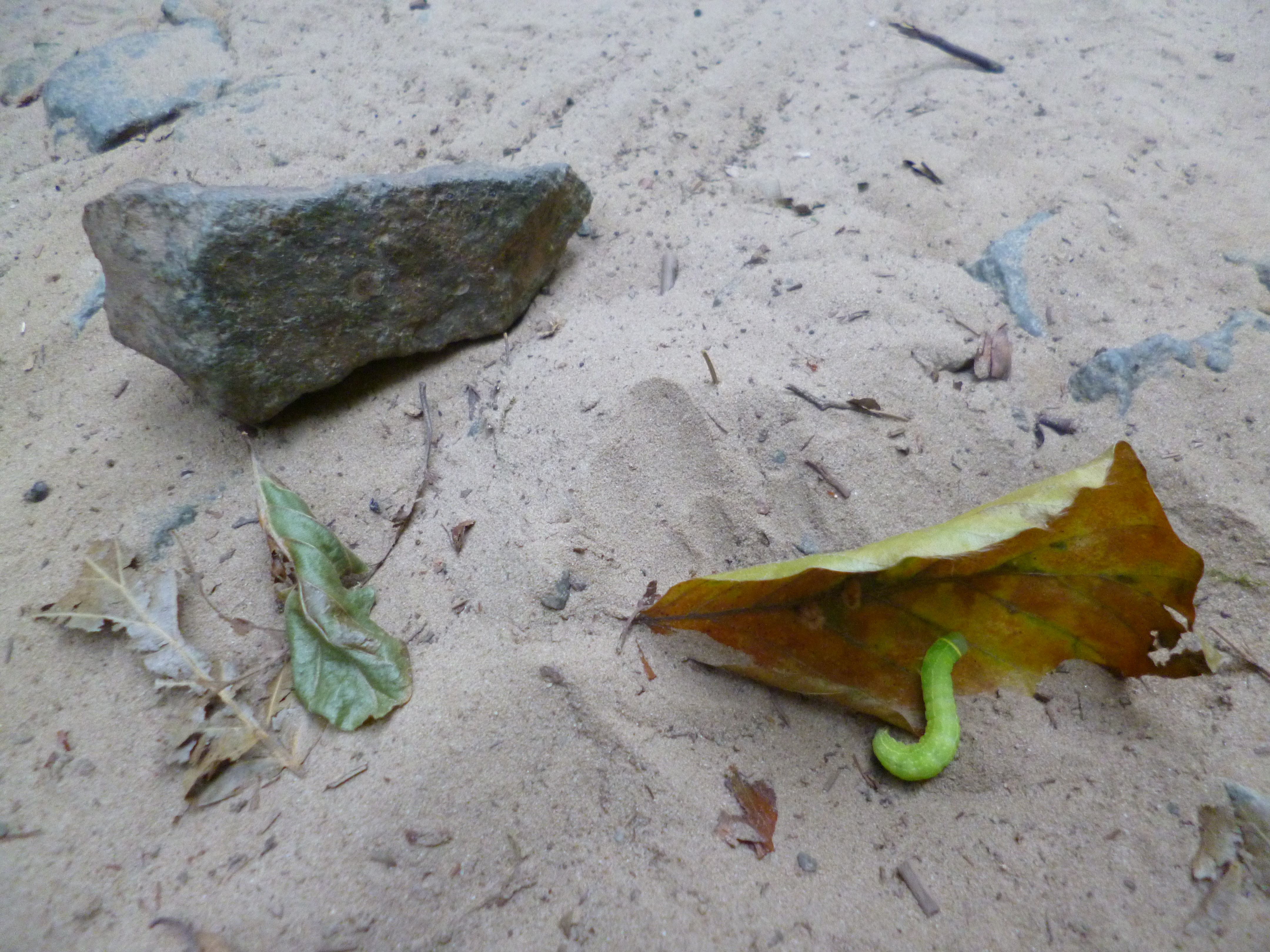
Caterpillar, very bright green, with crumpled leaf and edgy stone on sand.Ich fülle das Papier
mit langen schwarzen Kringeln,
die sich von mir zu dir
wie lauter Raupen ringeln.

In Wörtern schicke ich
mein Lächeln und mein Zwinkern
und jenes Frühlingslicht
gleich hinter meinen Wimpern.

Christina Egan © 2012

I had the poem and font colour before I found the caterpillar…!
I send a lot of handwritten letters; last year, it was exactly 100!

Photograph:  Christina Egan © 2016.

Ripples of People

Ripples of People
(Spring Equinox)

*

Ripples of people,
uneven waves, sudden whirls,
fast currents of cars:
a wayward river within
a canyon of grand buildings.

*

These neat white windows,
row upon row, road after road,
a thousand eyes
trying to catch light, praying
to touch the feeble sunset.

*

Christina Egan © 2013

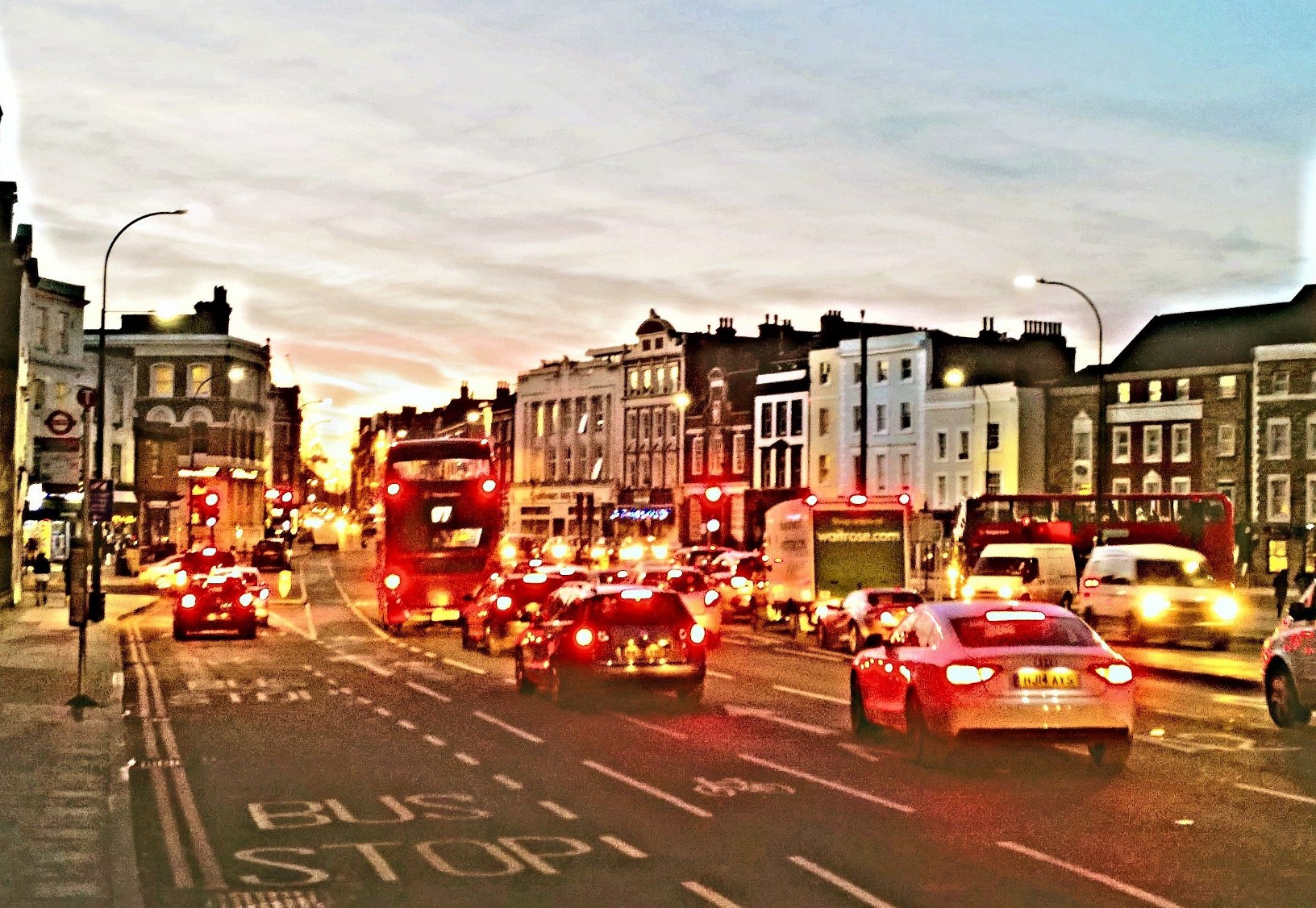
Busy junction in the dusk, with red and yellow lamps of cars and buses glaring.

These tanka were written in Knightsbridge, London,
in the last days of March — after equinox! —
when after months of dull and dark skies,
you may still be desperate for light and warmth.
For similar poems in German, see Alles drängt vorwärts.

Photograph: Deptford Broadway, London.
Michael Oakes © 2016

Le tesson / The Shard

Le tesson

En février givré, je fouille
les feuilles mortes pour des fleurs
modestes et fortes et courageuses :
soldats contre la froideur

ou des pierres précieuses
éparpillées en bas, fragments
pâlis de la Cité Céleste
que quelques éblouis attestent.

Parfois, une sphère lumineuse
me frappe, vive mais tranquille :
plutôt que le premier bouton
ton œil est le tesson qui brille.

Christina Egan © 2017

A pair of mauve crocusses, wide open, in bright sunlight, with honey-bee hovering above.

The Shard

In frosty February, I scour
decaying leaves for the first flower:
some modest soldiers, strong and bold
against the kingdom of the cold,

or precious stones on muddy ground,
some faded fragments of the round
of Heavenly Jerusalem,
that dazzling more-than-real realm.

At times a circle full of light,
as calm as lively, strikes my sight:
but rather than spring’s early guard
your eye is the resplendent shard.

Christina Egan © 2017


For a German and English parallel poem about the first spring flowers, go to my previous post, King Spring / König Frühjahr.

Photograph: Christina Egan © 2017.
Crocusses with honey-bee, captured in London in mid-February!

Get Up and Follow Me

Get Up and Follow Me

Love sometimes does  pass our little lives
and stops and speaks: Get up and follow me.
We look, look up, into each other’s eyes,
get up, leave all and follow hand in hand.
There is a love that’s larger than the sun,
it knows the shade, the night, it knows no end,
it’s definite and infinite, it flows
through our hearts, till two are truly one.

Christina Egan © 2000


These lines were inspired by the biblical stories of Jesus calling his followers, who literally got up, left everything behind and — followed him. Just imagine you are getting up from your desk this minute to walk out of your life!

I wrote this poem for my own wedding and recommend it also for anniversaries; a long time together is not eternity yet, but a great achievement and a great gift. Perhaps you could even use it for Valentine’s Day.

psalm für dich / The Charm

psalm für dich

ein schwebender lebender planet
ist dein auge
ein schimmernder sternennebel
dein haar

manche menschen drehen sich nach dir um
und auch manche engel
Gott hat dich erfunden
um sich zu erfreuen

Christina Egan © 2012


This poem has just been published in the Münsterschwarzacher Bildkalender 2017.

The person described may be someone the speaker is in love with or someone else, like a young child. Ultimately, it could be each one of us. I imagine that God feels as passionately about each human being as we feel only about very few others… and of course, still never as passionately.


The Charm

I want to rest my stormy eyes
in yours to find a moment’s calm;
I want to rest my wounded hands
in yours to find their strongest balm.

I need to lay my heart by yours,
which cast this fast and forceful charm,
I need to hear your heart tune in
to sing a brief and burning psalm.

Christina Egan © 2003