Quest / Suche

Quest

The market swirls
like ocean’s foam –
The harbour bursts
to roam the blue –

Yet nothing’s real
if not dream –
And music too –
and music too!

Christina Egan © 2015Fest_des_Lebens_1970

Suche

Der Marktplatz quirlt
wie Wellenschaum –
der Hafen quillt
hinaus ins Glück –

Doch nichts ist wirklich
als der Traum –
und die Musik –
und die Musik!

Christina Egan © 2015

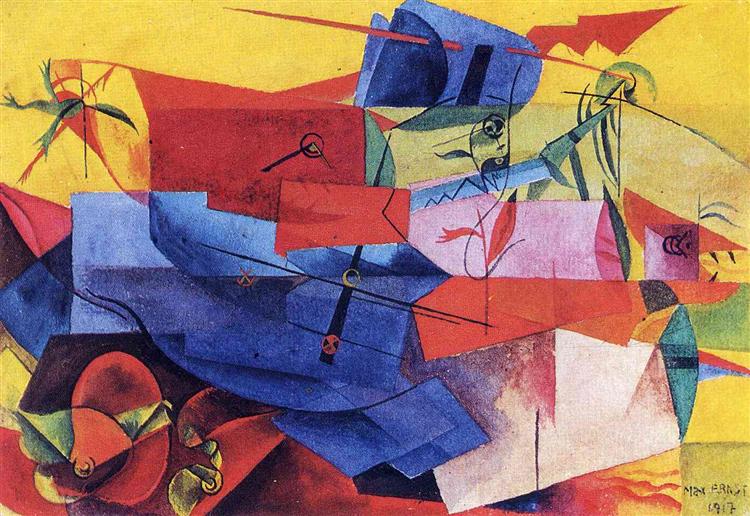
Very bright painting of mainly blue and red shapes on yellow.

This poem in German and English versions is dedicated to the painter Curt Echtermeyer, who for some of his work took on the pseudonym Curt Bruckner out of reverence for the composer Anton Bruckner. I hope Curt would appreciate the thought that dreams are more real than life…

Images: Das Fest des Lebens (The Feast of Life) by Curt Echtermeyer. Pastel, 1970. With thanks to Archiv Klaus Spermann.Max Ernst: Fish fight. Oil on canvas, 1917. – © Max Ernst. Distributed under FairUse at  WikiArt.

Dem Herausgeber des “Echtermeyer”

Dem Herausgeber des “Echtermeyer”

Du sammeltest leuchtende Lieder,
den mannigfaltigsten Strauß,
du trugst vom Parnassus hernieder
Gedichte in jedermanns Haus.
Verklungen ist längst deine Stimme,
im Schattenreich deine Gestalt,–
doch fesselst du unsere Sinne
durch eherner Worte Gewalt.

Christina Egan © 2015


Vixi, et, quem dederat cursum fortuna, peregi;
et nunc magna mei sub terras ibit imago.

Virgil, Aeneis IV, 653–654 


The name of this writer, Ernst Theodor Echtermeyer (1805-1844), became proverbial for a standard anthology of German poetry. It went through many mutations, and the latest editions are officially titled “The Echtermeyer”. Without this book, I would not be what I am!

We know little about Theodor’s life, but I have tried to imagine two key moments in his life: when he understands he is in love and decides to marry; and when he understands he is so ill that he must die soon. Theodor an Emilien  is written in the first person singular in 19th-century German.

Theodor an Emilien

Theodor an Emilien

Mit tausend dicken weißen Kerzen
Prangt der Kastanienbaum am Tor;
Ich steh’ mit hoffnungshellem Herzen
Im späten Dämmer stumm davor.

Der Vogelsang ist längst versickert
Wie Silberspur ins Dunkelblau…
Doch aus dem Gutshaus tröpfelt, zittert,
Quillt das Klavier wie Abendtau.

Ich mach’ im hohen Gartensaale
Den flinken schlanken Schatten aus –
Und werf’ nach jenem Ankerpfahle
Mein Tau mit einem Male aus.

Christina Egan © 2016


The old-fashioned names and inflections signal that this is a scene which happened long ago, a romantic story from the times of Jane Austen, set in Germany. There is a true story behind it, and the ending is happy and sad: the young man waiting hopefully outside the manor house in the summer night, Ernst Theodor Echtermeyermarried Lady Emilie, and they had a child, but they both died very young.

Portraits of Marble and Verse

silberblech

ich hämmere aus silberblech
aus makellosem mondenlicht
ein lebensvolles angesicht

ich bilde nach mit meiner glut
den sanften glanz den gott erschuf
dies sei mein einziger beruf

Christina Egan © 2015


Im Vorübergehn

II.

Es gibt von dir, mein Freund, kein Marmorbild,
in dem das Leben lautlos überquillt,
in dem ein andrer Mensch mit Meisterhand
in Stein das flüchtge Spiel der Züge bannt
und deine Stirn ins Licht des Südens taucht,–
nur Verse, im Vorübergehn gehaucht.

III.

Hinweg mit Ebenholz und Elfenbein,
hinweg mit Binnenreim und Gleichlautreim,–
kein Zeilensprung hält deine Schläfen und
kein Meißel schlägt aus Marmor deinen Mund!
Die sanfte Kraft der Adern übersteigt
ein jedes Bildwerk… bis es steht und schweigt.

Christina Egan © 2014


“I hammer from silver sheets”  claims that the foremost task of a sculptor – or any other artist – is to celebrate human beauty; and that he or she recreates the splendour of God’s creation.

“There is of you no marble image” suggests that the image of a person can be as full of life as the person itself; and that verse can make as good a classical monument as marble.

“Away with ebony and ivory” equates those materials with poetic devices – using them while naming them! – and concludes that human beauty, after all, surpasses any work of art.


CarlEchtermeyer


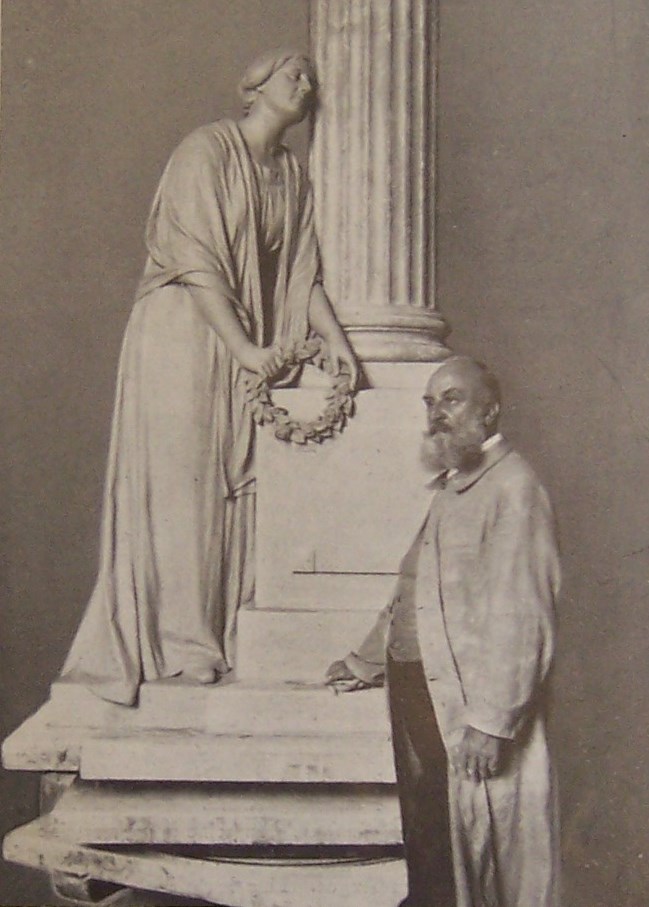
My ancestor Carl Echtermeier with the model of his last work in 1910.


Photograph: „CarlEchtermeyer“ von Unbekannt – Scan Illustrirte Zeitung, Nr. 3502, 11.August 1910. Lizenziert unter PD-alt-100 über Wikipedia –


Marmorrose

Auch dieses Gedicht,
knospengroß,
elfenbeinfarben,
morgenbetaut,

ist letzten Endes
gefrorener Atem,
eine Rose
aus Stein.

Mein eigenstes Eigentum
und deines
und das eines jeden,
mein geschenktes Geschenk.

Immerhin
eine Marmorrose,
dem Leben abgewonnen,
dem Tode abgerungen.

Christina Egan © 2014