Glass Mountain (Potsdamer Platz)

Glass Mountain
(Potsdamer Platz)

Lights above you, lights around you,
shifting blue and mauve and pink,
lights below you, lights surround you,
pierce the black and loom and shrink.

Glass fronts of enormous silos
mask the dusk and stare and blink,
figures wander in the windows,
lifts in tubes float up and sink.

Water basins spread around you
shifting blue and mauve and pink,
glass roofs open in the ground, too,
names flare up in mirror print.

Glass façades and water fountain
multiply the hum and glint:
you have stepped inside a mountain,
you are trapped in steely pink,

trapped beside a thousand others,
lulled by murmur and gay tunes,
screened from sun and stars and weathers
by a tent-roof in sweet blues.
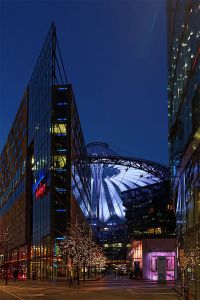
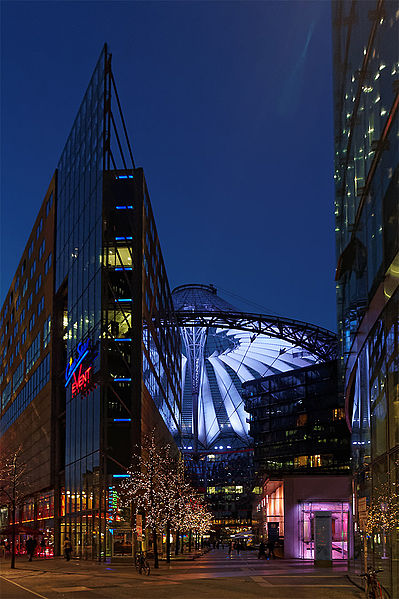
Futuristic glass buildings, pointed and rounded, illuminated in blue and pink; in the corner, old facade visible beneath.

Then you see the stucco hover,
curling in a livid tint;
chandeliers unfurl and quiver;
then you hear the glasses clink…

Have you dreamt of the Titanic
or of old Potsdamer Platz?
No, this is the real relic,
the hotel that dodged the Blitz

and kept spinning through the nightmare
of the void swept by the wind –
sad and splendid sole survivor
under glass and neon pink.

Christina Egan © 2017

Sony Center on Potsdamer Platz, with old façade visible beneath the glass (here, in pink). Photograph: Pedelecs by Wikivoyage and Wikipedia [CC BY-SA 3.0], via Wikimedia Commons.

For a German poem on the old, vanished, Potsdamer Platz, look at the sonnet Nächster Halt: Potsdamer Platz.
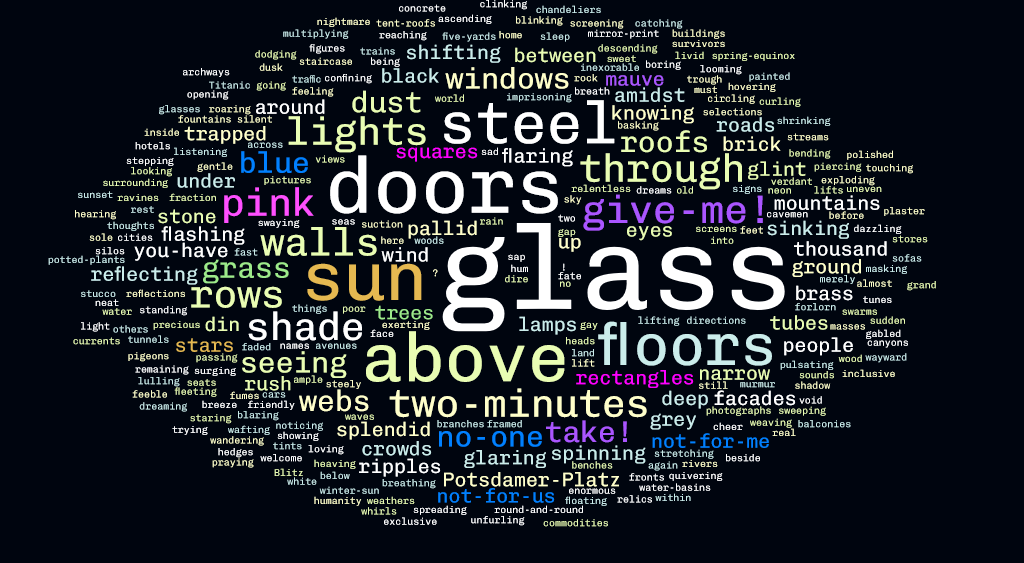
Word cloud on black, most words pale, some words glaring. In the middle, "glass", "steel", "doors", "sun".

Word cloud Steel & Glass. Christina Egan ©2024.
Developed from twelve poems about big cities on
this website, with some colours of the scene above.
See more at When Webs of Steel / Von stählernen Waben.
Many thanks to the Simple Word Cloud Generator.
The Green Dress / Im grasgrünen Kleid

The Green Dress

This green, this green! The purest of greens,
the softest of silk, the smoothest of greens!
It’s mellow and creamy –
and glossy and hard –
it’s distant and dreamy –
and sudden and sharp –
It’s got all the earth in it, fields in full plume,
the glow of the sun and the snow of the moon!
There’s birch in it, ivy –
there’s lemon and lime –
and oceans and icebergs –
and olives and pine –
And the lady beneath the shimmering screen
bears the soul of the earth in the secret of green!
In the gold of her hair
and the blue of her eyes,
in the lines of her limbs
and the flow of her voice
there’s the glow of the sun and the snow of the moon:
a creature of night and a creature of noon.

Christina Egan © 2009


Im grasgrünen Kleid

Ich stehe am Fenster und schaue hinaus,
und niemand bemerkt mein bescheidenes Haus,
und niemand bemerkt mein grasgrünes Kleid,
und niemand bedauert mein aschgraues Leid.

Die Dämmerung wogt, und es rauscht der Verkehr.
Ich stehe und schaue. Und niemand schaut her.
Zuletzt ist es still, und es rauscht nur die Zeit.
Ich weine allein in mein grasgrünes Kleid.

Und einst werd ich fort sein und einst sogar tot,
und nur dieses Liedlein bezeugt meine Not:
Mein Kleid wie der Sommer, mein Haar wie der Herbst,
mein Leben, das niemand als du, Leser, erbst.

Christina Egan © 2016


The woman in the green dress stands for life, fertility, plenty, joy — like the Green Man or Green Woman of ancient pagan traditions, I suppose…

Cimmerian Summer

Cimmerian Summer

This lifeless gloom: is it the dusk?
This pale white disc: is it the moon?
Is this a mild day in November?
No: in the land of ceaseless mist
this is the sun; the afternoon;
the lightless first day of September.

Christina Egan © 2015


“ἔνθα δὲ Κιμμερίων ἀνδρῶν δῆμός τε πόλις τε,
ἠέρι καὶ νεφέλῃ κεκαλυμμένοι.”

There are the land and city of the Cimmerians,
wrapped in mist and cloud.”  

Homer, Odyssey, 11:14-15


“Britain is set in the Sea of Darkness.
It is a considerable island. This country is most fertile,
its inhabitants brave, active and enterprising….
but all is in the grip of perpetual winter.”

Muhammad al-Idrisi of Sicily, ca. 1154


Homer never ceases to inspire us. Incidentally, I saw a retelling of the Odyssey  last night, at a London playhouse, or rather, amphitheatre! (On this first day of September, the weather is in fact glorious.)

The memory of four clearly marked seasons, full of bright leaves and fruits, and the sorrow about the apparent confusion of the climate are depicted in My Pack of Cards.

Der Knauf / Schnellgeschrieben

Der Knauf

Schon viele haben Blumen dir gepflückt,
von Löwenzahn bis hin zu Feuerlilien,

vielleicht auch mancher einen Edelstein –
doch niemand pflückte je dir einen Stern.

Und wenn ich tausend Jahre leben muß,
und wenn ich tausend Jahre lieben muß:

Ich hole dir den kupferfarbnen Knauf
vom ungeheuren Sternengittertor

zur dämmerdunkelblauen Seligkeit
und leg ihn sanft in deine hohle Hand.

Christina Egan © 2012


Schnellgeschrieben

Sterne ans Firmament zu setzen ist mir ein Leichtes:
Funkelnde Verse schleif flink ich mit sicherer Hand.
Sterne hingegen vom Himmel zu greifen geschieht nur im Traume:
Sprühende Küsse erhascht selten der federnde Fuß.

Christina Egan © 2016


In The Knob, the person wants to pick for her beloved one something better than a flame-coloured flower, better than a sparkling gem: a copper-coloured star!

In the distichon Written Quickly, the poet states that she can easily put stars up, that is, her verse, but rarely picks stars, that is, kisses, other than in dreams…

These poems would not work in a translation software because the first one invents words and the second one jumbles up the word order, like the ancients did.

December Date

December Date

The afternoon is royal blue,
Burning sparkler on black background, looking like a supernova!with tiny lights festooned,
I rush, I’m flushed, I look for you —
we never meet too soon!

The windows decked with evergreen,
with tinsel and with gold —
and there, my angel, genuine,
a candle in the cold!

Christina Egan © 2015

Photograph by Gabriel Pollard [CC BY-SA 2.5].
Featured picture on Wikimedia Commons.

You Want to Read This Poem

You Want to Read This Poem

You want to read this poem
time or no time
rhyme or no rhyme.

You want to know
that your face is a flame
in the hidden temple
of someone else’s heart
trembling and steady.

You want to dwell
on the deep-blue dusk
of her dress
of her eyes
of her soul.

You want to believe
one last time
that three hours are enough
to fuel three years of delight
and from there three thousand.

You want to be sure
she will never be too close
never too far
like surges of birdsong
like surf.

You want to read this poem
as if it were a prayer
as if it were a promise.

Christina Egan © 2011


You Do Not Want to Read this Poem

You do not want to read this poem
however much sunlight
however much midnight.

You do not want to plough
through luminous ciphers
of your own beauty
you want to hear it in someone’s voice
you want to see it on someone’s lips.

You want to lift your eyes from the paper
onto her face
you want to lift your hand from the paper
onto her arm
let it rest.

You want to step through this poem
as if it were a secret gate
to the tiered garden
of an ancient manor house
you heard of in a novel.

You do not want a host of poems
a pavement of paper
a quilt of hopes
you want a host of moments
a quilt of memories.

You do not want to read this poem
you want sudden life
before the sun has sunk.

Christina Egan © 2011

Mer de miel

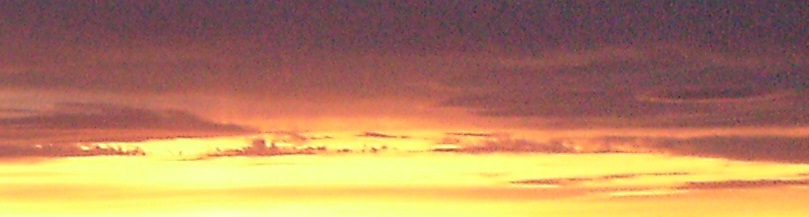
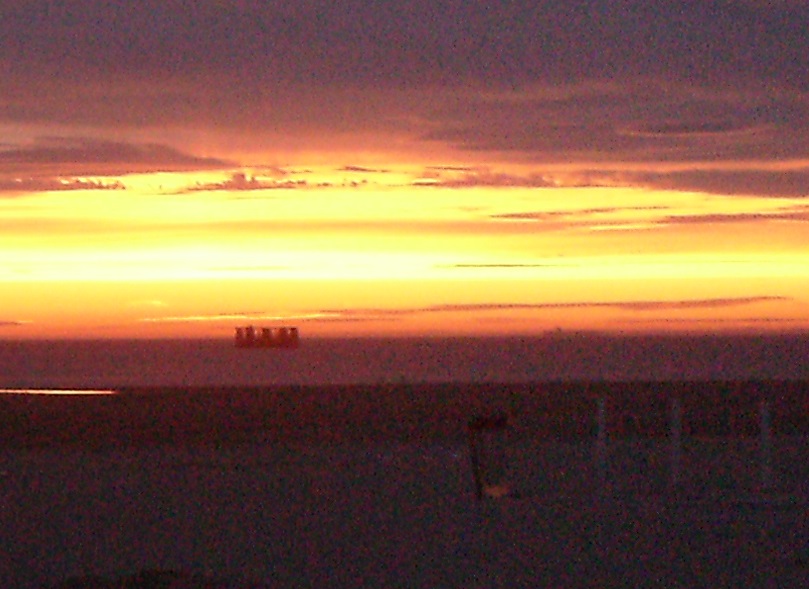
 Clouds in hte sunset, looking like a bright yellow sea, an orange coast and purple sky. An optic illusion above a real coast (not visible here).

Mer de miel
(Sète)

Levez vos yeux vers ce vitrail doré,
d’un jaune plus doux, d’un jaune plus pâle possible :
une baie cernée de hauts rochers
d’un bleu brumeux… Un crépuscule paisible.

Clignez vos yeux à ce vitrail distant,
mer de miel, montagne mauve, sauvage :
tout flotte au dessus de l’horizon –
des eaux de feu, une terre de nuages !

Ce paysage d’un or incomparable
s’évanouit et passe, une image…
Ou serait ça la côte impérissable
et notre terre et mer le grand mirage ?

Christina Egan © 2016


This poem takes up an idea from ancient pagan and Christian philosophy: our world may be only a pale reflexion of a higher, perfect, world. Those ‘heavens’, however, are an inaccessible and unimaginable place — beyond our universe — for which the visible sky is only an image.

The fiery sunset which took me quite literally ‘out of this world’ occurred in midwinter on one of the northernmost beaches of the Mediterranean, at the outskirts of Sète. For a daytime poem and photograph on the sea around Sète, see La Mer, enfin.

Clouds in the sunset, looking like a bright yellow sea, an orange coast and purple sky. An optic illusion above a real coast (also visible here).

Photographs: The sky above the coast in Sète, France. Christina Egan © 2016

Word Weaver

Word Weaver

More purple clouds than I can count
or weigh or paint for you
or snatch and send them underground
with some surrounding blue…

To one whose windows do not stretch
to spy the heaving sky,
I’ll weave my syllables to fetch
the purple passing by.

To one whose dusk and marble moon
are filtered through a rail,
I must thread silver on my loom
to leave a shiny trail.

I must request the best black silk
to mark the balmy dark…
By day I’ll stitch a roaring quilt
to catch the city’s heart!

Christina Egan © 2016

Drawing of the mechanics of a loom (yarn on rolls, without the frame)The poet describes the world to a prisoner who can barely see the majestic ever-changing sky and the bright busy city surrounding them. The sound and rhythm of the lines emulate the warp and weft of life, so that the words reflect the world — read the poem aloud and you will see!

The other person may be imprisoned by a totalitarian state or indeed by a democratic state, or locked up by their employers or indeed their own family, behind walls and perhaps under a garment. There are many millions of human beings who de facto are prisoners or slaves without being called so.

For poems about time (for instance ensuing generations) and space (for instance a big city) as a tissue, see my post Geflecht / Geflechte. All of civilisation and all of humanity is one web.

This is the Northern Land

This is the Northern Land

This is the northern land
of loose and juicy ground
where fern and forest glow
and wheat and fruit abound.

This is the continent
where mound responds to mound
and wind resounds on rock –
this is the home we found.

This is the realm of dusk
and star-embroidered night,
of fog caressing lakes…
and then the roaring light!

Christina Egan © 2013

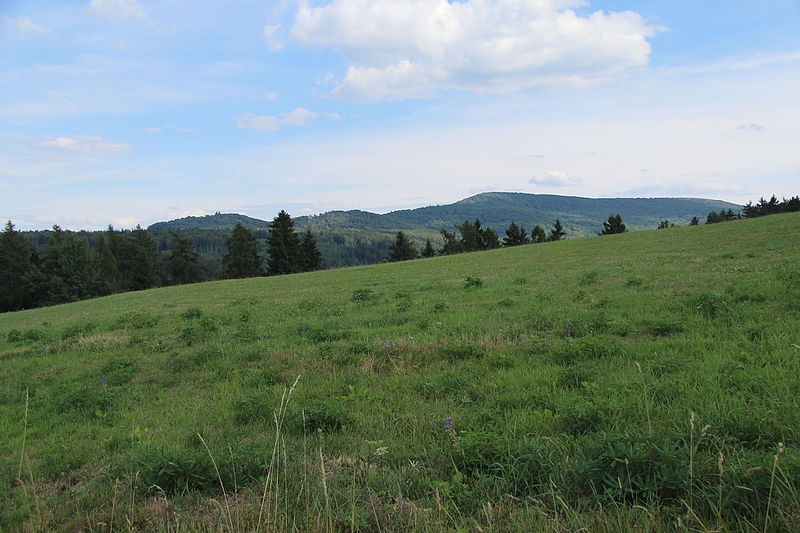
Mountain meadow filling lower half of picture, high trees right behing and mountain range in the distance along the middle, pale blue sky above.

Dammersfeld mountain ridge, Rhön (Central German Highlands).
Two of my great-grandparents grew up with precisely this view. —
Photograph
 by GerritR via Wikimedia Commons.


This poem was inspired by the Czech national anthem, Kde domov muj, which entirely refrains from politics and warfare and mainly describes the lush landscape of Central Europe. The Czech Republic abounds with hills and lakes, forests and fields.

My lines cover the whole of Central Europe or the whole continent (including the British Isles): my home is my region, or my country, or Central Europe, or all of Europe — none more so than the other.

The claim that even those who were born there ‘found’ their land may sound strange: yet their ancestors did immigrate one day, even if it was a thousand years or two thousand ago. No one just grew out of the ground. Moreover, most people are arguably of mixed ethnic origin, in our case, Celtic, Germanic, Slavic, Jewish, Hungarian, and more. No nation is an island.

Theodor an Emilien

Theodor an Emilien

Mit tausend dicken weißen Kerzen
Prangt der Kastanienbaum am Tor;
Ich steh’ mit hoffnungshellem Herzen
Im späten Dämmer stumm davor.

Der Vogelsang ist längst versickert
Wie Silberspur ins Dunkelblau…
Doch aus dem Gutshaus tröpfelt, zittert,
Quillt das Klavier wie Abendtau.

Ich mach’ im hohen Gartensaale
Den flinken schlanken Schatten aus –
Und werf’ nach jenem Ankerpfahle
Mein Tau mit einem Male aus.

Christina Egan © 2016


The old-fashioned names and inflections signal that this is a scene which happened long ago, a romantic story from the times of Jane Austen, set in Germany. There is a true story behind it, and the ending is happy and sad: the young man waiting hopefully outside the manor house in the summer night, Ernst Theodor Echtermeyermarried Lady Emilie, and they had a child, but they both died very young.