I did not read the book I took I did not cast a glance not once I took the bus and dreamt no end I wrote some verse of love and stuff I dreamt that in the street we’d meet and summer would return and burn and that would be the date from fate: the sun and you and me all three
This playful verse from a London double-decker bus was actually written in mid-August, when it should be bright and hot everywhere; yet the weather has always been unpredictable and is now turning seriously unstable. In this poem, the summer is not returning after the period of winter but after a long, dull, cool break between early and late heatwaves.
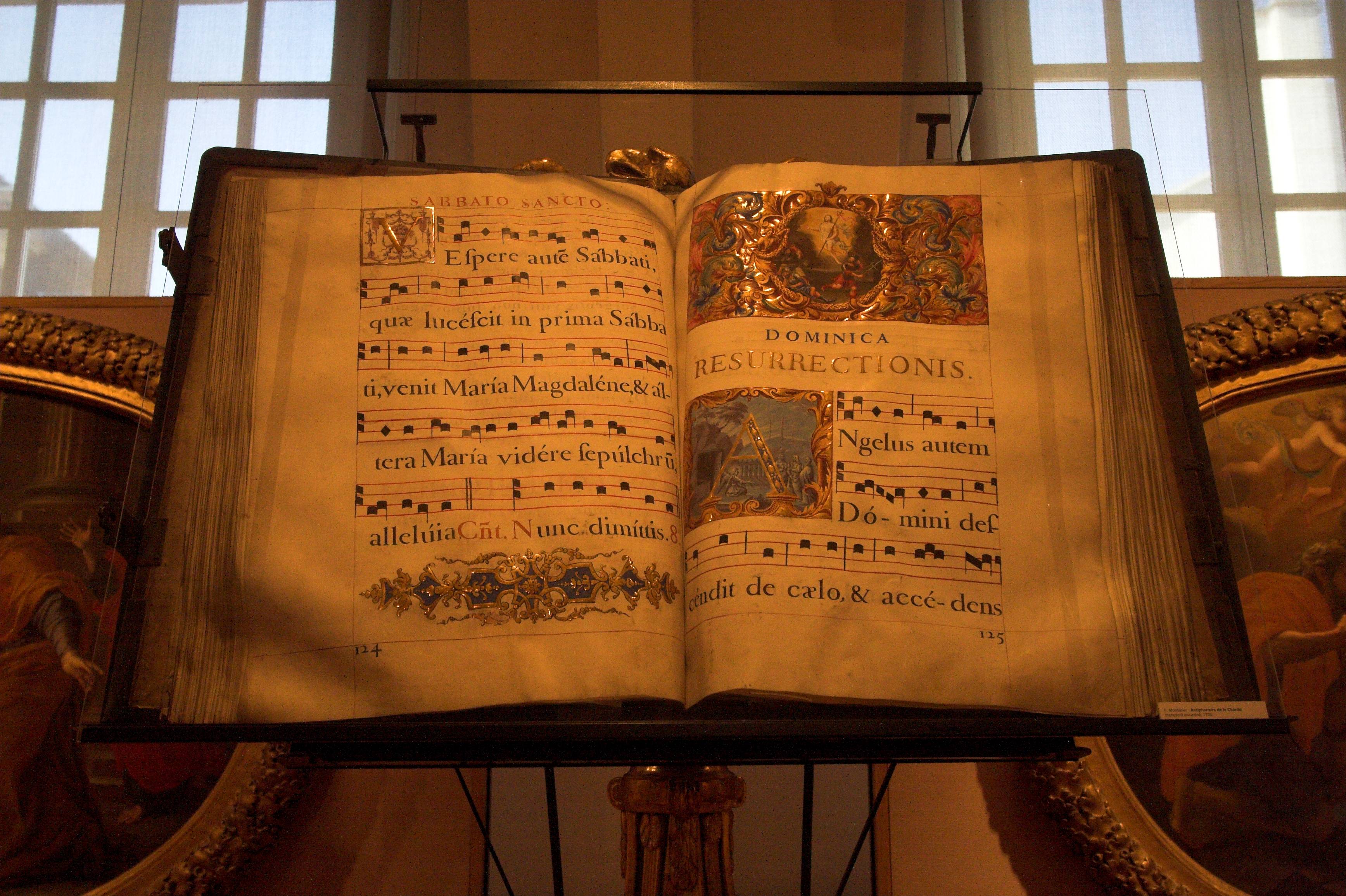
Du bist die Hand, die mein Gebetbuch hält in aller Frühe, wenn die laute Welt noch schlummert wie ein müdgetobtes Kind und wir die Stimme ihrer Träume sind. Wir sind der Psalm, der aus der Erde steigt, wenn Nachtwind noch die Wiesenblumen neigt, das erste Wechsellied im Weizenfeld… Du bist die Hand, die mein Gebetbuch hält.
At dawn, the noisy and unruly world, just like a tired child, has not yet stirred. We are the voice of all its dreams: we stand, my hymnal lifted by your distant hand. We are the psalm arising from the earth while night wind is still bending blooming herbs. We are the chant across the ripening land… My hymnal lifted by your distant hand.
These lines describe the early-morning prayer of Christian monks and nuns: standing up and bowing, chanting and responding to each other… They also imagine an invisible connection between two of them — good friends perhaps, close relatives, or former lovers — who feel that they are praying together across the distance between them.
Is this moon new or young, a sliver or a crescent, silver or golden in the deep blue, the newly deep sky, is it striking or dazzling or mesmerising?
Is this a late spring, belated and all the more welcome, bursting with life, with green, bright green, saturated with rain and sunshine, saturated with colour and heat, heat unfamiliar and all the more welcome, or is it sudden summer?
Is this life at last, is this joy, is this joy of life, is it zest, is it just new life-force or is it happiness or elation or bliss?
Reality, as it laps up against the shores of your eyes and your ears and your nose, reality as it washes over the leas of your skin and seeps beneath, cannot be captured in words, not even in verse: reality, so dense it feels like a dream, is not a dream cloud nor a word cloud.
Although this poem would make a good one, with the message of sudden summer sounding out like birdcall, flooded with light and colour, steeped in joy, as if words were written from life and for life, as if words were part of life, of the wide earth and the deep sky and the reality beyond, of the ever-flowing life-force.
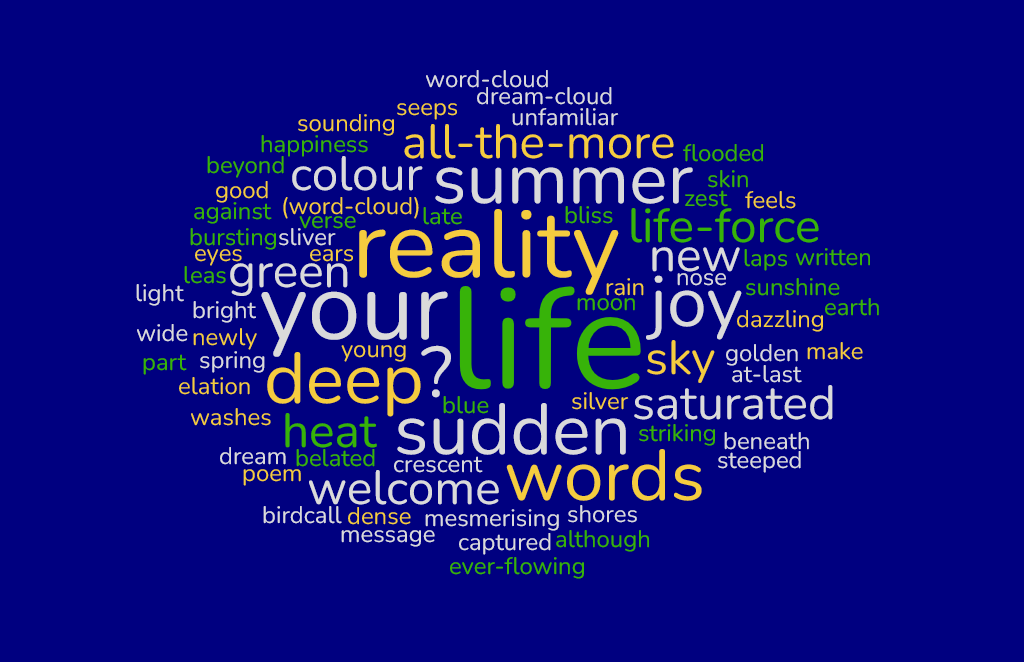
Word cloud of the poem Sudden Summer (colours edited but randomly allocated).
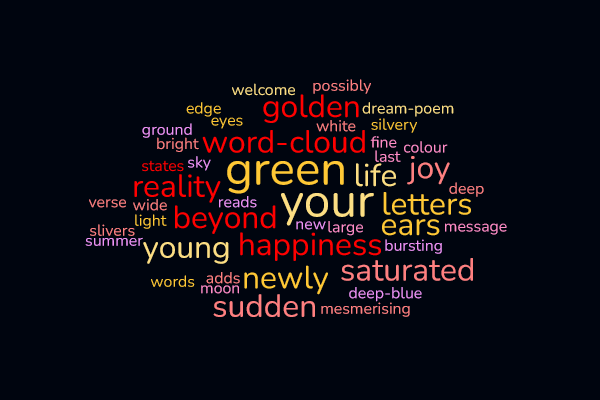
Happiness Beyond (Word Cloud)
Your life is a green reality, it reads in large green letters, and newly young; the sky is golden at last, it states in fine golden letters, and saturated with joy; eyes and ears are bursting with wide bright light, it adds in silvery white; and at the edge there is happiness beyond colour on deep-blue ground.
These are welcome words, sudden and possibly deep, a mesmerising message from slivers of verse in your ears, from the new dream poem, from the word cloud of Sudden summer: Your life is a green reality saturated with joy under the newly young moon.
One poem has a person with dark hair and a person with fair hair falling in love at first sight. In German, the words for ‘junction’ and ‘to cross’ come from the same root: ‘Kreuzung’ and ‘kreuzen’.
The other poem describes a beautiful beloved man (or, by changing one word, a woman) with greying hair. The stars write the lover’s delight onto the sky, and the beloved one’s soul shines like a star.
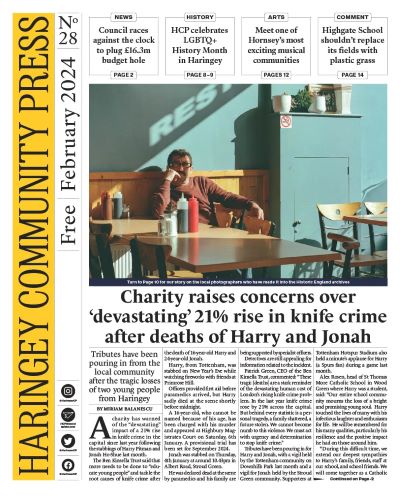
This poem is also published in a local paper today, in print and online: Haringey Community Press, February 2024(circulation 15,000).
The title is taken from Ingeborg Bachmann’s poem Reklame (1956), where she coins the word “Traumwäscherei” (dream laundry, laundry of dreams or through dreams?). The omnipresent publicity and cheerful music soothe your worries and questions – until they stop and leave you in “Totenstille” (deadly silence, or silence of the dead?).
The idea of downloading memories and dreams comes from science-fiction such as Ridley Scott’s movie Blade Runner (1982), M. T. Anderson’s novel Feed (2002), and Kazuo Ishiguro’s novel Klara and the Sun (2021). All three are superb and thoroughly disquieting.
The line “boots on the beach” comes from a particularly stupid – and sexist – video advertising hard drink by showing a young woman in a very scanty dress and very heavy boots. It played on a loop on several screens in a railway station so that there was no escape from it.
The line “music on the pillow” is inspired by Ray Bradbury’s novel Fahrenheit 451 (1953), where he predicts ceaseless entertainment broadcast onto our walls, even inviting participation, and into our ears, continuing into our sleep. The result is isolation and despair.
Afar, I’ve seen the keen and tranquil green
of crater lakes, like mirrors of my dream…
And now I turn to look into your eyes
and find the same mysterious silver gleam
and realise my dream’s materialised.
Love happens, blossoms, thrives – and never dies.


 Christina Egan