rosengarten (I. tiefversteckt)

rosengarten

I. tiefversteckt

wieviele monde sind uns noch beschieden
die ungeahnten sonnenglanz vergießen
wieviele rosen werden uns noch sprießen
aus blut und duft als wäre leben lieben?
wieviele strände dürfen wir genießen
im wilden norden und im kargen süden
wo winde endlos sich mit wellen wiegen
wieviele sommer sind uns noch geblieben?
du bist der tiefversteckte rosengarten
den ich nach langem suchen langem warten
betrübt doch immer hoffnungsvoll betrat.
du bist der mond der gleich der sonne leuchtet
du bist die brandung die den sand befeuchtet
du bist die erde wie am ersten tag.

Christina Egan ©2023

This sonnet forms the basis of a cycle of 14 poems, whereby each line furnishes the first line of a new sonnet (Continental pattern). Watch this space for the rose garden project (ROSENGARTEN).

This cycle is not about gardens alone or about islands, although many far-flung places will be reflected in these lines: it is about finding love and happiness, going through life together, finding liveable spaces…
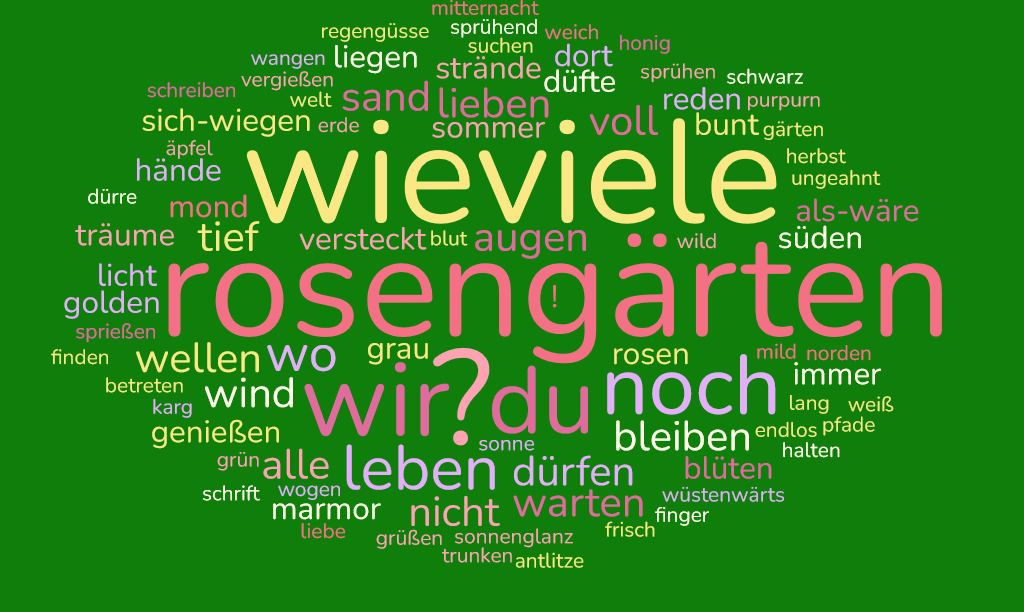
Word cloud in reddish and yellowish colours on green; in the middle, "how many" "rose gardens", and a question mark.

Word cloud of ten German sonnets (rosengarten I-X),
generated on the Simple Word Cloud Generator.
In the chance arrangement, words picked out
by size and colour form the sentence:
“how many rose gardens where we,
(O) you, may yet live?”

P.S.:
You can now view a word cloud of all 14 sonnets at WordItOut
and have it printed on a mousemat or mug or fridge magnet!
frau (außen und innen)

frau

außen und
innen
ganz
frau

lebe ich
rund
träume ich
dunkel und
bunt
denke ich
durchdringend

ruhe ich
in mir
rufe ich
mein du
runde ich mich
um mein kind

gebäre ich
mein gedicht
berge ich
mein gebet

auch mein gesicht
ist lehm und
licht
ist ebenbild

Christina Egan © 1990

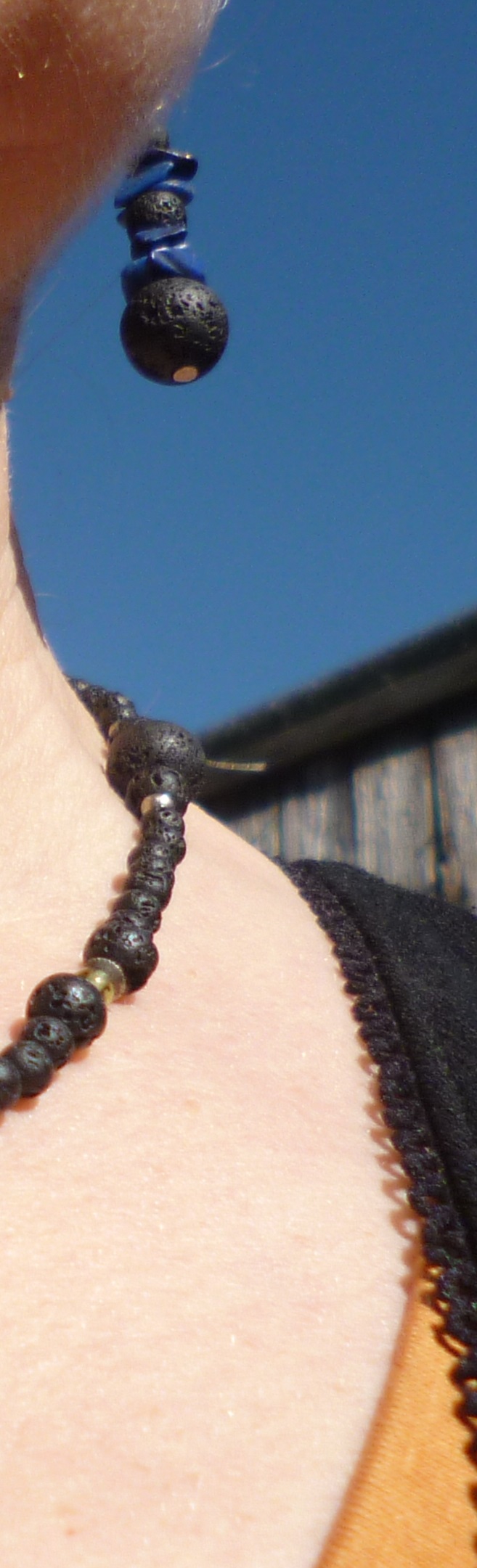
Detail of woman, with her body, clothes, and jewellery describing curves.


My early vision of my identity as a woman holds: centred around marriage and motherhood as well as thought and art, different from a man but absolutely equal — created from the same clay, not from a rib, and from the same spirit!

The central image is the round shape: this person is somehow round, gentle; she is rounded, balanced; bending herself around other things and other people in a natural impulse. Only her thoughts can be straight and piercing!


Jewellery from Lanzarote, made of lava, olivine, lapis lazuli. Photograph: Christina Egan © 2017.

Ursprung

Ursprung

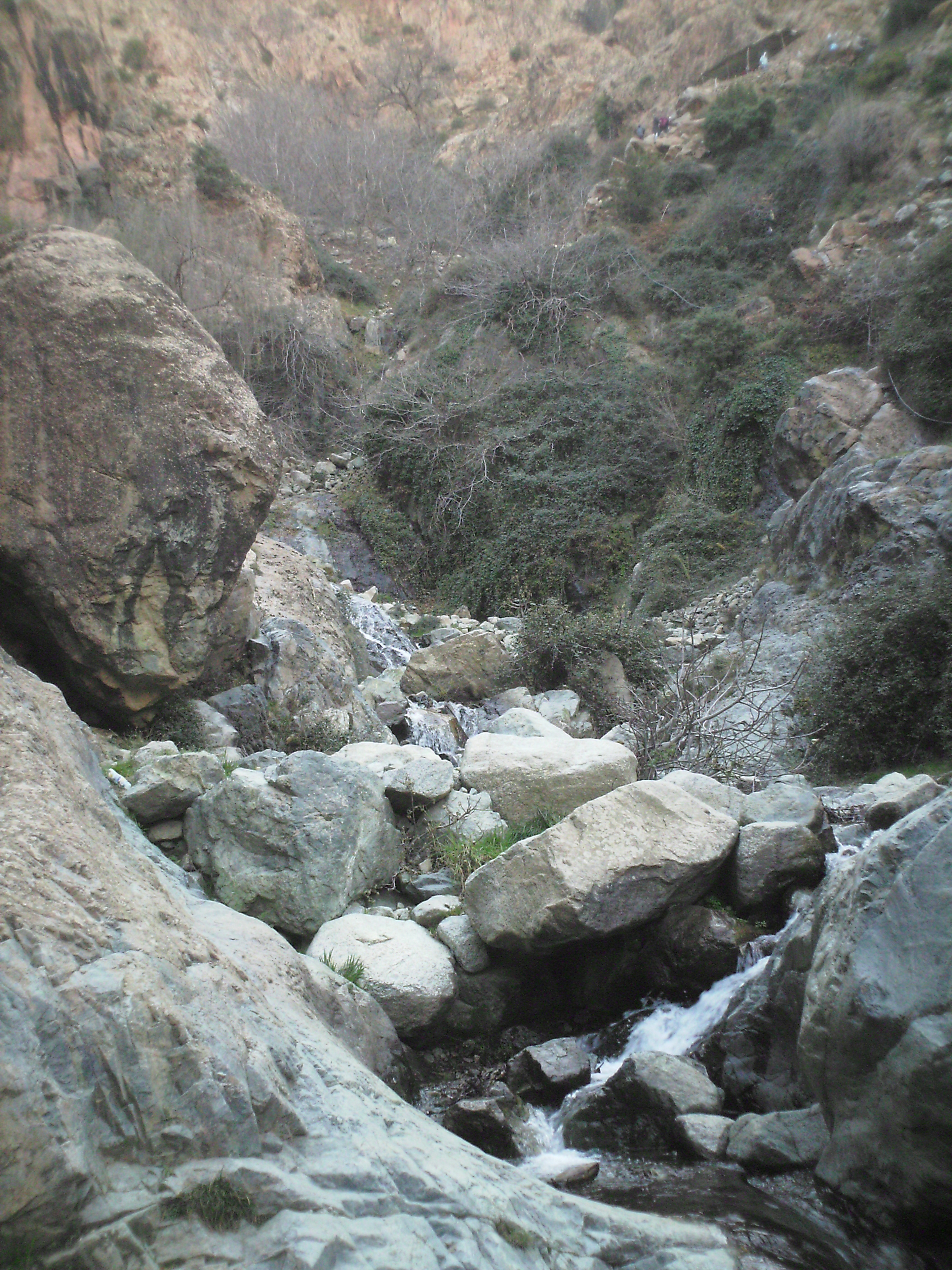
Narrow gorge with stream skipping around boulders and some vegetation on the rocks.Aus dem Felsen springt die Quelle:
So die Schöpfung aus dem Nichts.
Und sie strömet Well’ auf Welle
aufs Geheiß des Herrn des Lichts.

Und sie funkelt, und sie dunkelt,
und sie sprudelt fort und fort;
und sie murmelt, und sie rufet,
da geschaffen durch das Wort.

Und sie schäumet, und sie strebet,
spiegelt, springt empor zum Licht;
denn sie sucht den Herrn des Lebens
Angesicht zu Angesicht.

Christina Egan © 2016


This poem or hymn may work quite well in a translation software.

The text is based on the Jewish-Christian myth of creation: Out of nothingness (or chaos), God called everything into being (and order). Light was the first thing made, and it was all done through the word.

There is also a concept in Christian philosophy that God continues creating the world every moment; if he ever ceased, everything would tumble back into nothing. These ideas are really the opposite of nihilism.

Other thoughts from the Letters of the Apostles (at the end of the Christian part of the Bible) are that the whole of creation is striving and struggling towards God as if in labour; and that at the end of time, we shall emerge from darkness to see God ‘face to face’.

The title, ‘Origin’, means ‘first source’ in German; you can see the word ‘spring’ in it. Yet, I added the title in the end; the image and first lines stood clearly in my mind on waking up: the source springing from the rock, like the world out of nothingness, or life out of lifelessness.

A thought about a person stepping out from a building into the sunshine as if liberating himself or herself from a rockface can be found at Gelbes Licht, with a statue by Michelangelo that must have inspired it.

Photograph: Atlas Mountains, Morocco. Christina Egan © 2012.

psalm für dich / The Charm

psalm für dich

ein schwebender lebender planet
ist dein auge
ein schimmernder sternennebel
dein haar

manche menschen drehen sich nach dir um
und auch manche engel
Gott hat dich erfunden
um sich zu erfreuen

Christina Egan © 2012


This poem has just been published in the Münsterschwarzacher Bildkalender 2017.

The person described may be someone the speaker is in love with or someone else, like a young child. Ultimately, it could be each one of us. I imagine that God feels as passionately about each human being as we feel only about very few others… and of course, still never as passionately.


The Charm

I want to rest my stormy eyes
in yours to find a moment’s calm;
I want to rest my wounded hands
in yours to find their strongest balm.

I need to lay my heart by yours,
which cast this fast and forceful charm,
I need to hear your heart tune in
to sing a brief and burning psalm.

Christina Egan © 2003