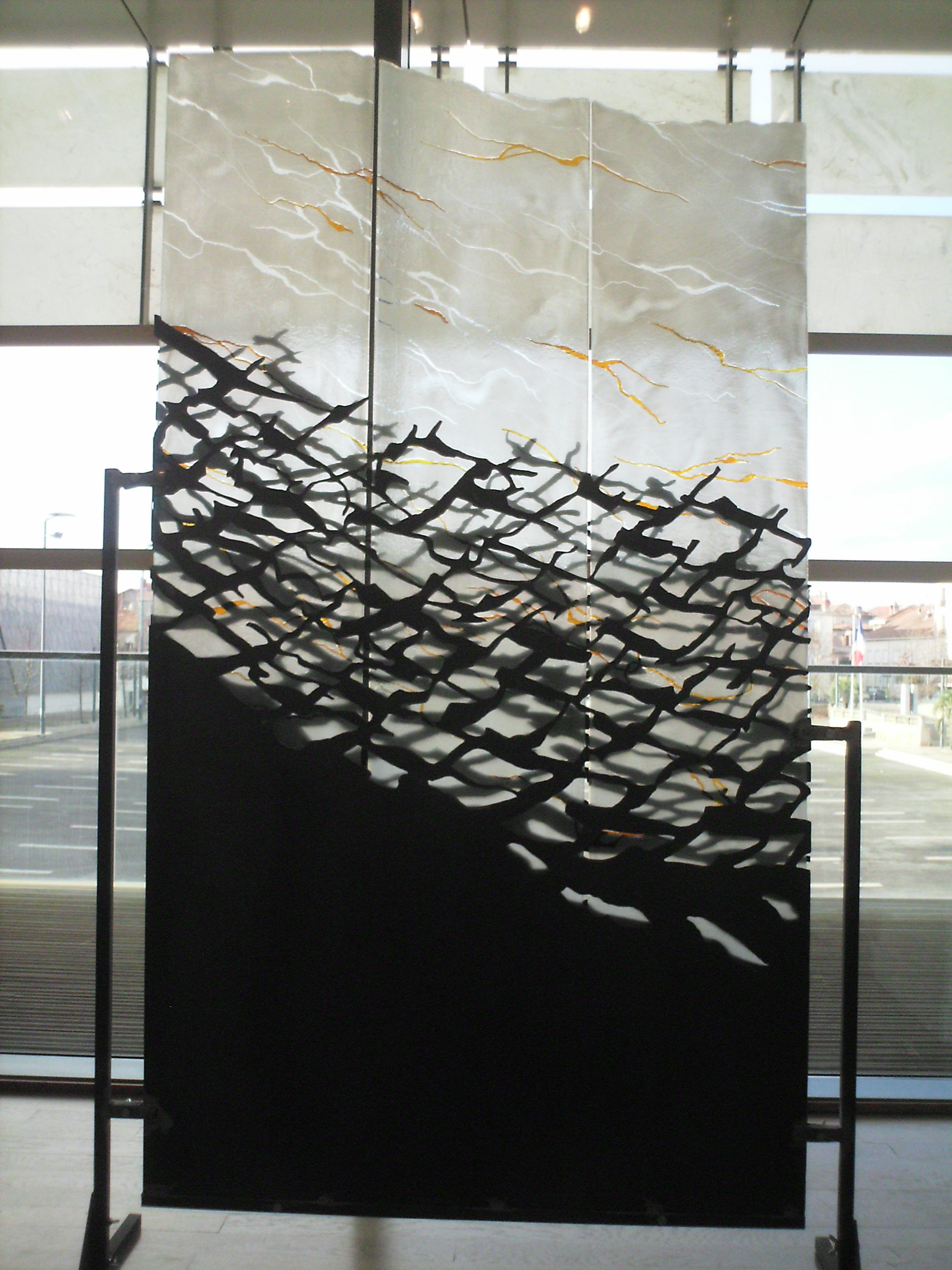
Arles im Winter

Arles im Winter

Die Fensterläden wie ein Farbenkasten,
kornblumenblau und flieder und türkis;
die goldnen Wände, die im Wind verblaßten,
die Gasse, die den kurzen Schnee verschlief.

Die Bogengänge wie bestickte Bänder,
die Krippenbilder wie ein Glockenspiel…
Und das Theater wechselnder Gewänder,
wo nie – seit Rom – der letzte Vorhang fiel.

Die weiche Luft am weiten Strom von Norden,
wo beißendkalter Wind bis eben blies,–
er wälzt sich meerwärts, kostet wohl schon morgen
Kornblumenblau und Flieder und Türkis!

Christina Egan © 2016
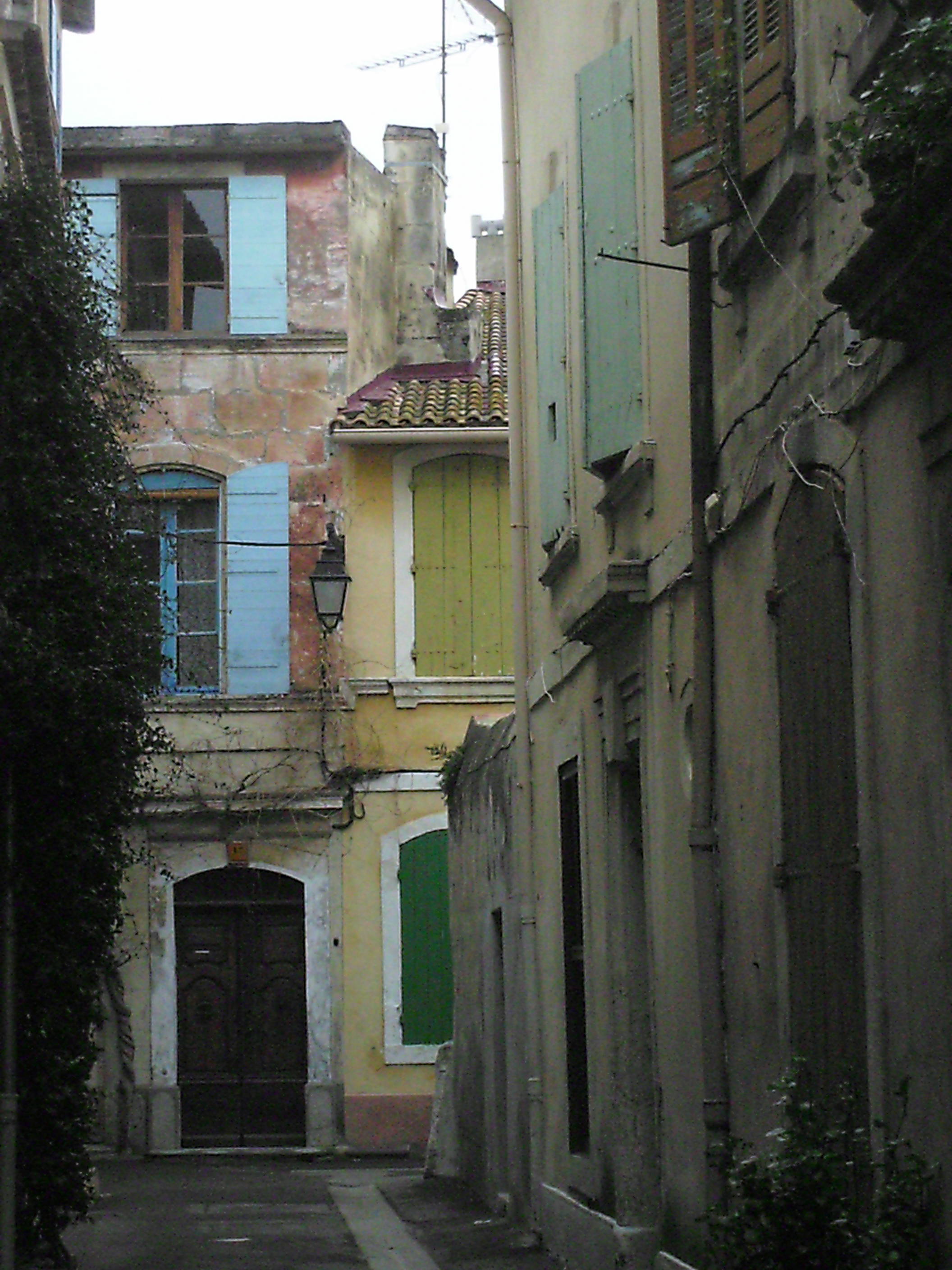
Lane with old houses, window shutters in various shades of turquoise and green.The Old Town of Arles is huddled together within the precincts of the Roman city, next to the vast River Rhône  and close to its mouth into the Mediterranean Sea – with the churches built of the stones of the temples and the houses built with the stones of the theatre.

Down the funnel of the river valley, there is a forceful and often icy wind, the Mistral; but there is also a mild wind from south, the Wind from the Sea, which may warm up the city in the midst of winter, so that you can sit in the Roman ruins…
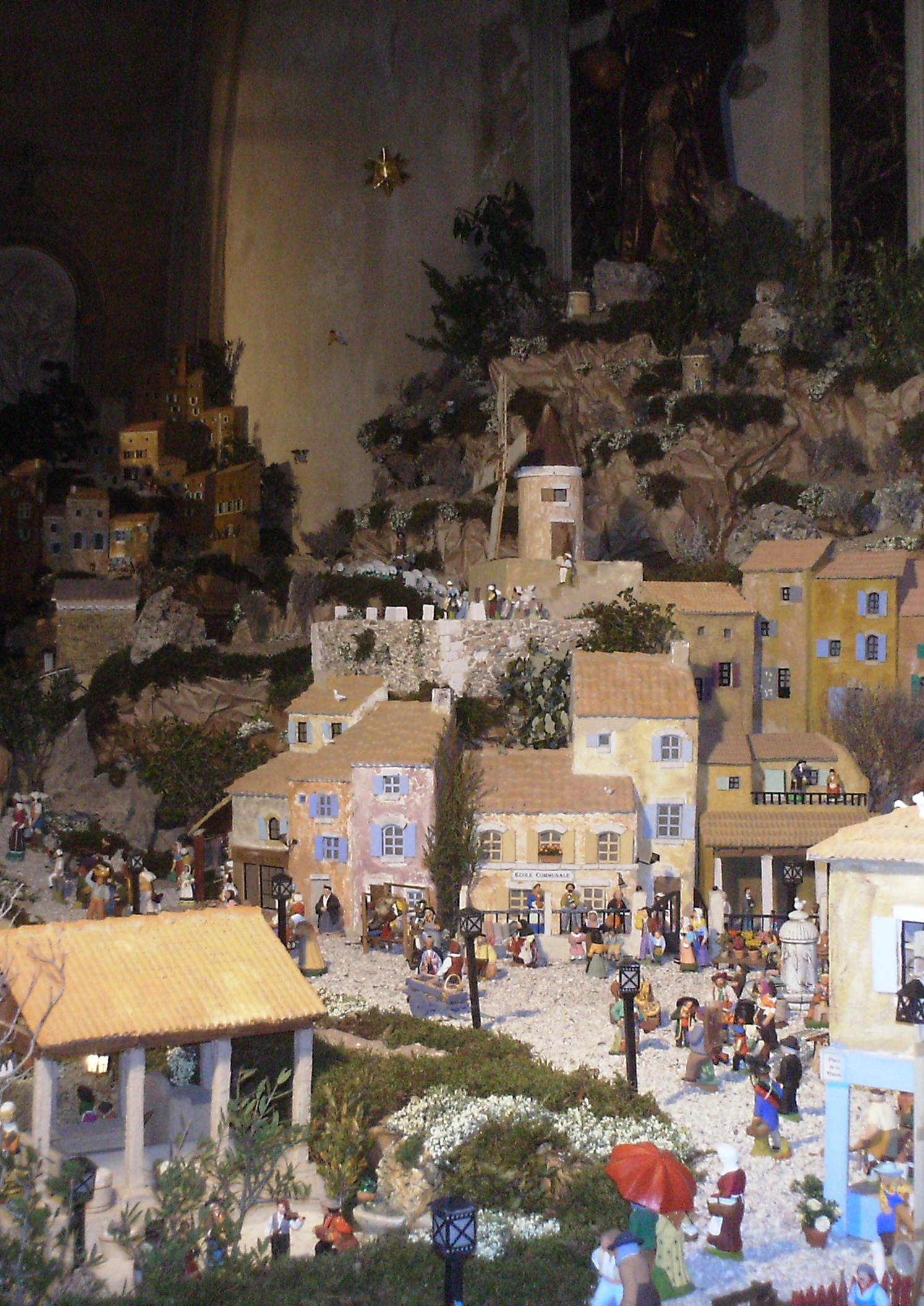
Model village on steep hills as backdrop to a nativity scene

There are exhibitions of nativity scenes and figurines in all styles, even contemporary, at Saint-Trophime; in another mediaeval church, a whole side-chapel is filled with a model village with rocks and trees, running water and flickering fire, and hundreds of tiny local people.

I have written another poem on Arles and the Vent de la mer  in French and English. This one here may work quite well in a translation software.

Photographs: Arles. Christina Egan © 2011.
Sonett der drei Seen

Sonett der drei Seen
(São Miguel, Azoren)

Der Teich war gelb, und gelbe Dämpfe stiegen
ins heiße Blau, umringt von dunklen Ranken,
als müde Glieder sich im Gelb entspannten
mit Blättern, die wie Schlick im Strudel trieben.
Der See war grün, und grüne Schimmer hingen
in steilen Hängen und in flachen Tiefen,
worunter ungeheure Feuer schliefen,–
zur rechten grün und himmelblau zur linken.
Und um die gelben, grünen, blauen Kessel
und buntbestickten Ufer lief ein Band
von schwarzen Felsen und von schwarzem Sand;
und darum – ohne Grenze, ohne Fessel
und ohne Form – das Meer, das Element…
O selig, wer die sanften Inseln kennt!

Christina Egan © 2016

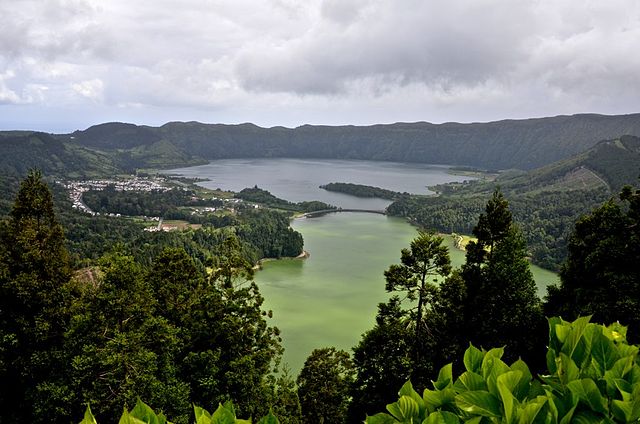
Sete_cidades_(14267780070)


Sete Cidades, (São Miguel, Azores). Photograph by Aires Almeida from Portimão, Portugal, via Wikimedia Commons.


The colours of the water are really like in the photo! See also my verse Acherons Mund  for the darker aspects of these isles.

These poems may work in a translation software, although you only get the meaning, not the sounds, which are like music and like the sounds of nature itself!

Berlin Zoo Station

Berlin Zoo Station

I.

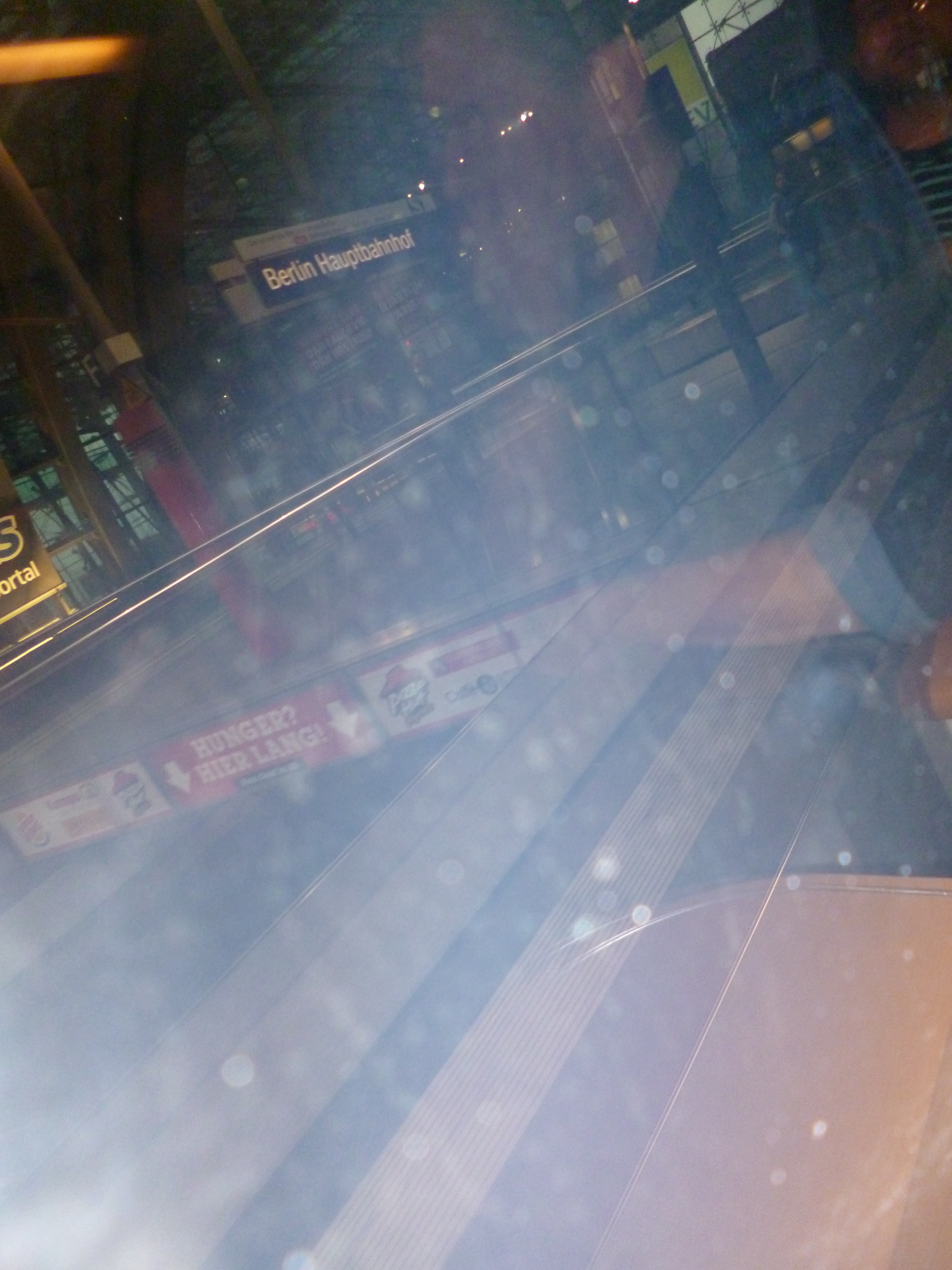
Blurred impression of large railway station through train window.Building sites, cordons,
corridors, concourses,
people whizzing, weaving,
people sauntering, skipping,
dragging luggage along, around,
trains shooting in and out,
shuttles on a loom.

Faces, faces like packs of cards,
shuffled, shuttled across the city,
voices, voices from all the winds,
into all the winds, and everyone
means something to someone,
everyone means something,
means everything.


II.

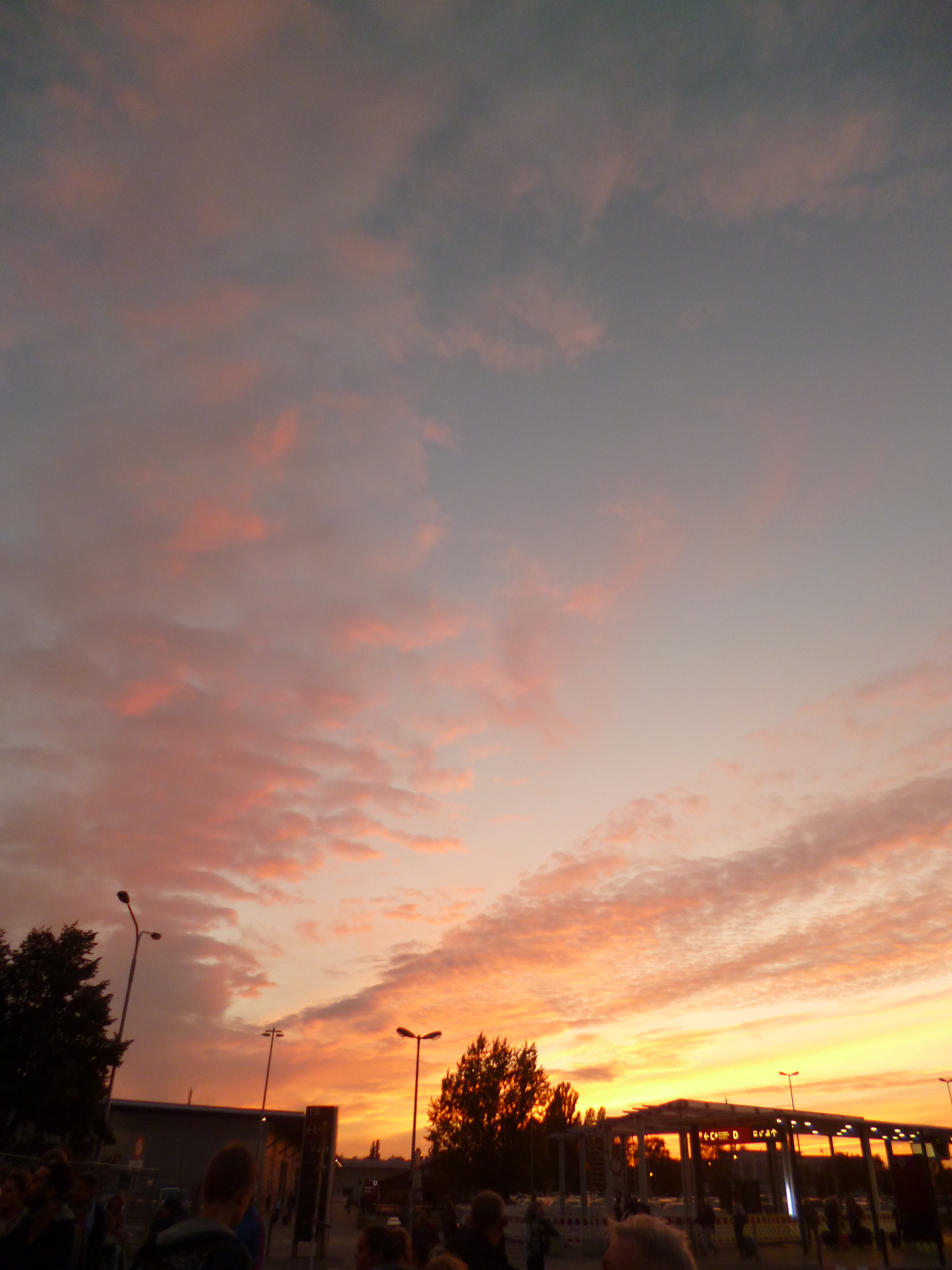
Cloud strips, golden and pink, above a dark crowded square at the very bottom.

Trains bridging borders,
the square, sun, people,
people, specks of colour
propelled past me,
their shades brushing me,
their warmth, breath,
so near, here, now.

Life, life, yes, yet
nothing but
the first faint dawn
of a future with no night,
no barriers, boundaries:
destination without distance,
one web of light.

Christina Egan © 2016 (I) / 1999 (II)

Photographs: Railway station and airport in Berlin. Christina Egan ©  2016.

Oktoberbilder

Oktoberbilder

I.

Die weiche Luft wie weißes Brot…
Das erste volle Herbstesrot
hängt überm frischgetränkten Gras.
Die Sonne bleibt durch Dunst versperrt,
doch Astern sprühn ihr Feuerwerk,
und Rosen quellen ohne Maß –
O erdgeborne Sternenpracht,
die uns am hellen Tage lacht,
o buntes Bild auf grauem Glas!

II.

Der Himmel ist mit Blau behaucht,
die Gärten neu in Gold getaucht,
mit Gelb getränkt schon manches Laub;
und selbst das Blatt, das sterbend schwebt,
ist kupferrot wie frischerregt.
Noch einmal kost das Licht die Haut…
Das Windrad saust, die Wolke fliegt,
ein weißer Blütenball zerstiebt –
Zuletzt wird jedes Ding zu Staub.

Christina Egan © 2015

This poem has meanwhile been published in the Rhönkalender 2017.

Ein Muster aus Muscheln / Greek Islands

Ein Muster aus Muscheln

Ein Muster aus Muscheln und Bernstein und Bein,
mit Karneol und Koralle durchsetzt,
auf lapislazuliblauem Grund:
So leuchten die Inseln im Sonnenschein,
vor dreitausend Jahren… und letzthin… und jetzt:
ein Mosaik, ein vollendeter Fund.

Vors Fenster des sinkenden Flugzeugs gespannt,
vom Guckloch des finsteren Turmes gerahmt
– nur einen Moment – nur einen Moment –
das Muster aufs wartende Auge gebannt,
die Farben ins wache Gedächtnis gemalt:
ein Bild, das nach dreißig Jahren noch brennt.

Christina Egan © 2016

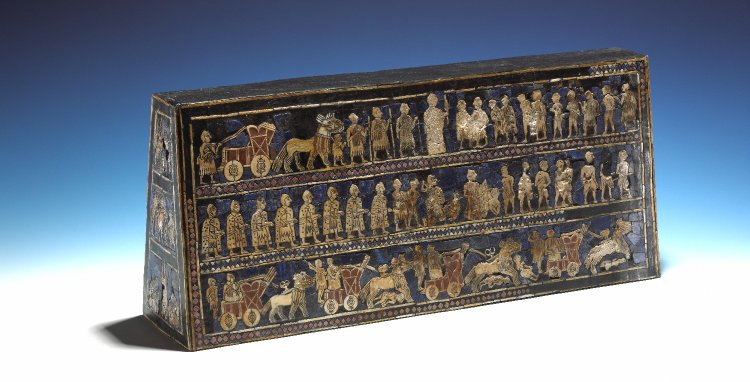
Standard_of_Ur_BM_121201

Standard of Ur (2500 BC). – Photograph© The Trustees of the British Museum.

I am showing this ancient object – twice as old as our classical antiquity – because it must have inspired my poem about Greece. The images on the box are made of shell, lapis lazuli, and red limestone, but I did not remember those details or  even think of the thing. When you have the chance to go to London, do not miss out on the Sumerian galleries of the British Museum!

The longing for a return to Greece, both for the Mediterranean environment and for the ancient civilisation, is also expressed in On Eating Olives / Beim Olivenessen  and in Greek Islands  (below). There are a number of poems about Crete in German and English on this website.


Greek Islands

There is more blue in the air
between here and the horizon,
between morning and evening,
than the cup of the eye can hold.

So my soul may flow over
into the sky,
into the sea,
into this scattered paradise…

Christina Egan © 2012 


On the topic of the blue Mediterranean Sea, see also Meine blaue Mauer  and O Heimatland aus Stein und Licht. On the manifold colours of the same sea, see The Purple Sea / Das lila Meer.

Die Fluten der Stadt

Die Fluten der Stadt

I.

Vor meinem Fenster rauscht die späte Stadt
und glitzert auf im Vollmond, schwarzes Meer;
sie spült Millionen Menschen hin und her,
spielt Fangen, nimmermüd und nimmersatt.
In ihrem Brausen höre ich Willkommen
und lasse mich auf ihren Wellen treiben.
Die Sternbilder der Leuchtreklamen schreiben
sich unter meine Lider… schon zerronnen.
Und nie allein: weil ich alleine bin,
zu Haus im selben Sehnsuchtsleitmotiv
wie jeder andre aufgewühlte Sinn.
Was immer schon in meinen Gliedern schlief,
schäumt ungebärdig zu den Sternen hin:
Ich will dich, will dich wild und meerestief.

II.

Auf vielen Brücken stand ich, ausgespannt
von Stahl und Stein an Themse, Rhein und Main,
und unter allen Himmeln stets allein:
stets einem Unsichtbaren zugewandt.
Es wandeln ja mit jedem neuen Strand
die Menschen wie die Häuser ihr Gesicht,
erstehen anders schon im Morgenlicht;
und immer wieder scheint mir eins verwandt.

Die Fluten wechseln – braun, blau, grau und grün –
die Augen ebenso, die mich gebannt,

sie füllen meine Augen – und entfliehn.
Doch deine, die ich nur von ferne fand,
die kaum mich streiften, seh ich weitersprühn…
Und ihre Farbe hab ich nie gekannt.

Christina Egan © 1995 / 1996

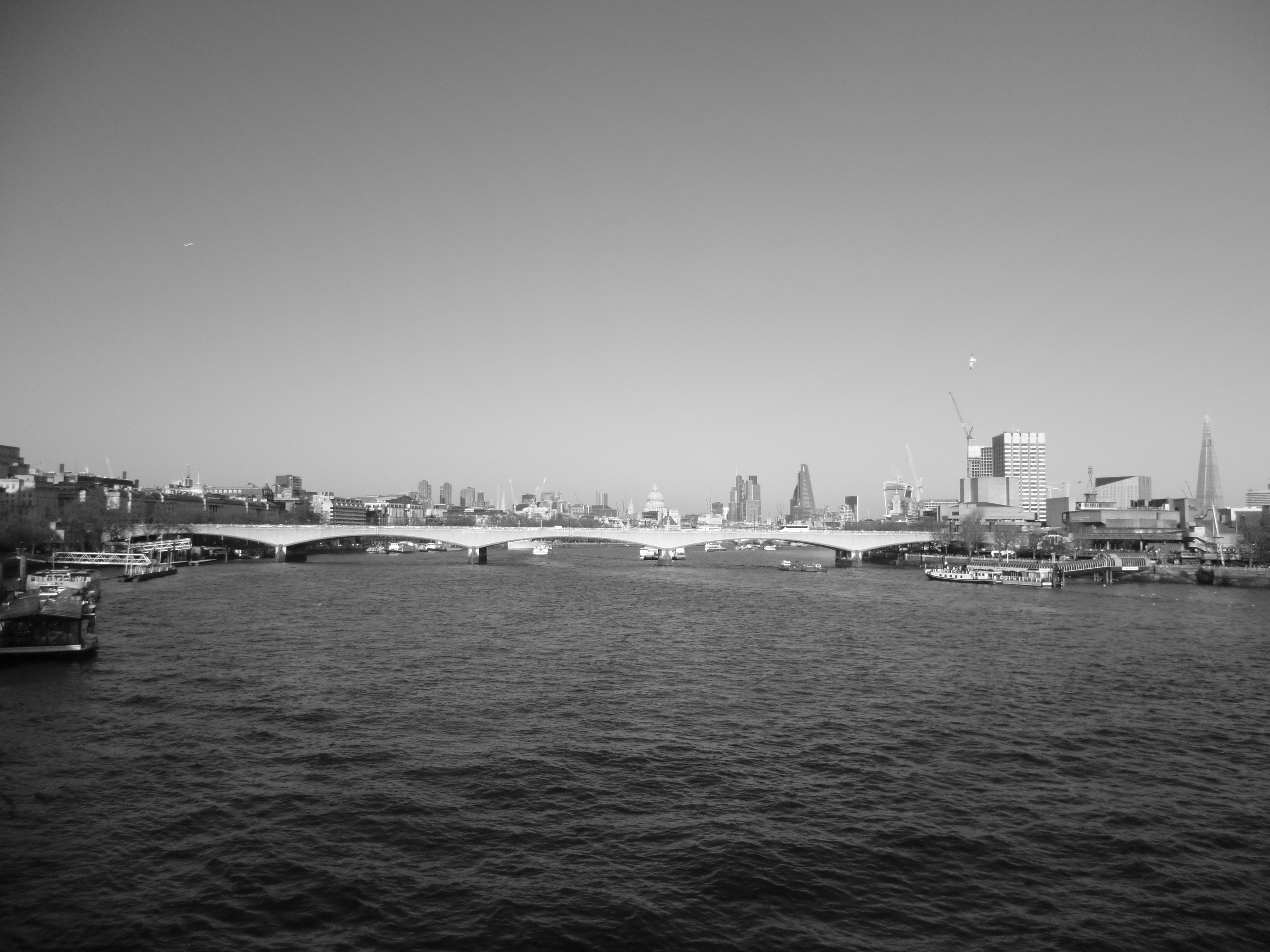
Black and white panorama of London skyline from a Thames bridge, with another bridge, boats, skyscrapers, St Paul's.

London. Photograph: Christina Egan © 2014


The narrator looks for love amidst the masses of the big city by the big river, where the star constellations consist of neon advertisements. She or he adores someone whom she has only seen from afar so that she does not even know the colour of his or her eyes.

Each sonnet makes a paradoxical statement about loneliness: This person is never lonely because many other people in this city share her loneliness; and she is always lonely because she is in the presence of a beloved one who is absent.

dans le verre / Mother-of-Pearl

dans le verre

Glass screen with patterns in black, white and gold, resembling surf and seagulls.les couleurs de la mer
sont versées dans le verre
du présent du souvenir
faites-les resurgir

les couleurs de la mer
de l’argent jusqu’au vert
améthyste et saphir
laissez-les reluire

dans ce vers

Christina Egan © 2016


Mother-of-Pearl

The sea is not blue,
no more is the sky:
that is a child’s view,
a picture-book’s lie.

Whenever the rainbow
touches the sea,
it sprinkles a faint glow
of eternity.

From indigo ink,
to raspberry pink,
with peppermint green
and gold-leaf between…

The sea is not blue,
or grey of some hue:
the sea is a swirl
of mother-of-pearl!

Christina Egan © 2016


Photograph: ‘Rhizome’. Sculpture by Laurence Bourgeois (Lô).
Verse pattern of French poem after Jean-Yves Léopold (J. Y. L.).

The Dittany of Crete

The Dittany of Crete

I’ve found the place where red and blue,
where earth and sea and sky all meet;
I’ve even climbed the ashen rock
to pick the dittany of Crete:

to weave a spell about your eyes,
to wake your smiling silent mouth,
to share with you the flaming light
and heavy flavours of the south.

Christina Egan © 2012

Hanging oblong flowers in bright green with bright pink.


The ‘dittany of Crete’ is a rare wild plant, gathered as a flavouring, medicine, aphrodisiac, or love token. I tried it on Crete in a delicious and wholesome tea!

The red colour in the poem could be the pink and orange surf in the sunset, or the pink and orange beaches of Crete. The sea might be bright blue and then again bright green

Origanum dictamnus.
Photograph:
HelenaH via Wikimedia.

Word Weaver

Word Weaver

More purple clouds than I can count
or weigh or paint for you
or snatch and send them underground
with some surrounding blue…

To one whose windows do not stretch
to spy the heaving sky,
I’ll weave my syllables to fetch
the purple passing by.

To one whose dusk and marble moon
are filtered through a rail,
I must thread silver on my loom
to leave a shiny trail.

I must request the best black silk
to mark the balmy dark…
By day I’ll stitch a roaring quilt
to catch the city’s heart!

Christina Egan © 2016

Drawing of the mechanics of a loom (yarn on rolls, without the frame)The poet describes the world to a prisoner who can barely see the majestic ever-changing sky and the bright busy city surrounding them. The sound and rhythm of the lines emulate the warp and weft of life, so that the words reflect the world — read the poem aloud and you will see!

The other person may be imprisoned by a totalitarian state or indeed by a democratic state, or locked up by their employers or indeed their own family, behind walls and perhaps under a garment. There are many millions of human beings who de facto are prisoners or slaves without being called so.

For poems about time (for instance ensuing generations) and space (for instance a big city) as a tissue, see my post Geflecht / Geflechte. All of civilisation and all of humanity is one web.

Augustfest

Augustfest

August.
Klangvolles,
sattgoldnes Wort,
beinah orangerot.

Abend.
Wort voll blauer Ruhe,
verborgener Kraft
und süßer Verheißung.

Norden.
Ein weites graues Feld
im Winter… im Sommer aber
ein ganz grüner Horizont.

Augustabend im Norden.
Ein Fest ist uns bereitet,
herrlich wie ein Hochzeitstag.
Schau dich doch um.

Christina Egan © 2016


Some more thoughts on the north of the planet… In winter all is grey, sky and land and water alike; but in summer, the world shines in blue and green and golden. This is before you look at the flowers and fruits, and the places and things whose colours show again, and the people who have come outdoors again. Winter lasts six months in Southern Europe, like in the myth of Persephone, but seven months in Central Europe and perhaps nine in Northern Europe… All the more do we enjoy the glories of summer!

This is one of many poems I wrote for my wedding anniversaries in August; I hope plenty of other people will be able to use it for their engagements, weddings, and anniversaries! The little poem I read at my wedding is simply called I Love You.