Die blauen Fernen

Die blauen Fernen

Fernab der Meere und der mächtgen Ströme
liegt meine Hügelheimat hingebreitet;
mit jeder Wendung, Steigung, die ich nehme,
wird mir der Blick auf neue Höhn geweitet.

Was braucht es Meere, wenn uns Wald und Wiesen
und Feld und Felsen und die blauen Fernen
wie Wellenberge, Wellentäler fließen,
den Schritt beflügeln und das Herz erwärmen?

Die Luft ist rein, mit Duft und Kraft geladen,
die Glieder und den Geist mir zu verjüngen;
und winters werden Schnee und Nebelschwaden
des Eismeers Zauber in die Berge bringen.

Christina Egan © 2016


One stanza of this poem is printed in the Rhönkalender 2018 with a photo from that part of the Central German Highlands; the whole poem has been published in the Münsterschwarzacher Bildkalender 2019.
Prag, golden

Prag, golden

Im Meerblau des Abends,
im Windschutz der Burg
ersteigen die steilen
sandfarbnen Stufen
zwei Schatten und flüstern
und lachen und schweigen.

Schleier, besetzt
mit zahllosen Perlen,
die Büsche im Regen;
Kelche, geblasen
aus purpurnem Glas,
die berstenden Blüten.

Landschaft von Türmen,
spiegelnde Schluchten –
Bilder in Winkeln
des unruhigen Herzens,
Erinnerung an Träume,
an Heimat der Zukunft.

Reigen von Brücken,
behütet von Engeln,
von Helden der Vorzeit.
Türmende Treppen,
hängende Gärten,
Stadt ohne Alter.

Christina Egan © 2004


 My impression may work quite well in a translation software.

If you have the opportunity to visit one city only in Europe north of the Alps, let it be Prague. It is Central Europe in a nutshell. And it is enchanted…

The Czech Republic is a lovely little country anyway, with countless hills and lakes, mediaeval castles and market squares — absurdly romantic!

By the way, two other excellent destinations in Europe, other than Mediterranean, are Tallinn (Estonia) and Bruges (Belgium).

This is the Northern Land

This is the Northern Land

This is the northern land
of loose and juicy ground
where fern and forest glow
and wheat and fruit abound.

This is the continent
where mound responds to mound
and wind resounds on rock –
this is the home we found.

This is the realm of dusk
and star-embroidered night,
of fog caressing lakes…
and then the roaring light!

Christina Egan © 2013

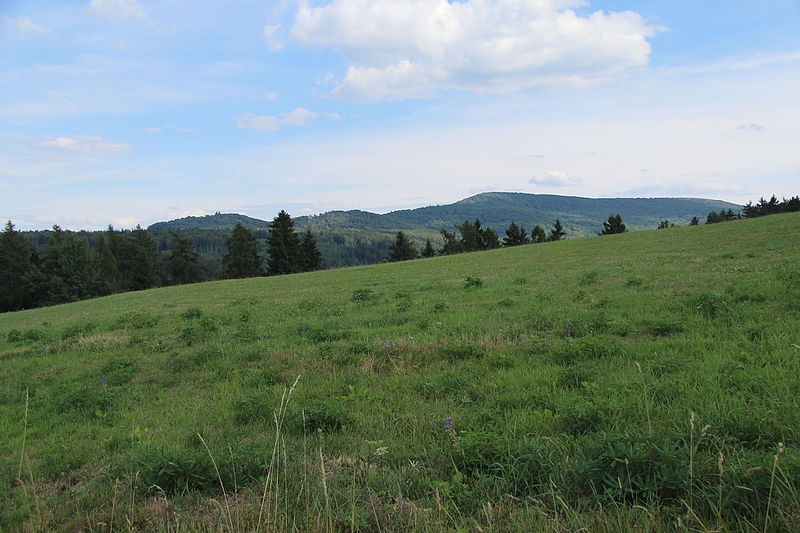
Mountain meadow filling lower half of picture, high trees right behing and mountain range in the distance along the middle, pale blue sky above.

Dammersfeld mountain ridge, Rhön (Central German Highlands).
Two of my great-grandparents grew up with precisely this view. —
Photograph
 by GerritR via Wikimedia Commons.


This poem was inspired by the Czech national anthem, Kde domov muj, which entirely refrains from politics and warfare and mainly describes the lush landscape of Central Europe. The Czech Republic abounds with hills and lakes, forests and fields.

My lines cover the whole of Central Europe or the whole continent (including the British Isles): my home is my region, or my country, or Central Europe, or all of Europe — none more so than the other.

The claim that even those who were born there ‘found’ their land may sound strange: yet their ancestors did immigrate one day, even if it was a thousand years or two thousand ago. No one just grew out of the ground. Moreover, most people are arguably of mixed ethnic origin, in our case, Celtic, Germanic, Slavic, Jewish, Hungarian, and more. No nation is an island.