Is this moon new or young, a sliver or a crescent, silver or golden in the deep blue, the newly deep sky, is it striking or dazzling or mesmerising?
Is this a late spring, belated and all the more welcome, bursting with life, with green, bright green, saturated with rain and sunshine, saturated with colour and heat, heat unfamiliar and all the more welcome, or is it sudden summer?
Is this life at last, is this joy, is this joy of life, is it zest, is it just new life-force or is it happiness or elation or bliss?
Reality, as it laps up against the shores of your eyes and your ears and your nose, reality as it washes over the leas of your skin and seeps beneath, cannot be captured in words, not even in verse: reality, so dense it feels like a dream, is not a dream cloud nor a word cloud.
Although this poem would make a good one, with the message of sudden summer sounding out like birdcall, flooded with light and colour, steeped in joy, as if words were written from life and for life, as if words were part of life, of the wide earth and the deep sky and the reality beyond, of the ever-flowing life-force.
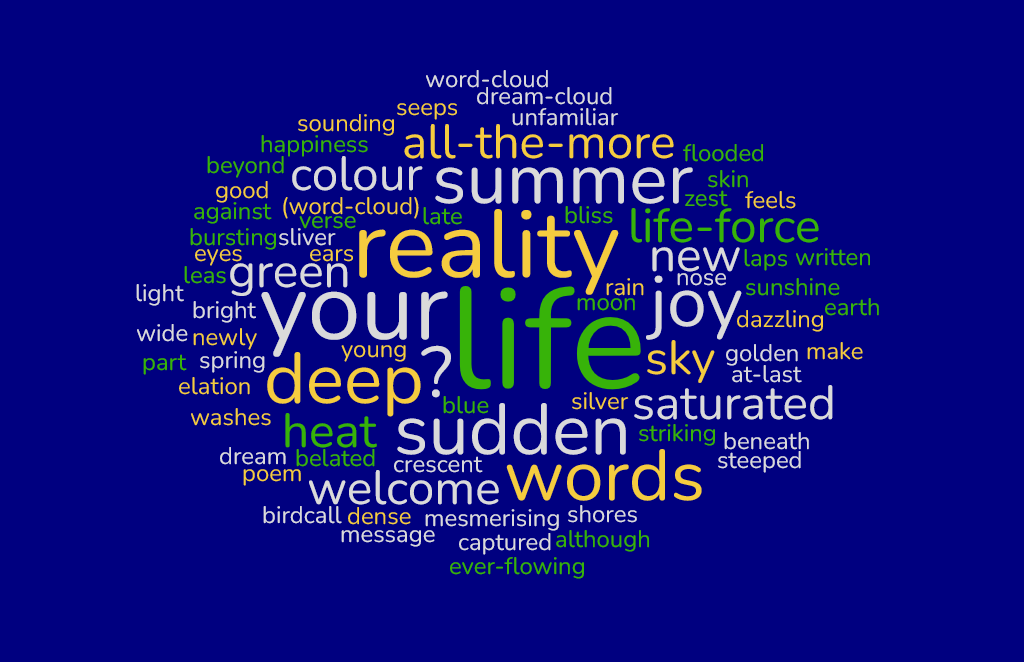
Word cloud of the poem Sudden Summer (colours edited but randomly allocated).
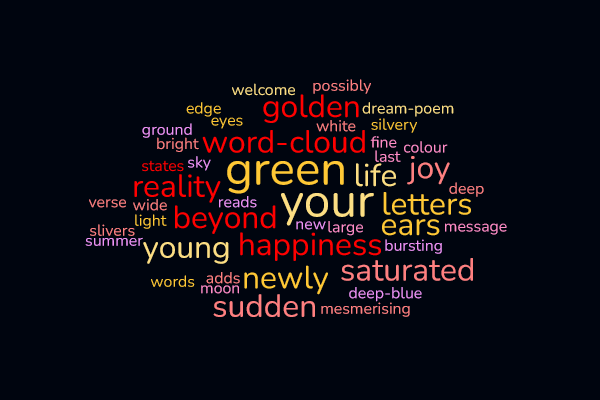
Happiness Beyond (Word Cloud)
Your life is a green reality, it reads in large green letters, and newly young; the sky is golden at last, it states in fine golden letters, and saturated with joy; eyes and ears are bursting with wide bright light, it adds in silvery white; and at the edge there is happiness beyond colour on deep-blue ground.
These are welcome words, sudden and possibly deep, a mesmerising message from slivers of verse in your ears, from the new dream poem, from the word cloud of Sudden summer: Your life is a green reality saturated with joy under the newly young moon.
One poem has a person with dark hair and a person with fair hair falling in love at first sight. In German, the words for ‘junction’ and ‘to cross’ come from the same root: ‘Kreuzung’ and ‘kreuzen’.
The other poem describes a beautiful beloved man (or, by changing one word, a woman) with greying hair. The stars write the lover’s delight onto the sky, and the beloved one’s soul shines like a star.
Raindrops on window, with flowers showing in each drop. Photograph by Kumiko Shimizu on Unsplash.
One Drop of Rain
If one still drop of rain contains a rose and if my eye encompasses your face, a secret crystal must exist that holds the sparkling galaxy in one round space.
You may wonder why I label philosophical musings “Religion” or why my poems on “Religion” do not refer more to a certain creed. Yet for me personally, there is no philosophy without religion. God is present everywhere, whether we feel it or not, and our life is a search for God, whether we know it or not.
As regards Christianity, my poetry is very much inspired by the Scriptures, the hymns, the liturgy, the imagery. I probably owe more to Martin Luther than to any other writer. All German speakers do. It also seems to me that in this secular society, I would most put people off by mentioning that I am a Catholic.
I am writing on the wall in lurid colours painting mouthless faces naming faceless fears the hydra of the mutating germ the wheel of the rotating power filling the space by the street with the sunflower yellow of hope one day it will be overwritten by times to come and poets to come
The poem speaking through a mask was inspired by photographs in the Tottenham Community Press and published by the same newspaper in TCP Issue 43, February 2021. It continues as the Haringey Community Press.
Tottenham is full of art in in very bright colours: graffiti on walls, mosaics on houses, paintings on roll-shutters of shops…
The fear expressed in these lines is of the malicious pandemic as well as of total surveillance. The masks gave us a chance to protect us from both to an extent.
I had great hopes that the pandemic would change our society to become more local, sustainable, authentic, co-operative, considerate… more healthy in every respect.
Sadly, only some positive outcomes have persisted against the pressure of ever more exploitation, exhaustion, pollution, production, consumption, and waste.
Image: Red camera eye of HAL 9000 (from ‘2001: A Space Odyssey’). Julian Mendez, CC BY-SA 3.0, via Wikimedia Commons.
Im Dämmer schwebt der neugeborne Mond, ein unhörbares Gutenachtgeläute. Die Amsel, die auf der Antenne thront, ruft sternenklar… Mein Herz zerspringt vor Freude.
II.
Pflücken
Und immer wieder Amsel, Mond und Rose, und immer wieder Wehmut und Entzücken… Und unterm Abendstern das grenzenlose Verlangen, diesen Augenblick zu pflücken.
III.
Xylophon
Ich brauche nichts als diese Vorstadtstraße, den Blattgoldhimmel und den Vogelruf,– und dann das klare Xylophon der Sprache, die Hunderte verklärter Verse schuf.
die ungeahnten sonnenglanz vergießen die regenschauer und den regenbogen zu einem milden meeresgrau verwoben die augen sollen meine verse grüßen. dem nebelland das immerkalte wogen in ungestümem reigentanz umschließen den inseln voller sprühendgrüner wiesen sind jene augen ursprünglich enthoben. drum frag ich nicht nach lilien und lavendel die flammen sprühen auf gebeugtem stengel noch nach des südens uferlosem blau nichts brauche ich als meinen kleinen garten wo alle wunder lächelnd meiner warten die bunte welt geballt in sprühendgrau.
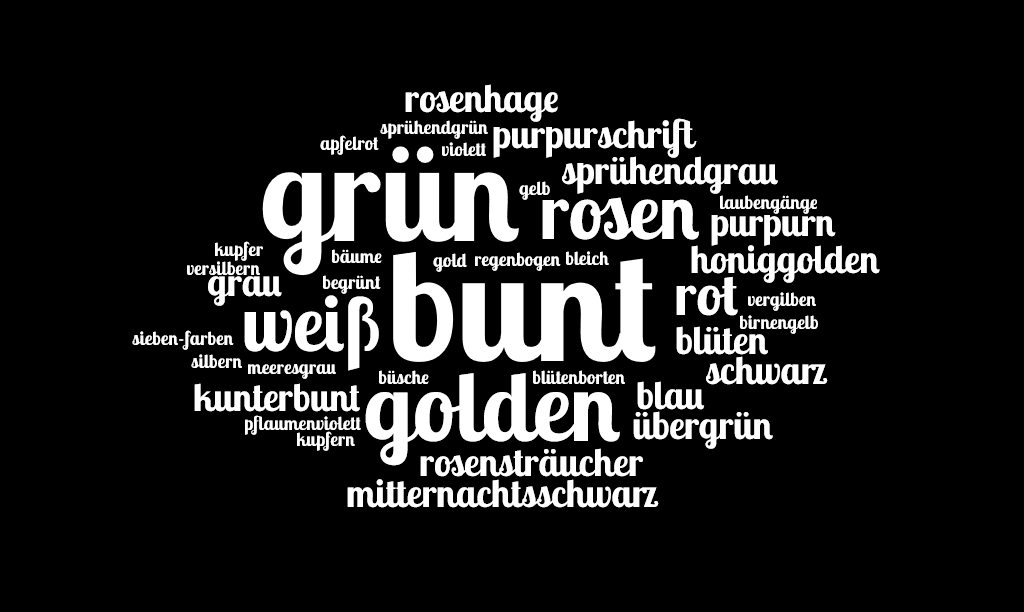
This sonnet is part of a cycle of 14 poems, whereby each line of the first one (rosengarten I. tiefversteckt) furnishes the first line of a new sonnet.
The island described here is Ireland, but the cycle takes you to other islands, as well as to the palace gardens of Würzburg, Germany, which first inspired me.
Word cloud of colours in the German sonnet cycle (rosengarten I-XIV), generated on theSimple Word Cloud Generator. In the middle are “colourful”, “green”, and “golden”. Since the colours of the roses are not described, the roses themselves are added.



 Christina Egan
