Au milieu de la vie

Au milieu de la vie

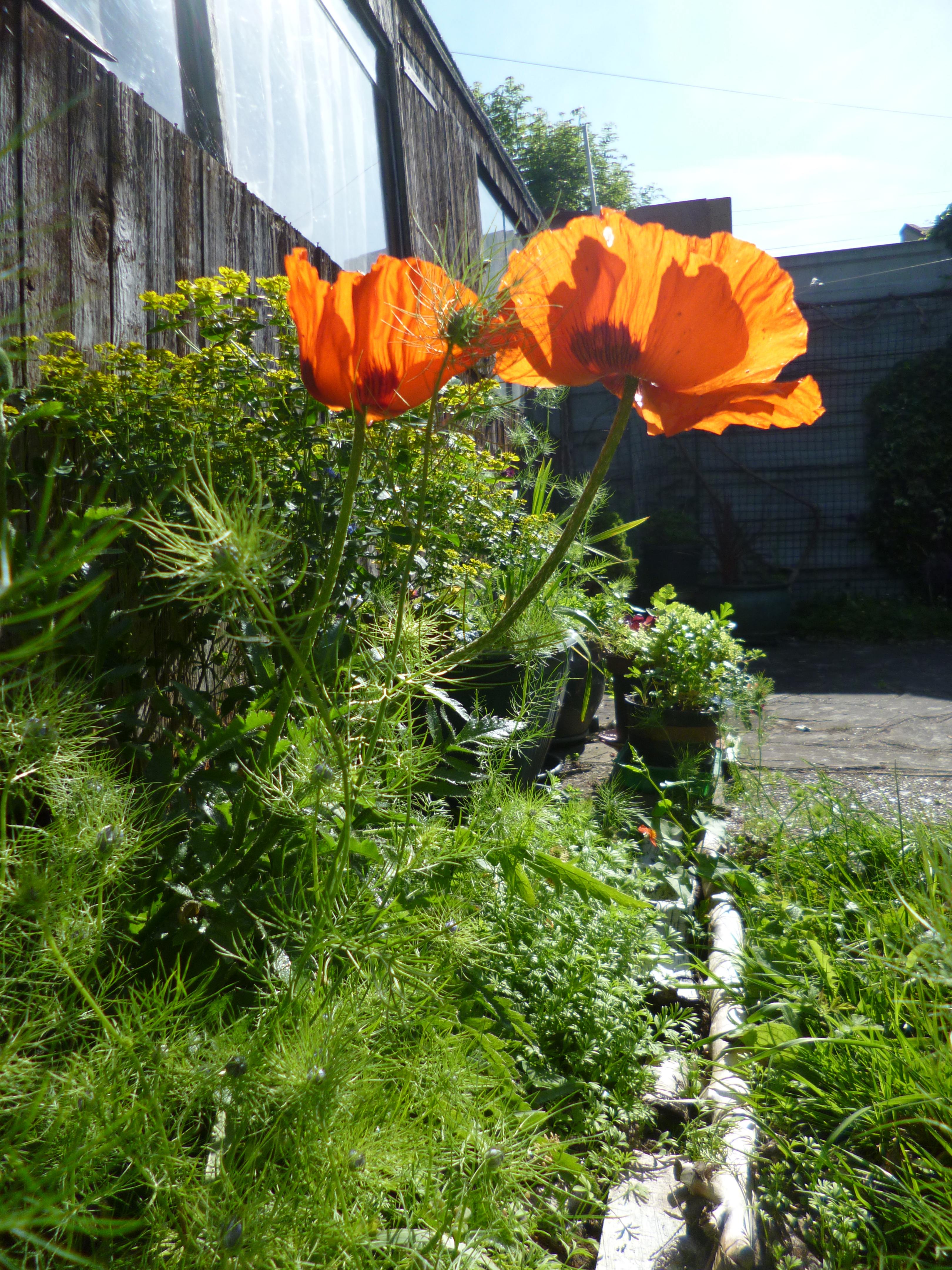
Two large poppies almost touching, looking like goblets filled with sunlight.On s’est trouvé en Messidor,
toujours en pleine jeunesse;
on s’épousé sous chutes d’or
avec une folle tendresse;

on a franchi brouillard, chaleur,
tempête et sécheresse.

On est toujours en Fervidor,
en pleine abondance,
comme s’il y avait de l’avenir,
toujours rempli de chances…
On entrera le Fructidor
toujours en pleine danse!

Christina Egan © 2013


This poem uses the terms of the French Revolutionary Calendar, which were created by a poet; the names of the summer months evoke heat and harvest.

The couple have met in the midsummer of their lives, got married a little later, and are now going through late summer — still dancing!

Not only according to numbers are they “in the middle of life”: they are in the midst of things, and they live more intensely than in their youth.

Photograph: Christina Egan © 2017.

The Mooness Grows / Die Mondin rollt

The Mooness Grows

The Mooness grows: she’s almost round.
She steps out of a wooded mound.
She knows:
The sea will swell, the sap will well,
a thousand creatures will give birth.
The earth
is restless, waiting for Queen Moon
and for King Sun to round her girth,
her life.
The fruit is red, the fruit is ripe.
The Mooness strews her silent spell:
She glows.

Christina Egan © 2016


Die Mondin rollt

Die Mondin rollt, ein Bronzegong,
vom vielgezackten Horizont
das königsblaue Rund empor.
Ihr hoheitsvoller Ruf erschallt,
bis alles bebend widerhallt
in Stein und Blatt, in Bein und Ohr.

Noch einmal steigt, noch einmal loht
nach Mittagsglut und Abendrot
des vollen Sommers Vollmondschein.
Der Bronzegong um Mitternacht
hat neues Leben angefacht
in Ohr und Bein, in Blatt und Stein.

Christina Egan © 2016


These two poems about the ‘Mooness’ are very similar (and written at the same time) but not translations of each other.

In Greek and Latin, the moon is linguistically and mythologically female, and we should have such a word in English and German.

As a woman, I feel instinctively related to the powerful moon and all life cycles — irrespective of reproductive capacity or activity.

Diet of Dreams

Diet of Dreams

My lodgings are perched at the seams
where a canvas of cloud islands leans.
All my life I have nibbled on air,
on a breeze, on a bird chirp, a song,
on a call or a bell or a gong.
I have fed on my speech all along.
The more hope, the less room for despair…
Watching dew-drops in quivering beams,
I am used to a diet of dreams.

Christina Egan © 2006

Layer of orange clouds on blue sky


Photograph: Christina Egan © 2014.

geh aus mein herz

geh aus mein herz

die braunen bauklotzhäuser
mit farbenkastentüren
die weißen blütenkelche
die sich versonnen rühren

im wind aus samt und seide
die schweren purpurrosen
in Salomonis kleide
die deine finger kosen…

der sommer will dich füllen
die erde lädt dich ein
zu laufen und zu schaffen
zu schauen und zu
sein

Christina Egan © 2011


Salomonis Seide

In Purpur zog der Kaiser einst,
in Scharlachrot der Kardinal,
in Violett die Kaiserin
in einen grüngeschmückten Saal.

So prunken die Geranien
in ihrer Sommerprozession
und rufen in das Gartenrund:
“Wir übertrumpfen Salomon!”

Christina Egan © 2014


The appeal ‘Go out and seek joy’ and the metaphor of King Solomon’s silk are taken from the jubilant hymn and folksong Geh aus, mein Herz, und suche Freud, written by Paul Gerhardt in the middle of the 17th century.

The houses in uniform dull colours with front doors in different bright colours are typical for London. So are the little private gardens with geraniums.

The first poem is contemplative and intense, the second one humorous and light. The last line of the first poem is cut up on purpose: to let the word ‘to be’ resound on its own.


For an English poem about the pageant of summer see Lilac and Lime.


Auf dem Riesenrad

Auf dem Riesenrad

Es ruht auf kahlen Wänden
in unserm Rumpelzimmer
und auf verschränkten Händen
ein sonnenroter Schimmer.
Macht das bloß die Gardine,
macht das ein Rosenhimmel?
Ist dies die Holzkabine
hoch überm Stadtgetümmel?
Ach, sei es hingeschrieben
ganz ohne Wortgeflimmer:
Ich will dich immer lieben.
Ich wollte es schon immer.

Christina Egan © 2008

Red wooden cabins on an old ferris-wheel, against a blue and white sky.The old ferris-wheel in Vienna is the one in this poem and in We Married on the Ferris-Wheel.
Photograph: In luftiger Höhe  by Otto Domes (Own work) [CC BY-SA 4.0], via Wikimedia Commons.

Tiefgelb / Tieftürkis

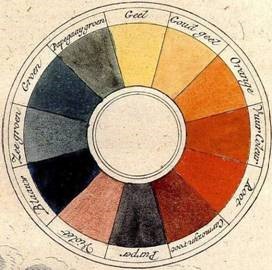
Colour wheel with 18th century labels: clockwise from yellow over red to blue and green; one purple field has paled to pink.Tiefgelb

Die tiefgelbe Blume vor wollweißer Wand,
die frohrosa Büschel vor lehmbraunem Zaun,
der vollblaue Tag über kraftgrünem Land –
der rundbunte Sommer, ein tiefgelber Traum!

Christina Egan © 2016


Tieftürkis

Tieftürkis und lässig prächtig,
sonnensatt und sonnenträchtig
steht der Horizont noch spät.
Schwarze Flammen, schwanken Bäume,
stumm gestaltgewordne Träume,
wenn der wirre Nachtwind weht.

Liegt die Erde endlich nächtig,
scheint der Himmel übermächtig,
unerschöpfter Helle Quell.
Alle Sehnsucht kann noch fruchten
in verborgnen Gartenfluchten
oder einer höhern Welt.

Christina Egan © 2017


Colour adjectives develop only very slowly in languages all over the world. There are still not nearly enough! I don’t see why in German, we have the words ‘deep red’ and ‘deep blue’ — written as one word, even — but no ‘deep yellow’ or ‘deep turquoise’; so I am introducing them. I also made up a number of unusual descriptors for the first poem, leading up to the internally rhyming ‘rundbunt’ for multi-coloured in all colours of the earth or of the colour wheel.

Colour wheel with 18th century labels: clockwise from yellow over red to blue and green; one purple field has paled to pink.


Image: Arnoldus Lobedanius, Utrecht, 1744. (One purple field must have paled to pink.)

Reproduced with kind permission of the Library of Cologne University of Applied Sciences (Fachhochschule Köln).

Snow-White Patches

Snow-White Patches
(July Tanka)

Daisies, buttercups,
scattered across the lush green
like two galaxies:
humble, ephemeral and
full of the glory of God.

*

Those snow-white patches,
patterns on the lawn, the mulch:
hortensia flowers,
as if cut out from the world
of colours and of motion.

Christina Egan © 2012


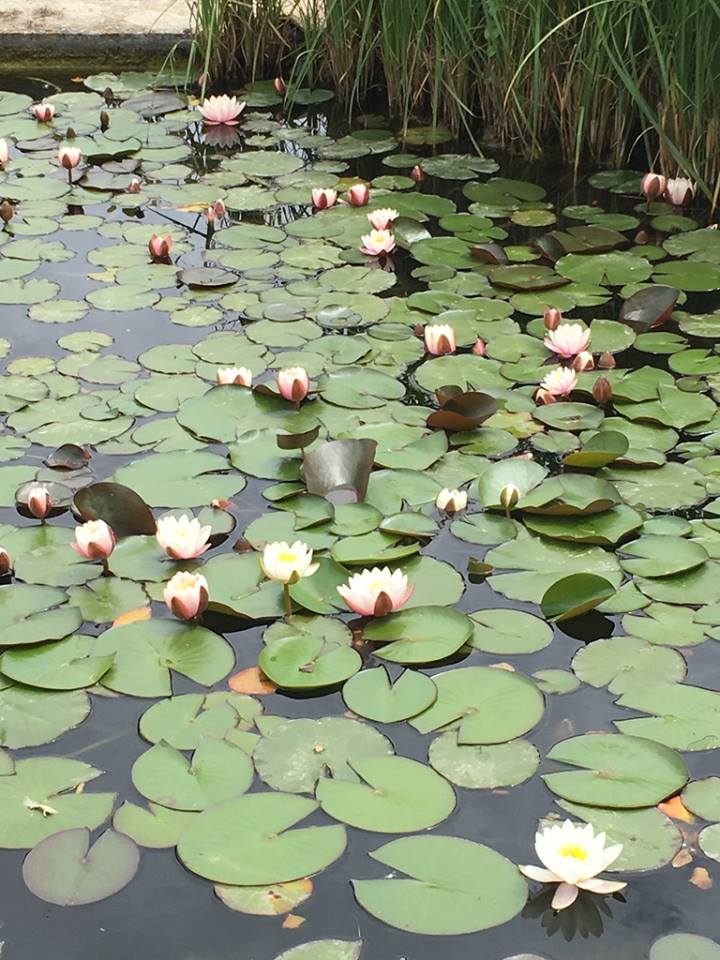
Waterlilies with half-open luminous pink and white flowers.

These poems describe the world as an ensemble of patterns. They also try to make sense of the world, and perhaps the act of discovering order also unveils meaning…

Something tiny resembles something gigantic, the whole of the known world, in fact. Something white appears as a hole or an island in the colourful picture: like a shadow of death or a gate to eternity.


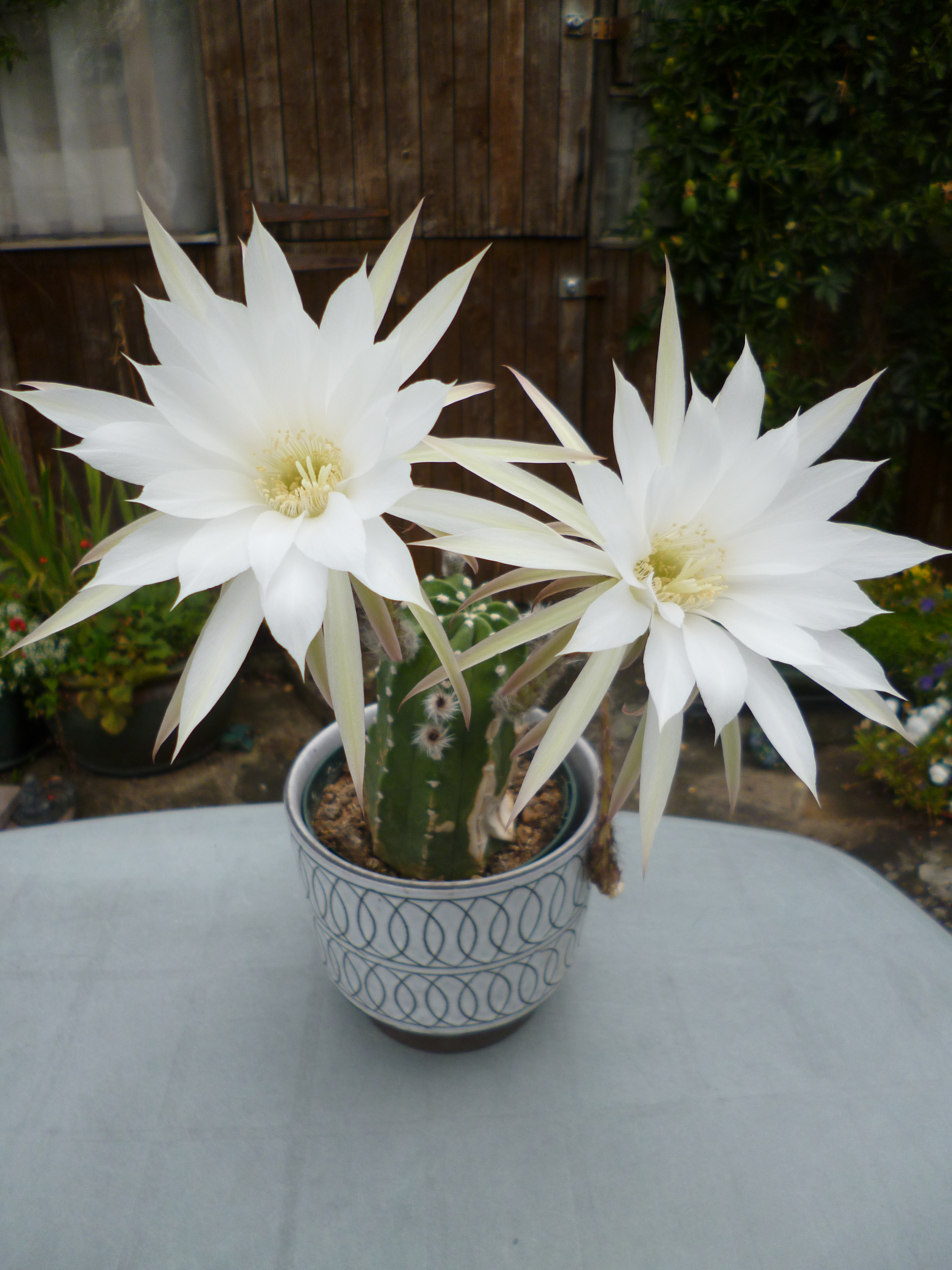
Cactus seen from above, with two star-like flowers bigger than the body of the cactusThe line ‘full of the glory of God’ was inspired by the verse ‘The world is charged with the grandeur of God‘ by Gerald Manley Hopkins.

You can truly ‘see a world in a grain of sand / and a heaven in a wild flower’, as William Blake claimed!

Photographs: Water-lilies. Liu Ye (Ye Liu) © 2016. — Queen of the night. Christina Egan © 2014.

Silver Vein

Silver Vein

The curves of your step and your hand
leave a feathery trail in the air,
leave a flickering trace in my heart.

It’s a script you can’t see,
it’s a script I can’t read,
it’s a glittering vein on the earth.

That you weigh your weight,
that your flesh fills space,
that you radiate warmth

is a wonder to me,
a wealth of amazement,
a maze of desire.

Christina Egan © 2006

gedichte über blumen

gedichte über blumen

Buds and fresh leaves on top of shoots above a parkein jeder blumenkranz
ein jedes sommerlied

jede hochgemute knospe
ja jeder nadelfeine halm

ist eine kriegserklärung
an den krieg

Close-up of poppy flower with dew or rain on it, above other red, orange, purple, and white flowers.

eine nichtigkeitserklärung
des nichts

eine liebeserklärung
an die liebe

an alle
ans all

Christina Egan © 2014

Photographs: Christina Egan © 2014 / 2016.


My insistence on writing poems about flowers is a reaction to Bertolt Brecht’s often-quoted suggestion that a conversation about trees borders on criminal negligence because it is silent about atrocities. In the poem An die Nachgeborenen from the 1930’s he exclaims:

“Was sind das für Zeiten, wo
Ein Gespräch über Bäume fast ein Verbrechen ist
Weil es ein Schweigen über so viele Untaten einschließt!”

Brecht’s idea is  startling and ingenious; but I hold that all praise of a flower or a bud is a praise of life and peace: ‘a declaration of war / against War… a declaration of love / to Love.’

Also, if you have read a few of my poems, you will have noticed that they do not describe flowers and trees alone, but use them as images for human life and joy, suffering and death. ‘Poems about flowers’ has 35 words — but amongst them are ‘nothingness’ and ‘the universe’!

Moon Rainbow

Moon Rainbow

Enveloped in the velvet cloak of night,
I feel I have been chosen before birth
As secret queen of this enchanted earth,
Enrobed in moon and star and rainbow light.
Enveloped in this sparkling cloak of night,
Embroidered by an angel, tireless,
And lined with solid human tenderness,
I know I live and die to see the light.
I’m wrapped into this lining of the night:
Your silver beauty scooped out of the moon
And made to breathe and smile and give me room.
I hold your smooth and tapered fingers tight,
I hold your dreams to give them earth to bloom:
Around us moves the sky’s luminous loom.

Christina Egan © 2010