Standing in the Slush

Standing in the Slush
(February Haiku )

*

Standing in the slush,
by the bus stop, I’m looking
for lost memories.

*

Wet empty benches,
wet winding sand paths, furrowed
by hurried footsteps.

*

I’m rubbing my eyes,
weighed down by dreams, and there –
first leaves like lances!

*

Christina Egan © 2013


Like February Sparks, these haiku were written at the hardest time of the year, when our strength is about to be exhausted entirely. This is when we have to be strongest, when we have to fight hardest, as the previous post, Venus and Mars, describes. At least, in southern England, flowers appear very early, in winter, really, to cheer you up…!

Haltbare Rose

Haltbare Rose

Wenn ich mit einer Rose um dich würbe,
gewölbt, gefüllt, gedrängt und überfließend,
mit ihrer Gegenwart den Raum versüßend,
so wüßte ich, daß sie im Nu dir stürbe.
Und wenn ihr eine Faserblume gliche,
burgunderrot und makellos gewoben,
so wäre sie zwei Jahre todenthoben
und höchstens drei, bevor sie ganz verbliche.
Und wenn ich eine Bronzeblume fände,
so wäre doch ein Feuersturm ihr Ende,
in dem ihr unverrückter Glanz verglühe.
Ich schicke dir statt aller dieser Rosen
nur dies Gedicht, das deine Lippen kosen,
auf daß es bis zum Jüngsten Tage blühe.

Christina Egan © 2016
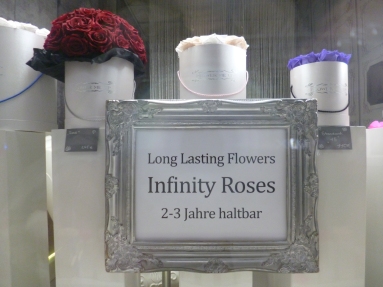
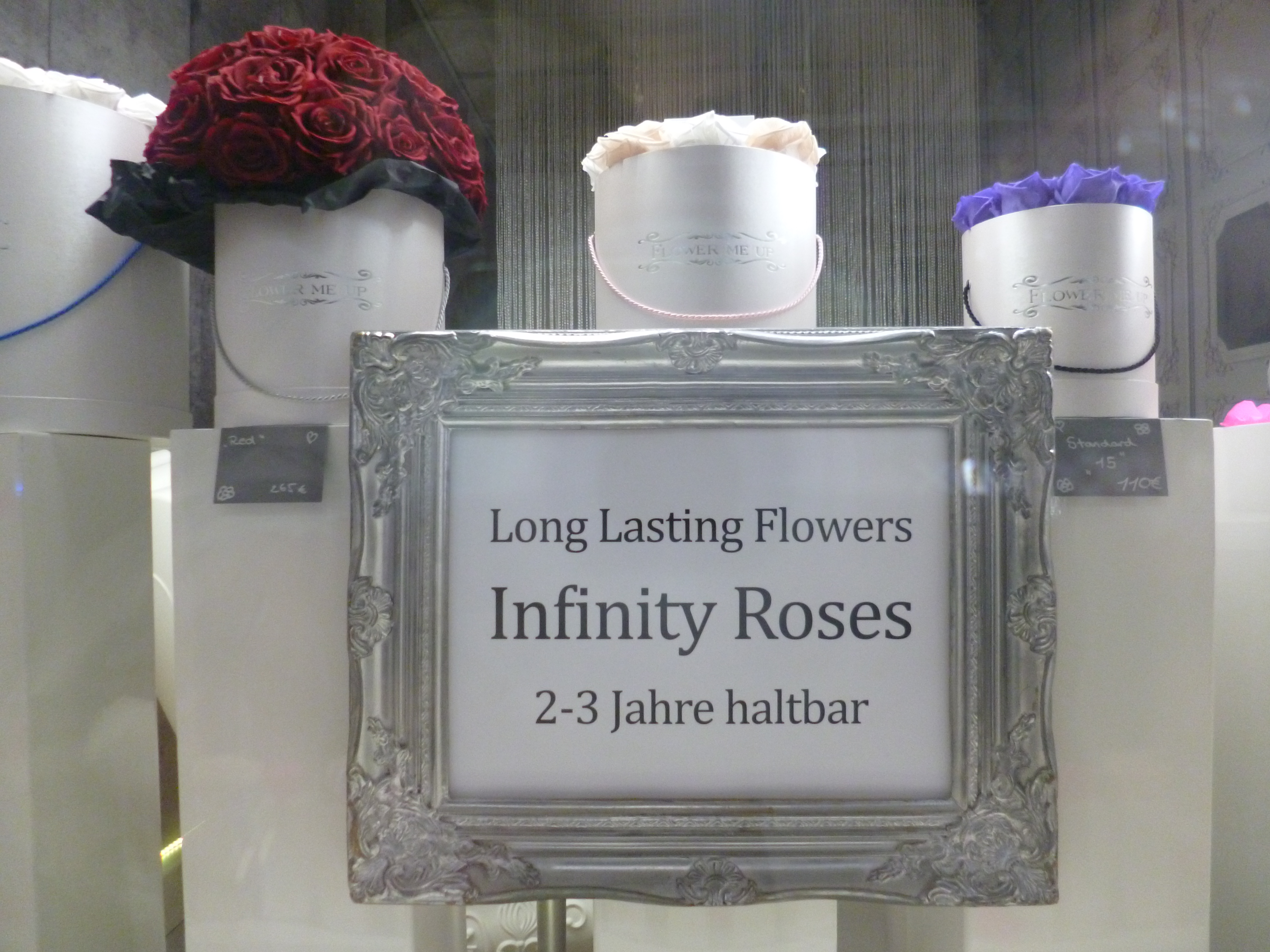
Advert reading "Long lasting flowers: Infinity Roses: 2-3 Jahre haltbar".This sonnet was inspired by an advertisement in a shop window: ‘Infinity Roses’, guaranteed to last two to three years. I found this hilarious: most love stories, which one naturally believes to be forever, last at most that long. Then they get cast away just like an artificial rose.

My idea was that a real flower lasts only a few days; an imitation of fabric or plastic (the German word leaves the material open) lasts only a few years; and even a sculpture of bronze might perish in a fire one day. A poem, however, may outlive them all! (The question whether the love will outlive them all remains.) Instead of kissing the poet, the beloved one turns the lines of the poem over on his or her lips. Well, that’s something at least…


Noch immer blühend

Ich lieb’ dich insgeheim schon seit drei Jahren,
was eine ungeheure Leistung ist –
von dir, der du noch immer blühend bist!
Ich bin berückt, und niemand darf’s erfahren.
Man will ja auch nichts Falsches offenbaren:
Ich liebe dich schon seit drei Jahren halb,
das macht dann immerhinque anderthalb.
Man muß zuweilen mit der Neigung sparen.
Wir sind sogar persönlich schon bekannt.
Zählst du wohl auch…? Drei Stunden insgesamt!
Drei Meter nur, dann einen Meter fort –––
Ich schicke, Liebster, dir zum Unterpfand
Nur eine rote Rose durch das Land:
Schau auf, steh auf und küß mich ohne Wort.

Christina Egan © 2017


This sonnet takes up the thought of Haltbare Rose in a satirical fashion: The woman has been in love with the man for three years already – but only half, which she counts as one-and-a half years!

Photograph: Shop window in Berlin. Christina Egan © 2016.

Alles drängt vorwärts

Alles drängt vorwärts

*

Fahrzeug um Fahrzeug,
bunte Menschen, Hunderte,
alles drängt vorwärts.
Durch das Adernetz der Stadt
rollt das Leben, das Sterben.

*

Kein einziger Stern,
bloß Wolken, Nebel und Staub
über den Dächern.
Doch Funken stieben, golden
und rot, über die Kreuzung.

*

Christina Egan © 2015/ © 2017

Busy junction in the dusk, with red and yellow lamps of cars and buses glaring.

These tanka were written in Bloomsbury, London,
one in summer and one in winter, one bright light
and one in dim light;  but the seasons and hours
make less difference in London than elsewhere…
For similar poems in English, go to Ripples of People.

Photograph: Deptford Broadway, London.
Michael Oakes © 2016

Oasis (Marrakesh)

Oasis
(Marrakesh)

All these proud palm-trees,
a thousand and one, now bow
before your beauty.

*

A road of roses,
an avenue fit for a king –
just right for you.

*

Desert dust reaches
for your ankles of marble,
envied by my hands.

*

Christina Egan © 2016


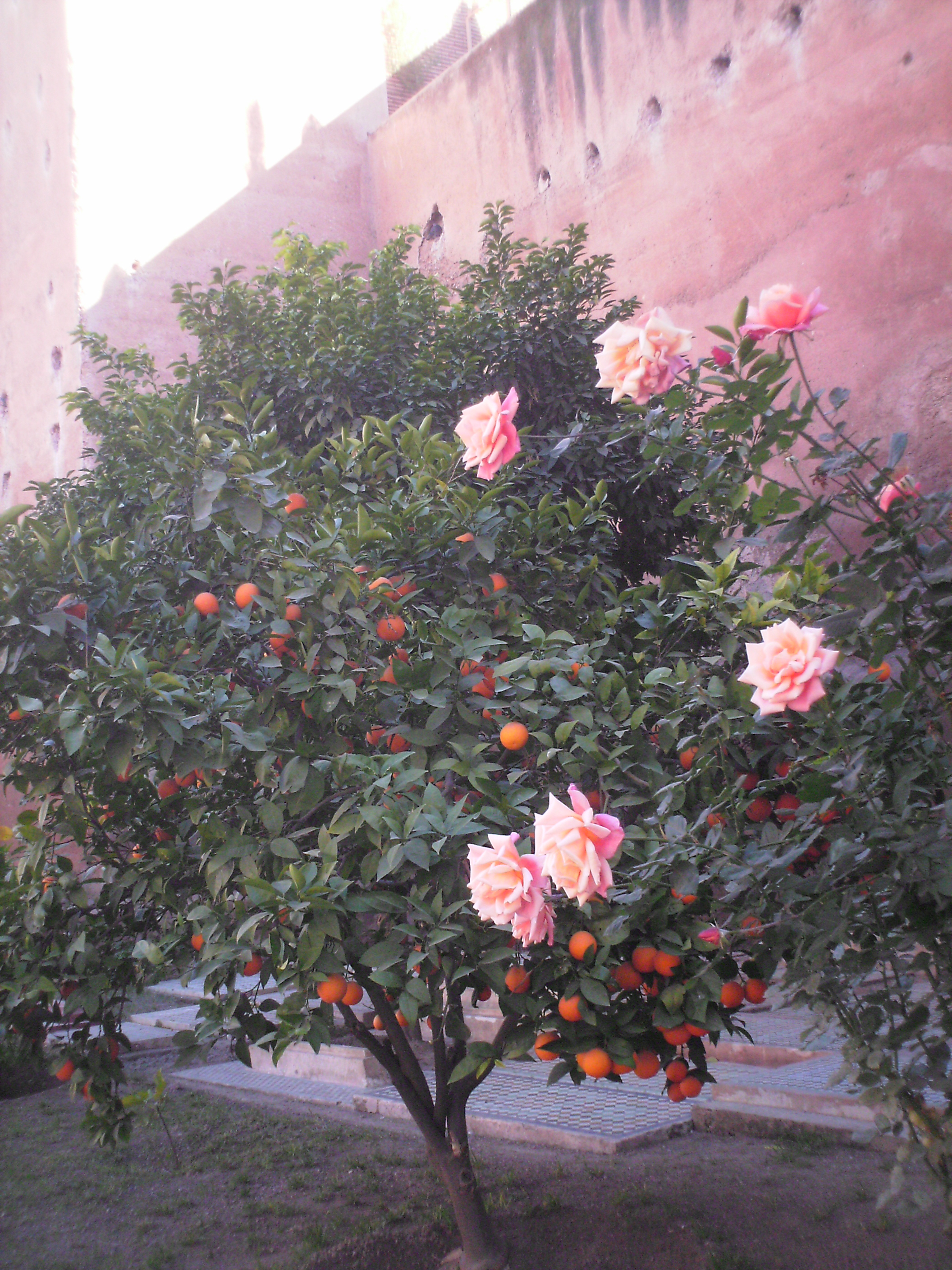
Orange tree full of fruit and rose tree with large roses in front of high pink wallsThis is actually a set of winter poems: Morocco in midwinter is like northern Europe in midsummer! Marrakesh welcomes you with warm sunshine, thousands of palm-trees and tens of thousands of roses in all colours… Around the city, wherever the ancient irrigation system does not reach, the land stretches dry and dusty.

Photograph: Orange-trees and rose-trees within the rose-coloured walls of Marrakesh. Christina Egan © 2012

The Dance of the Sacks

The Dance of the Sacks

There’s the war tax and the peace tax
There’s the core tax and the fleece tax
There’s the fish tax and the spice tax
There’s the poll tax and the vice tax!

There’s the whisper of a tax-plan
There’s the whistle of the tax-man!

There’s the old tax and the new tax
There’s the wool tax and the wheat tax
There’s the old tax for the new sacks
And the new tax for the old sacks!

There’s the tax-man with his tablet
It’s a state-protected racket!

Christina Egan © 2011

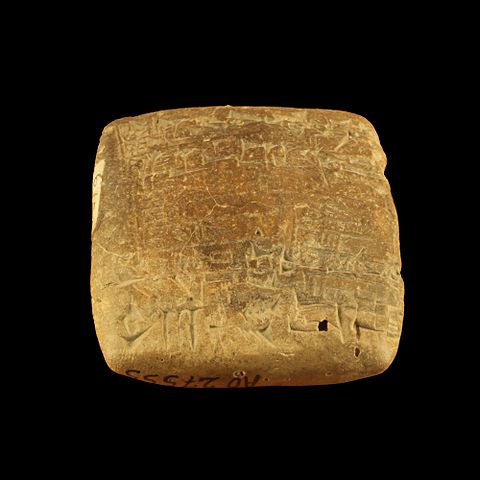
Small clay tablet with cuneiform text.

This comical song for a jig is taken from my stage play The Bricks of Ur  (© 2011) set around 2000 BC.

The tax collectors could wield either Sumerian clay tablets or 21st century electronic tablets!

I must have been inspired by a hilarious jig in one of the first seasons of Shakespeare’s Globe in London…

Receipt for 13 woolen garments, ca. 2038 BC. Photograph by Rama, Cc-by-sa-2.0-fr [CeCILL or CC BY-SA 2.0 fr] via Wikimedia Commons.

Bus Stop Haiku

Bus Stop Haiku

The full moon captured
in a cage of stone and wood:
a white paper lamp.

*

Wilting lavender
on the window sill, turning
into bursts of scent.

*

Brick wall and bus stop:
in between, seven nations
squeezing together.

*

Christina Egan © 2016


An ancient art form capturing mundane moments from the big city: In Wood Green, London, a crowd from seven nations is squeezing onto the red buses. I looked out for beauty at the bus stop and found it.

The full moon glimpsed turns out to be a bedroom lamp. The luxurious lavender grows in a little tin pot. The third autumn haiku does not even have any image from nature: just a brick wall…

Sonnenuhrzeiger / Sundial Garden

Sonnenuhrzeiger

Die Sonne gleißt auf grüner Flur:
Ein jeder wird zur Sonnenuhr.
Der Schattenmensch liegt lang im Gras,
der Abend schrumpft in gleichem Maß.

Die hingestreute Sternenzier
ist mürbes Laub wie Packpapier.
Die weißen Blumen tanzen stumm
um einen dicken Stamm herum.

O trink das Licht mit Haut und Haar:
Noch ist der Himmel hoch und klar!
O trink das Licht mit Aug und Sinn:
Es liegt die Kraft des Alls darin.

Christina Egan © 2016

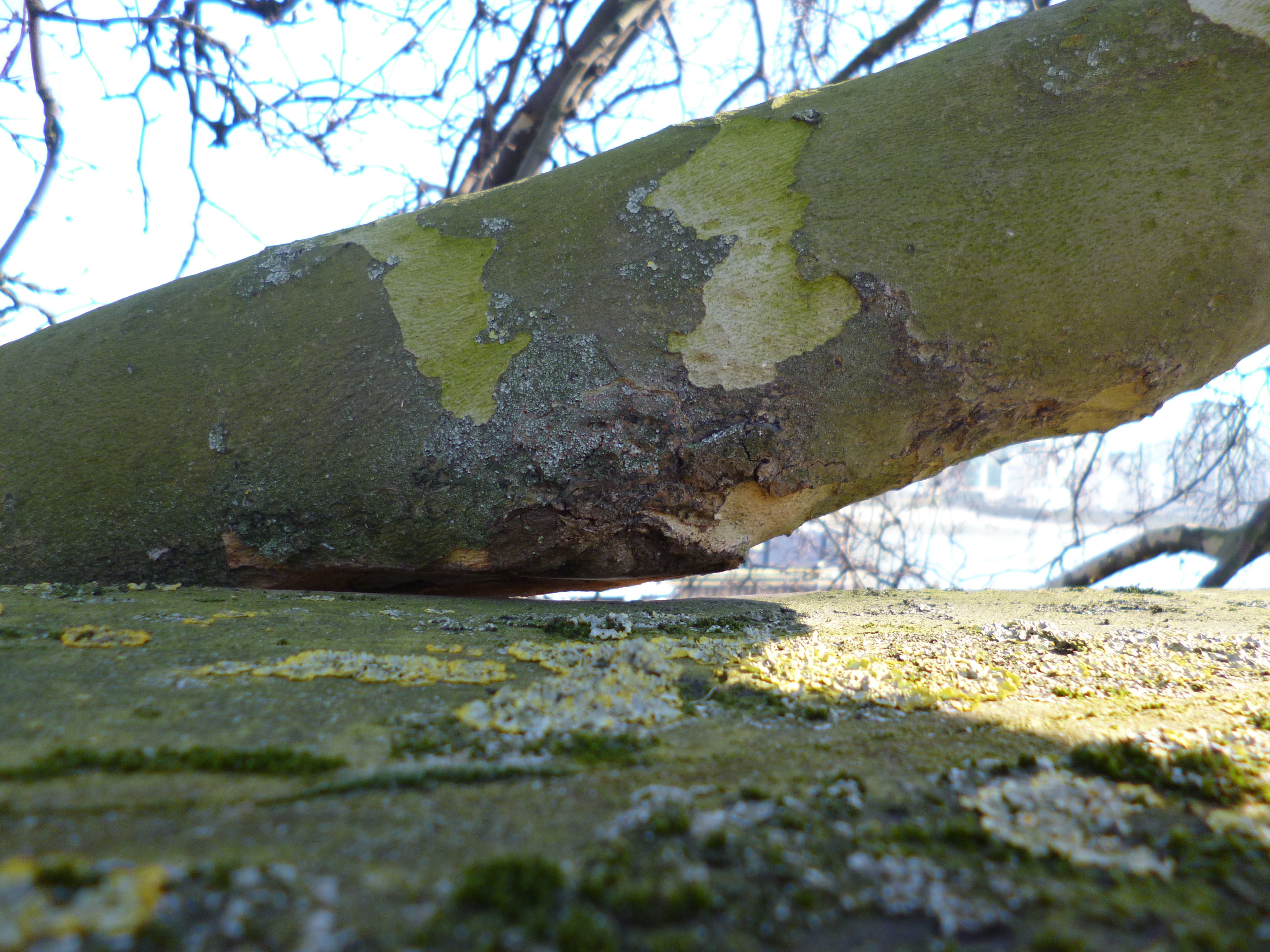
Top of wall covered with lichen and tree with patchy bark, mirroring each other.

Sundial Garden

The sun will gain ground,
conquer inches of lichen,
of leaves and of lawn.
Across the square garden creeps
the shade of the steep gable.

Christina Egan © 2005


In these poems, a whole gardens turns into a sundial: in the first one, each person in the park is a sundial hand, and in the second, a house with a pointed roof fulfils this function, casting its shadow over a north-facing yard.

The first poem is set in late summer or autumn and in the late afternoon or evening, the second one in late winter or spring and possibly in the morning. The yearly and daily descent of the light is as inevitable as its subsequent rise.

Photograph: Christina Egan © 2016.

A Window will be Thrust Open

A Window will be Thrust Open

A window will be thrust open
where you forgot there was one,
a glow as of noon will be thrown
over your working hands, over your tired face.

You will look into the mirror
and find upon yourself the gaze of an absent one,
you will look into the eyes of a stranger
and find there your face as if steeped in sunset.

halkett_1938_ohnetitelYou will run down the road
to overtake your shadow,
you will push through all your doubts
to hold that hand, to clasp it tight.

Christina Egan ©2003

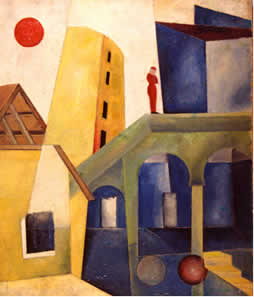
No title. René Halkett (1938).
Image with kind permission
of Galerie Klaus Spermann.

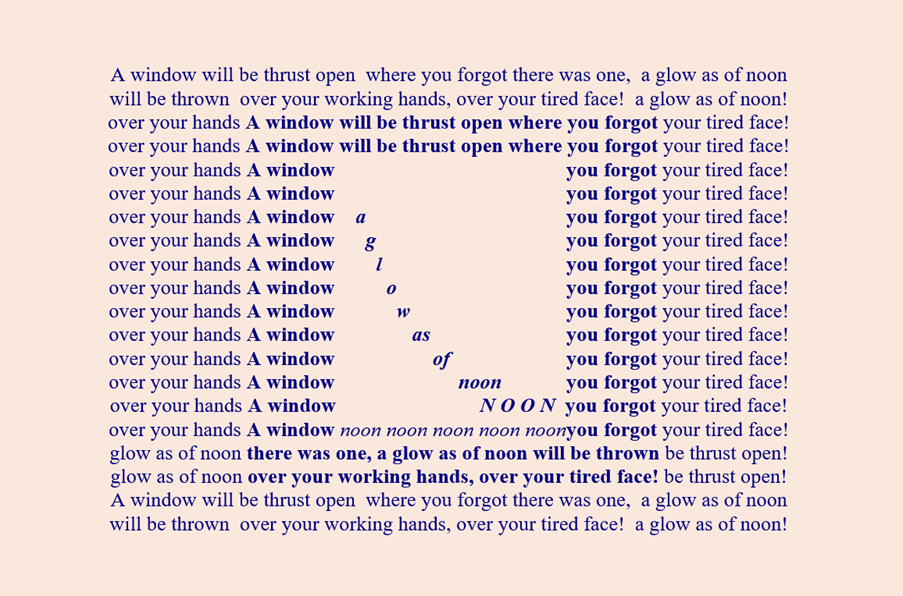
Text "A Window will be Thrust Open", 1st stanza, typed up in the shape of a window with a ray of sunshine coming in.


Visual poetry: 1st stanza of A Window will be Thrust Open. Christina Egan ©2024 (Text ©2003). (Click on the image to enlarge it).

Ripe Apples and Pears

Ripe Apples and Pears
(Rhön, September)

*

Ripe apples and pears,
plenty, between the pebbles
in the nimble stream.

*

The forest, still green,
whispers and rustles and taps
with dropping acorns.

*

The gilded beech-tree
stretches out one long arm
towards the morning sun.

*

Christina Egan © 2013

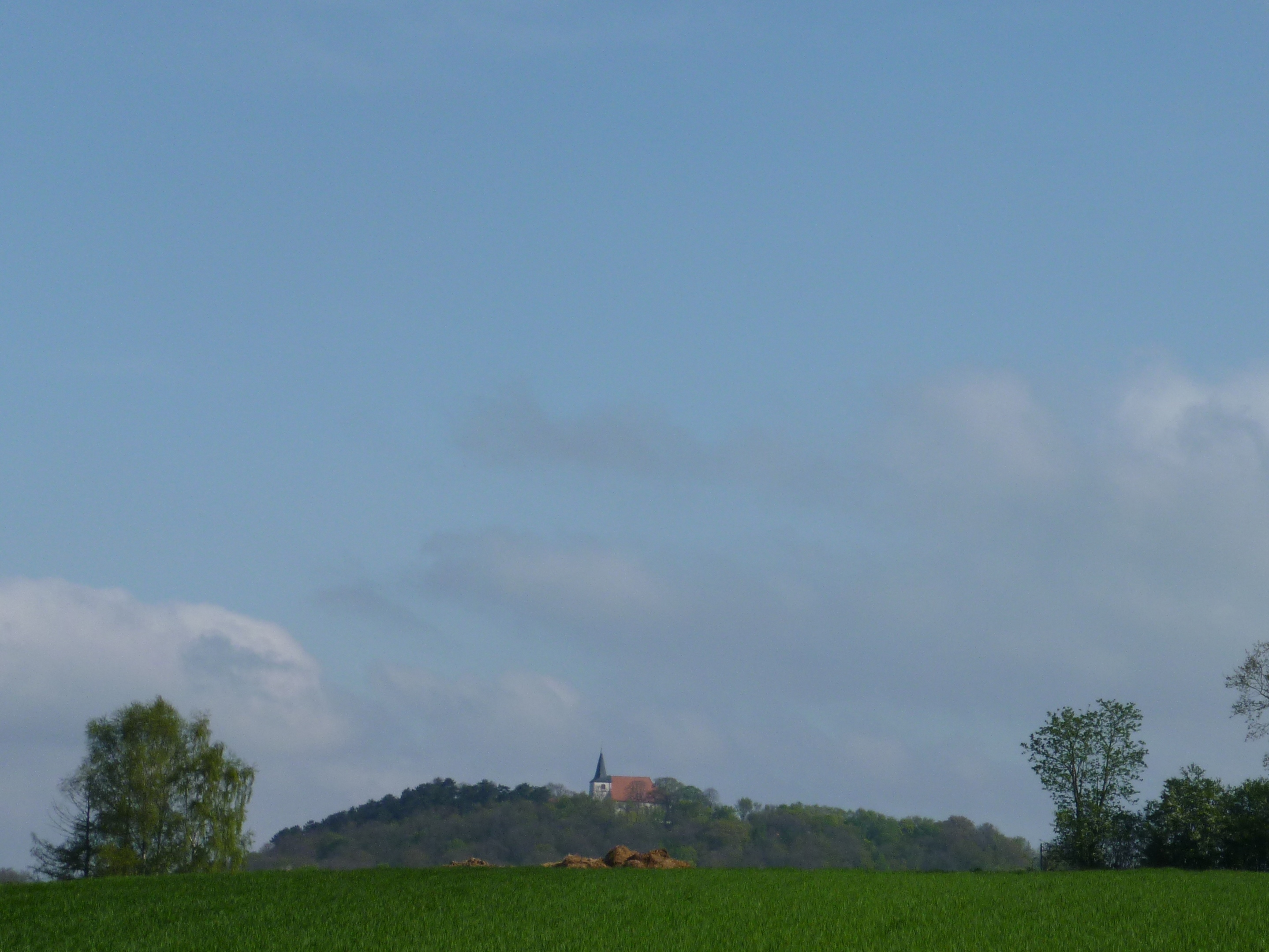
Green field in the foreground, flat top of wooded hill with chapel in the distance, much blue sky above.

These haiku were written on walks around the Florenberg, a steep little hill in Germany, clothed with forest and crowned with a one-thousand-year-old chapel. The Fulda area was covered with beech-trees and oak-trees once.

Summit of Florenberg in spring, seen from another hilltop. Photograph: Christina Egan © 2014.

Three Stars / Drei Sterne

Three Stars

Three stars in the sky…
Three lines only to tell you
all my hopes for us.

*

Sneeze

Your sweet face – a sneeze –
as sudden and explosive
as your sweet haiku.

Christina Egan © 2013

Stamp with bright artistic impression of spaceship flying between planets and stars.

Drei Sterne

Drei Sterne am Himmel…
Drei Zeilen für dich, für
all meine Hoffnung.

*

Nieser

Dein liebes Gesicht
– ein Nieser – plötzlich, heftig
,
wie deine Haikus!

Christina Egan © 2016


A haiku is a Japanese poetic form; each poem has only three lines and seventeen syllables, which amounts sometimes to only a dozen words, even with a title. Yet you can say a lot in three lines… The word game is more difficult in German than in English, since the words are longer; translation can be a challenge.

A traditional haiku starts with an image from nature indicating the season; you will see on my haiku pages that I largely follow this rule. These here are different: one is simply romantic and one humorous, and both are about reading and hearing haiku!


Illustration: Stamp of 1963. (Scanned by Darjac) [Public domain], via Wikimedia Commons.