Gingerbread Man

Gingerbread Man

God made you of some gingerbread
which over time intensifies:
so that with every year, your breath
will taste of hotter, sweeter spice!

Christina Egan © 2014

We Married on the Ferris-Wheel

Vienna quivered in the heat
for our furtive feast:
we married on the ferris-wheel
(we kissed on it, at least).

The palaces shone yellow-white
like lemon cakes with glaze:
we married in the royal grounds
(we kissed within a maze).

That summer rolled into a ball
and down the hill of time –
Vienna basks in splendour still,
my bridegroom still is mine!

Christina Egan © 2014

String of Pearls

Your presence makes this globe that whirls
the best of all existing worlds —
your kisses make this blob a pearl
from which a string of worlds unfurls!

Christina Egan © 2015

Asteroid

He inhabits his own tiny planet,
a fragment of rock, you might say;
his orbit seems steep and erratic
and often immensely away.

Yet, what you can’t see from your garret
nor find in your smart telescopes:
it’s two of them snug on that comet
that’s studded with roses and oaks.

Christina Egan © 2010
Über alle Hoffnung

Über alle Hoffnung

Fürchte nicht der Tage Neige,
nicht der Kräfte bittern Schwund,
denn der Gott des Lebenshauches
birgt das ganze Erdenrund.

Fürchte nicht der Freunde Ende,
nicht einmal das eigne Grab,
denn der Gott der Engelheere
steigt mit dir zur Nacht hinab.

Hinter allen Schattentälern
wartet unverrückt das Licht,
denn der Gott der Sternenfernen
hält zuletzt, was er verspricht,

und er wird dich neu beleben,
dich als sprühendschönen Stein
über alle Hoffnung heben,–
Alles Glück wird unser sein.

Christina Egan © 2015

This poem declares that after bitter
death, a new life is prepared for us,
a happiness surpassing hope. –
It could be turned into a hymn.

Der letzte Tag des Sommers ist gekommen

Der letzte Tag des Sommers ist gekommen

Der letzte Tag des Sommers ist gekommen
mit Tropfen frischen Bluts und Flocken Schnees
entlang des ausgeblichnen Blumenbeets,
mit Sonnenschein, geballt und dann verschwommen,
mit Regenschauern, hart und schon zerronnen,
mit tausendfacher Kraft des Krauts und Klees
und brüchigbraunem Laub entlang des Wegs,
mit Silbernetzen wie aus Luft gesponnen.
Der letzte Tag des Sommers hält die Fahne
von allen Farben in die wilden Winde,
daß sie das Auge ohne Suche finde,
daß sie die Seele ohne Zweifel ahne…
Der letzte Tag des Sommers hängt die Fahne
an gelber Rosen berstendes Gebinde.

Christina Egan © 2014


The first part of this sonnet (8 lines) conjures up scattered petals like drops of blood and flakes of snow, bright sunshine and hard rain, vigorous herbs and brittle leaves and delicate webs. The second part (6 lines) lets the last day of summer hold a colourful banner into the wild winds and hang it onto a lush garland of yellow roses. — See also Poems about roses, life and death (a German and English selection).

Auf den Höhen der Rhön

Auf den Höhen der Rhön
(Juli-Haiku)

*

Mit blauen Blumen
bestickt, bläht sich das goldne Korn,
ein Tanzgewand.

*

Auf dem Kiefernduft
gleitet der Habicht dahin
hoch über den Höhn.

*

Die Kuppen im Dunst,
ein perlgrauer Scherenschnitt
vorm Silberhimmel.

*

Im kupfernen Laub
ganze Quader von Jade:
bemooste Felsen.

*

Christina Egan © 2003

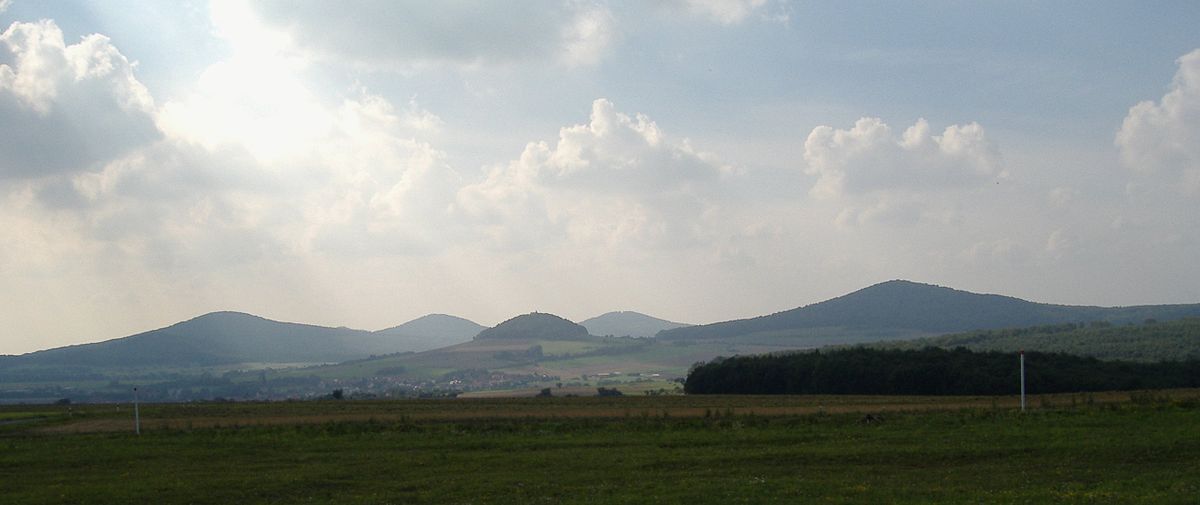
The Rhön Mountains, part of the Central Uplands of Germany, stand out through their wild and austere beauty. – This series of haiku has just been published in the photo calendar Rhönkalender 2016.

English speakers: This text, titled On the heights of the Rhön, works quite well in a translation software. You can also see two wonderful panoramas of the mountains at the link to the calendar and some more on Wikipedia.

Silhouette of low silver-blue mountain range against silver-blue sky, just like in the poem.

Photograph: “Kegelspiel” by N8mahl at the German language Wikipedia.

Göttermahl (Malerei in Fulda)

Göttermahl
(Malerei im Stadtschloß zu Fulda)

Rundes Brot mit blonder Rinde
spendet uns der Sonne Kraft;
roter Wein voll süßer Hitze
filtert uns der Erde Saft.

Zu dem Abendbrot gesellt sich
stückweis gutgewürzte Wurst;
saftigbunte Früchte endlich
stillen den entfachten Durst.

Welches Mahl man mir auch biete,
nichts kommt dieser Speise gleich,–
und mir scheint gar, man genieße
ebenso im Götterreich!

Christina Egan © 2015

You can find very clear photographs of
Emanuel Wohlhaupter’s painted ceiling
(1728-1730) in the City Palace of Fulda
at Zentralinstitut für Kunstgeschichte.

The Man is Not in his Seat

The Man is Not in his Seat

The coffee is still on the table,
the table is still in the street,
the seat is still in the corner:
but the man is not in his seat.

Perhaps he has gone to his office,
perhaps he has gone to the park;
perhaps he’ll be back in a minute,
perhaps he’ll be back before dark.

I think he is due in the morning,
I think he is due every day;
I think we have all of us seen him
whenever the bus passed this way.

The coffee dries out on the table,
the table is still in the street,
the seat is still in the corner:
but the man is not in his seat.

A friend may have called at the café
and lead him away with a smile;
or a man in a car brought a message,
so he said: I might be a while.

Or else he will never return here
to raise his glass to the street:
The stranger who passed was an angel
to take him away from his seat.

Christina Egan © 2015

In memoriam Erdogan Güzel
Murdered in the street in Wood Green,
London, England, on 10.7.2015
Requiescat in pace

SEMPER AMEMUS

SEMPER AMEMUS
 
Ein großer lila Schmetterling
an einem feinen Silberband:
ein einfallsreiches Ornament
von unbekannter Künstlerhand,

das man vielleicht den Mauerresten
des Vorstadthauses einst entringt,
in sorgsam aufgereihten Kästen
dem Publikum zur Ansicht bringt.

Bis dahin werden Bild und Name
der Trägerin verloren sein;
nur ein verbeulter Brillenrahmen
wirft einen warmen Kupferschein,

und, rätselhaft, ein Silberring
trägt eine Inschrift auf Latein.
Die Zeitung schreibt: Der Schmetterling
mag Zeugnis einer Liebe sein.
 
Christina Egan © 2015

A woman's throat with a large butterfly pendant in silver and purple and a long blond ringlet on her dark garment.This story takes place in the future: when we are the past  unearthed, marvelled at, mused about. The inscription on the ring – which is a real item from the year 2000 AD – means ‘May we always love each other’.

Quo vadis?

Quo vadis?

Roman mosaic of bottle and cupI drank a cup of strong red wine,
and half of it I somehow spilt…
That was still in another life,
before this winding lane was built…
It was along the straight wide road,
beneath a square of bright-red tiles…
I spilt it from a bright-red cup,
and then I walked from town for miles…
I limped along the riverside,
I lay down in the damp dark fern…
I spilt my wine, I spilt my life:
one day, I shall have to return.

Christina Egan © 2015

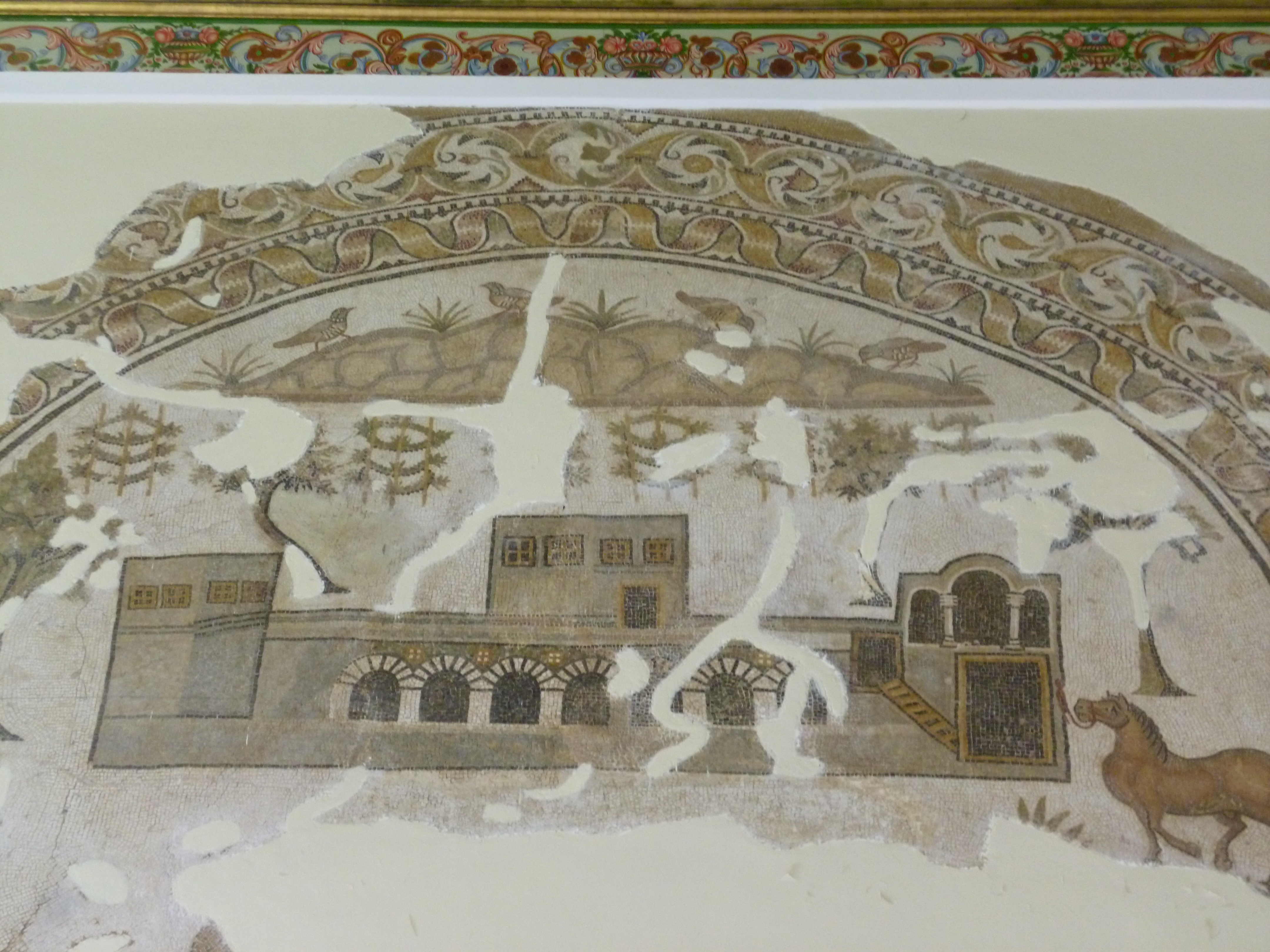
Roman mosaic of a mansion

This story was inspired by the winding highways and the straight Roman road meeting at Tottenham, London, England.

The Latin title means ‘Where are you going?’ and may imply a reproach to someone who is trying to flee their place in life.

See also my poem By the Highway
(in German and English versions).

Roman mosaics, Bardo Museum, Tunis.
Photographs: Christina Egan © 2014

An der breiten Straße / By the Highway

An der breiten Straße

In des Stadttors Schatten steh’ ich,
Wo die Straße sich entrollt:
Und die Stadt ist nicht von Marmor
Und das Pflaster nicht von Gold.

An der breiten Straße sitz’ ich
Eine Stunde und ein Jahr:
Und ich träume, und ich hoffe,
Und ich warte immerdar.

Händler fahren ihre Waren,
Pilger ziehen aus und ein,
Gräber reihen sich allmählich:
Und ich werde selbst zu Stein.

Eines Nachts verkünden Sterne:
Gehe aus und such’ dein Glück!
Eines Tages bringst du’s hierher,
Denn die Stadt ruft dich zurück.

Christina Egan © 2015

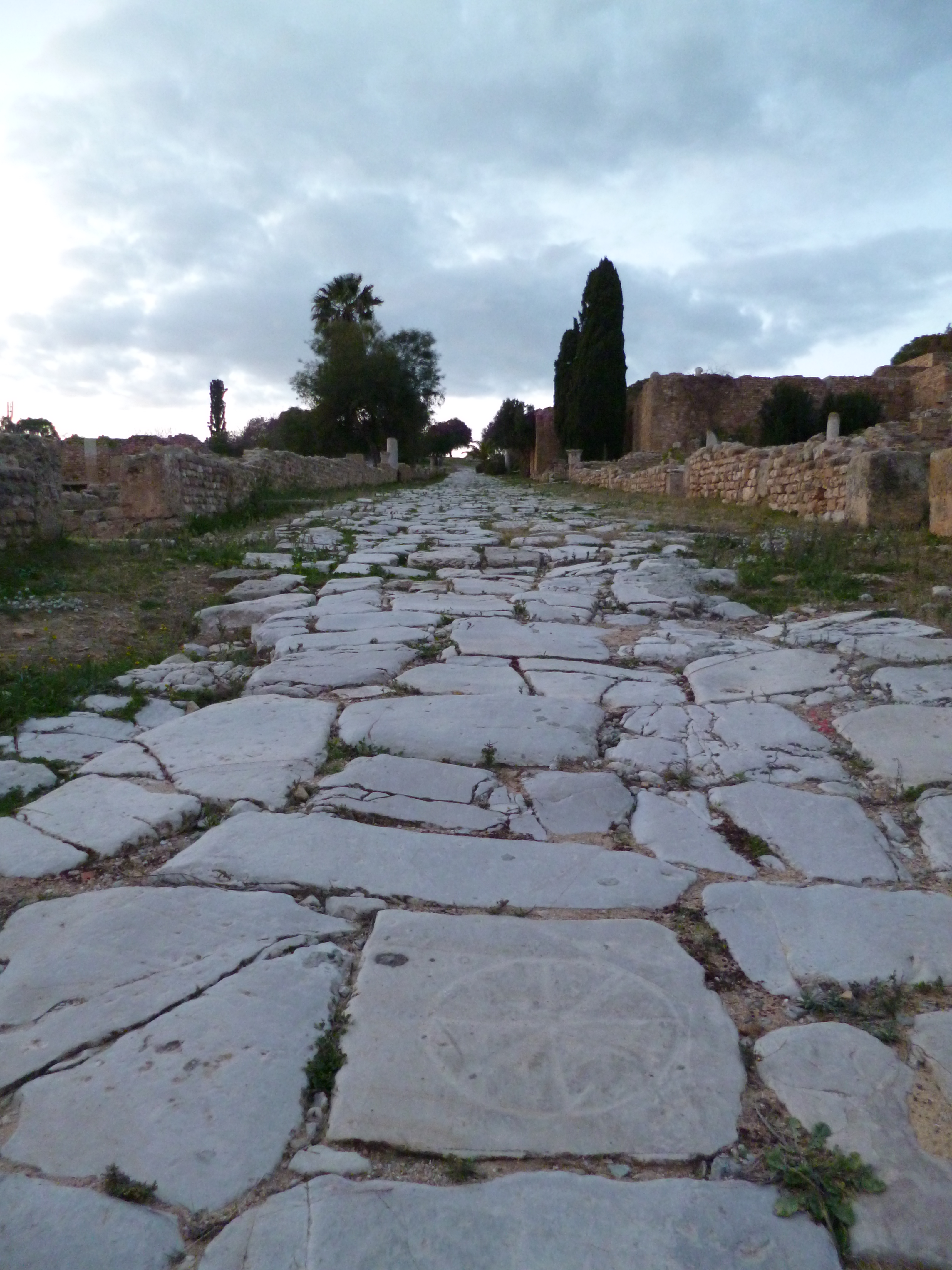
Straight Roman road with ruins and trees to the left and right, in the dusk

Roman road in Carthage, Tunisia.
Photograph: Christina Egan © 2014

By the Highway

In the city gate I’m standing,
Where the outbound road‘s unrolled:
And the city’s not of marble
And the pavement not of gold.

By the highway I am sitting,
First an hour, then a year:
And I’m dreaming, and I’m hoping,
And I’m waiting, sitting here.

Merchants cart their goods to market,
Pilgrims visit and go home,
Tombs line up along the highway:
Slowly, I, too, turn to stone.

Yet one night some stars announce it:
Seek your luck now, seek your track!
And one day bring back your luck here,
When the city calls you back.

Christina Egan © 2015

This poem is timeless. A similar song is part of my play The Bricks of Ur, which is set 4,000 years ago. Another story from a highway outside a Roman city is Quo vadis?.View of Roman Cologne: a large neat grid of buildings with red tiles, located on flat land by a wide river“Roman Cologne, reconstruction” by Nicolas von Kospoth via Wikimedia.

This poem or song was inspired by ancient Roman tombs along Severinstraße, the straight road leading southwards out of Cologne, Germany (left in the picture). Artistic impressions of a Cologne city gate and a highway lined by tombs are online on p. 48 and p. 28-29 of Römer Straßen Köln. When I wrote the poem, I did not know that at times, Severinstraße was known as “Lata platea” or “Breite Straße” (“Broadway”)!

Postscriptum:  This was my first post ever! Roman roads and Cologne are two of my favourite subjects; so you can link to the texts covering them directly.