Fluchtlinien

Fluchtlinien

Ich bin relativ normal.

Ich trage normal verrückte Klamotten
und subventionierte Brillengestelle.
Ich prüfe mit Mühe die Reife der Avocados
und wehre mich nicht gegen Rostbratwurst.

Ich steige beinahe rechtzeitig in den Bus
und steige am richtigen Bahnhof um.
Ich sitze am Bildschirm und tippe.
Ich gieße die Dickblattgewächse im Büro.

Ich kaufe die richtigen Zeitungen
und entsorge sie ordnungsgemäß.
Ich gehe auf die richtigen Demos
und brülle ein bißchen herum.

Ich rede von Konflikt und Diskurs
und folge den Regeln der Republik.
Ich sitze am Bildschirm und tippe.
Ich gieße die Dickblattgewächse im Büro.

Ich buche das Zimmer mit Seeblick
und Reiserücktrittsversicherung,
ich recherchiere die Sonnencreme
und die regionale Sozialgeschichte.

Ich wirke normal; es gibt Zeugen.

Und die ganze Zeit, die ganze lange Zeit
lebe ich entlang der unsichtbaren Linien
auf den Fluchtpunkt deiner Gestalt,
deines Lächelns, deiner Lippen.

Als käme darauf alles an.

Ich renne den Strand entlang,
wild wie der Wellenschlag,
ich werfe deinen Namen in den Wind
mit den Schreien der Möwen.

Aber nur, wenn mich niemand hört.

Ich schreibe Verse über Sommerwolken
und Schwäne zwischen den Wellenkämmen
und Orgelklänge und Engel vielleicht
und dann noch ein paar Obdachlose.

Aber eigentlich suche ich nur dich.

Christina Egan ©2018

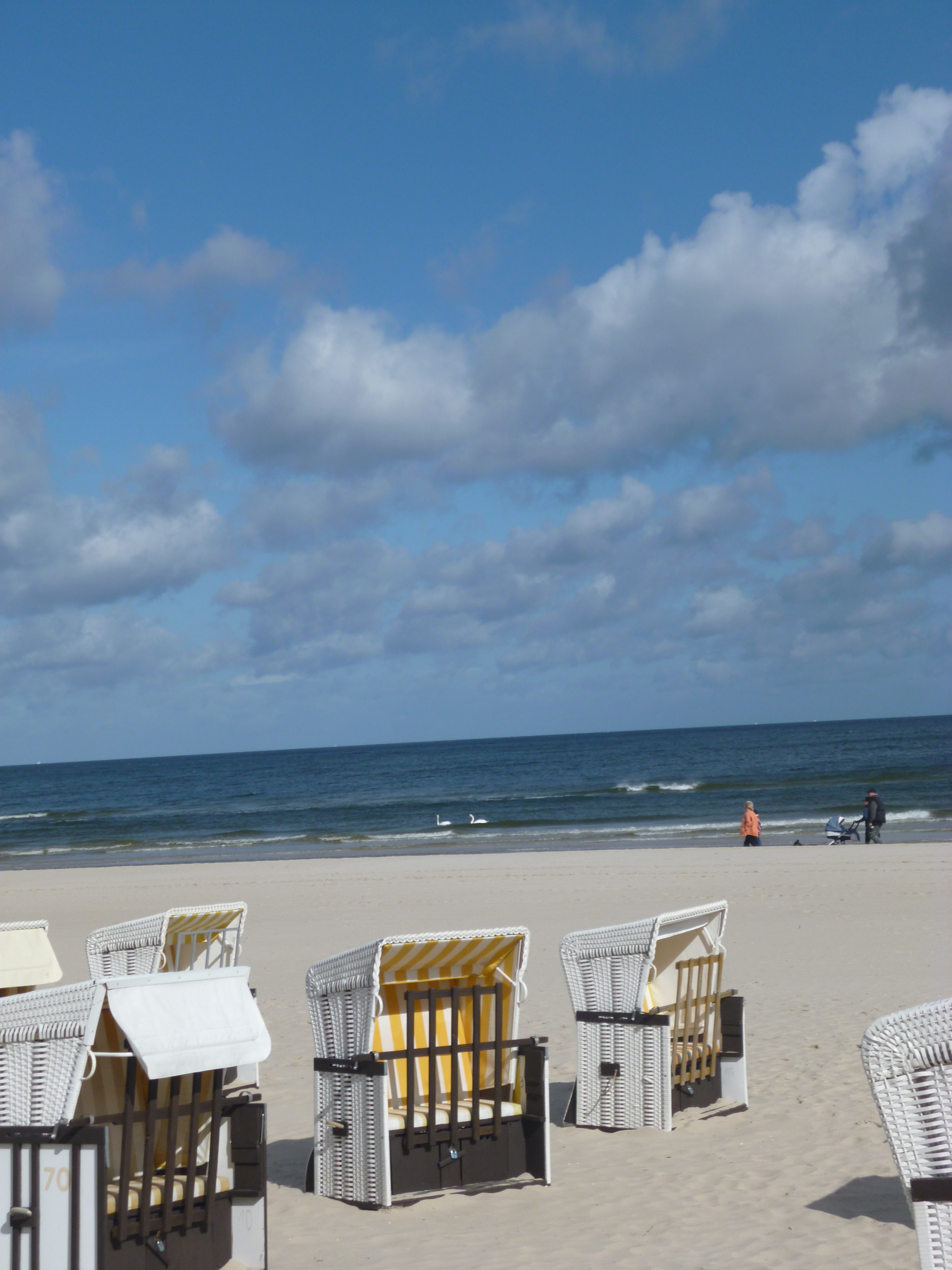
White sandy beach, deep blue water and sky; German beach chairs in the foreground; two swans in the surf.

The first part of the poem is a portrait of normal and politically correct behaviour: healthy diet, regular work, keeping pot-plants, recycling waste, joining in demonstrations, and so forth.

Woman standing on sandy beach, in a blue-and-white striped dress, with a heart motif on her chest.The second part reveals the inner world of the same ordinary citizen, passionate and unreasonable: secretly in love with someone far away… and writing verse about clouds and swans.

The title has a double meaning: ‘vanishing lines’ and ‘flight lines’, as in ‘escape routes’.


Beach of Świnoujście (Swinemünde) on the Baltic Sea, complete with the hooded beach chairs typical of Germany and the swans which live in the estuary. – Photographs: Christina Egan ©2017.

Nächster Halt: Potsdamer Platz

Nächster Halt: Potsdamer Platz

Schwingt ihre Hüften und wippt ihre Füße
fröhlich die Straßenbahn, macht einen Satz,–
weben Zylinder und Wagenradhüte,
Kappen und Häubchen am Potsdamer  Platz!

Strahlen geschwungene Straßenlaternen,
äugen Gesichter aus blumigem Putz,
lachen Plakate und wirbeln und werben:
Pflückt euch das Leben am Potsdamer Platz!

Längst sind zu Staub die Fassaden zerstoben,
längst ist verklungen Berlins Karussell,–
aber im Geiste, dem Zeitlauf enthoben,
dreht es sich kunterbunt, munter und schnell.

Christina Egan © 2017

Noble townhouse with rich stucco ornaments and rose-tree.

This poem is the middle part of my Berlin Triptych, together with Nächster Halt: Bahnhof Zoo and Nächster Halt: Flughafen Schönefeld. Someone arrives at Zoo Station, then passes Potsdamer Platz on a round-trip, and leaves from Schönefeld airport.

For an English poem about the same square, go to Glass Mountain (Potsdamer Platz).

Photograph: Noble townhouse in Berlin — one inspiration for these lines! Christina Egan © 2016.

The Mooness Grows / Die Mondin rollt

The Mooness Grows

The Mooness grows: she’s almost round.
She steps out of a wooded mound.
She knows:
The sea will swell, the sap will well,
a thousand creatures will give birth.
The earth
is restless, waiting for Queen Moon
and for King Sun to round her girth,
her life.
The fruit is red, the fruit is ripe.
The Mooness strews her silent spell:
She glows.

Christina Egan © 2016


Die Mondin rollt

Die Mondin rollt, ein Bronzegong,
vom vielgezackten Horizont
das königsblaue Rund empor.
Ihr hoheitsvoller Ruf erschallt,
bis alles bebend widerhallt
in Stein und Blatt, in Bein und Ohr.

Noch einmal steigt, noch einmal loht
nach Mittagsglut und Abendrot
des vollen Sommers Vollmondschein.
Der Bronzegong um Mitternacht
hat neues Leben angefacht
in Ohr und Bein, in Blatt und Stein.

Christina Egan © 2016


These two poems about the ‘Mooness’ are very similar (and written at the same time) but not translations of each other.

In Greek and Latin, the moon is linguistically and mythologically female, and we should have such a word in English and German.

As a woman, I feel instinctively related to the powerful moon and all life cycles — irrespective of reproductive capacity or activity.

geh aus mein herz

geh aus mein herz

die braunen bauklotzhäuser
mit farbenkastentüren
die weißen blütenkelche
die sich versonnen rühren

im wind aus samt und seide
die schweren purpurrosen
in Salomonis kleide
die deine finger kosen…

der sommer will dich füllen
die erde lädt dich ein
zu laufen und zu schaffen
zu schauen und zu
sein

Christina Egan © 2011


Salomonis Seide

In Purpur zog der Kaiser einst,
in Scharlachrot der Kardinal,
in Violett die Kaiserin
in einen grüngeschmückten Saal.

So prunken die Geranien
in ihrer Sommerprozession
und rufen in das Gartenrund:
“Wir übertrumpfen Salomon!”

Christina Egan © 2014


The appeal ‘Go out and seek joy’ and the metaphor of King Solomon’s silk are taken from the jubilant hymn and folksong Geh aus, mein Herz, und suche Freud, written by Paul Gerhardt in the middle of the 17th century.

The houses in uniform dull colours with front doors in different bright colours are typical for London. So are the little private gardens with geraniums.

The first poem is contemplative and intense, the second one humorous and light. The last line of the first poem is cut up on purpose: to let the word ‘to be’ resound on its own.


For an English poem about the pageant of summer see Lilac and Lime.


Auf dem Riesenrad

Auf dem Riesenrad

Es ruht auf kahlen Wänden
in unserm Rumpelzimmer
und auf verschränkten Händen
ein sonnenroter Schimmer.
Macht das bloß die Gardine,
macht das ein Rosenhimmel?
Ist dies die Holzkabine
hoch überm Stadtgetümmel?
Ach, sei es hingeschrieben
ganz ohne Wortgeflimmer:
Ich will dich immer lieben.
Ich wollte es schon immer.

Christina Egan © 2008

Red wooden cabins on an old ferris-wheel, against a blue and white sky.The old ferris-wheel in Vienna is the one in this poem and in We Married on the Ferris-Wheel.

Photograph: In luftiger Höhe  by Otto Domes (Own work) [CC BY-SA 4.0], via Wikimedia Commons.

Tiefgelb / Tieftürkis

Colour wheel with 18th century labels: clockwise from yellow over red to blue and green; one purple field has paled to pink.Tiefgelb

Die tiefgelbe Blume vor wollweißer Wand,
die frohrosa Büschel vor lehmbraunem Zaun,
der vollblaue Tag über kraftgrünem Land –
der rundbunte Sommer, ein tiefgelber Traum!

Christina Egan © 2016


Tieftürkis

Tieftürkis und lässig prächtig,
sonnensatt und sonnenträchtig
steht der Horizont noch spät.
Schwarze Flammen, schwanken Bäume,
stumm gestaltgewordne Träume,
wenn der wirre Nachtwind weht.

Liegt die Erde endlich nächtig,
scheint der Himmel übermächtig,
unerschöpfter Helle Quell.
Alle Sehnsucht kann noch fruchten
in verborgnen Gartenfluchten
oder einer höhern Welt.

Christina Egan © 2017


Colour adjectives develop only very slowly in languages all over the world. There are still not nearly enough! I don’t see why in German, we have the words ‘deep red’ and ‘deep blue’ — written as one word, even — but no ‘deep yellow’ or ‘deep turquoise’; so I am introducing them. I also made up a number of unusual descriptors for the first poem, leading up to the internally rhyming ‘rundbunt’ for multi-coloured in all colours of the earth or of the colour wheel.

Colour wheel with 18th century labels: clockwise from yellow over red to blue and green; one purple field has paled to pink.


Image: Arnoldus Lobedanius, Utrecht, 1744. (One purple field must have paled to pink.)

Reproduced with kind permission of the Library of Cologne University of Applied Sciences (Fachhochschule Köln).

gedichte über blumen

gedichte über blumen

Buds and fresh leaves on top of shoots above a parkein jeder blumenkranz
ein jedes sommerlied

jede hochgemute knospe
ja jeder nadelfeine halm

ist eine kriegserklärung
an den krieg

Close-up of poppy flower with dew or rain on it, above other red, orange, purple, and white flowers.

eine nichtigkeitserklärung
des nichts

eine liebeserklärung
an die liebe

an alle
ans all

Christina Egan © 2014

Photographs: Christina Egan © 2014 / 2016.


My insistence on writing poems about flowers is a reaction to Bertolt Brecht’s often-quoted suggestion that a conversation about trees borders on criminal negligence because it is silent about atrocities. In the poem An die Nachgeborenen from the 1930’s he exclaims:

“Was sind das für Zeiten, wo
Ein Gespräch über Bäume fast ein Verbrechen ist
Weil es ein Schweigen über so viele Untaten einschließt!”

Brecht’s idea is  startling and ingenious; but I hold that all praise of a flower or a bud is a praise of life and peace: ‘a declaration of war / against War… a declaration of love / to Love.’

Also, if you have read a few of my poems, you will have noticed that they do not describe flowers and trees alone, but use them as images for human life and joy, suffering and death. ‘Poems about flowers’ has 35 words — but amongst them are ‘nothingness’ and ‘the universe’!

Sambation

Sambation

O daß der Mühlenräderlärm der Plätze
verrauschte wie ein Sommerwolkenbruch,
das grelle purzelnde Geröll der Menge
versiegte in der Großstadtstraßenschlucht,

auf daß das Flußbett sich durchwandern ließe
an Pforten, Traufen, Blumentrog vorbei
und nur die Schwalbe in die Stille stoße,
hoch, froh, mit Sichelflug und Silberschrei.

O daß die Lichterstrecken, Lichterhaufen
verblaßten wie das Nordlicht überm Meer,
auf daß die Sterne aus dem Dunkel tauchten
wie ein mit Bronze überglänztes Heer!

Christina Egan © 2017


The mythical river Sambation at the edge of the known world cannot be crossed because it is wild and full of mud and rocks — or even consists of rocks instead of water.

Here, the busy streets of a big city are experienced as a ravine full of tumbling stones, while the screech like grinding millstones; by night, the galaxies of lamplights drown the stars.

The opposite images are the quiet riverbeds of empty streets; the silent sky punctuated by the flight and cry of a swallow; and then the stars re-emerging…

This poem will be published in the German-language calendar Münsterschwarzacher Bildkalender 2019 (available from mid-August).

trompetenlied

trompetenlied

ich liebe dich
mehr als das licht
das sich im sturz
des stromes bricht

Narrow gorge with stream skipping around boulders and some vegetation on the rocks.ich liebe dich
dein angesicht
in dem sich geist
mit fleisch verflicht

den klaren blick
die kühne hand
von allem anfang
mir verwandt

das dunkle haar
wie waldesrand
die helle haut
wie meeressand

ich liebe dich
mein nachbarland
zum ziel der zeiten
hingespannt

Christina Egan © 2014

Photograph: Atlas Mountains, Morocco.
Christina Egan © 2012.

Schläft ein Lied / Sleeping Choir

Schläft ein Lied von tausend Zungen

Schläft ein Lied von tausend Zungen
im geweihten Marmorrund;
und der Stein hebt an zu schwingen,
wenn die Orgel perlt und summt,
und der Stein hebt an zu klingen,
wenn die Orgel schwillt und braust –
Wird das Herz vom Ruf durchdrungen
und der Leib in Glanz getaucht.

Christina Egan © 2017


Sleeping Choir

Sleeping in the marble round
choir of a thousand tongues;
and the stone vibrates and hums,
when the organ wakes to sound,
and the stone pulsates and sings,
when the organ swells and roars –
In your heart the message soars,
steeped in splendour are your limbs.

Christina Egan © 2018


This poem is developed from a key verse of German Romanticism. Joseph von Eichendorff (popular to this day and one of my favourite poets) imagines the world dreaming and a song slumbering within; you need to find the magical word to awaken them.

Schläft ein Lied in allen Dingen,
Die da träumen fort und fort,
Und die Welt hebt an zu singen,
Triffst du nur das Zauberwort.

Joseph von Eichendorff

The lines were also inspired by a Pentecost service at Notre Dame de France at Leicester Square in London: when the organ plays at a high volume, its circular walls — not really marble, but snow-white — seem to vibrate and sing around the visitor.

The German version of this poem will be published in the calendar Münsterschwarzacher Bildkalender 2019 (available from mid-August).

Photograph: Catholic church Stella Maris, Binz on the Isle of Rügen, Germany. Christina Egan © 2016.