Weißer Schnee auf roten Rosen

Weißer Schnee auf roten Rosen

Graue Gänse, grauer Himmel
Stumme Stämme um den Teich
Ungewohntes weißes Flimmern
Und ein Schimmern im Gesträuch

Weißer Schnee auf roten Rosen
Hingesunken über Nacht
Stengel von der Last gebogen
Späte Knospen überrascht

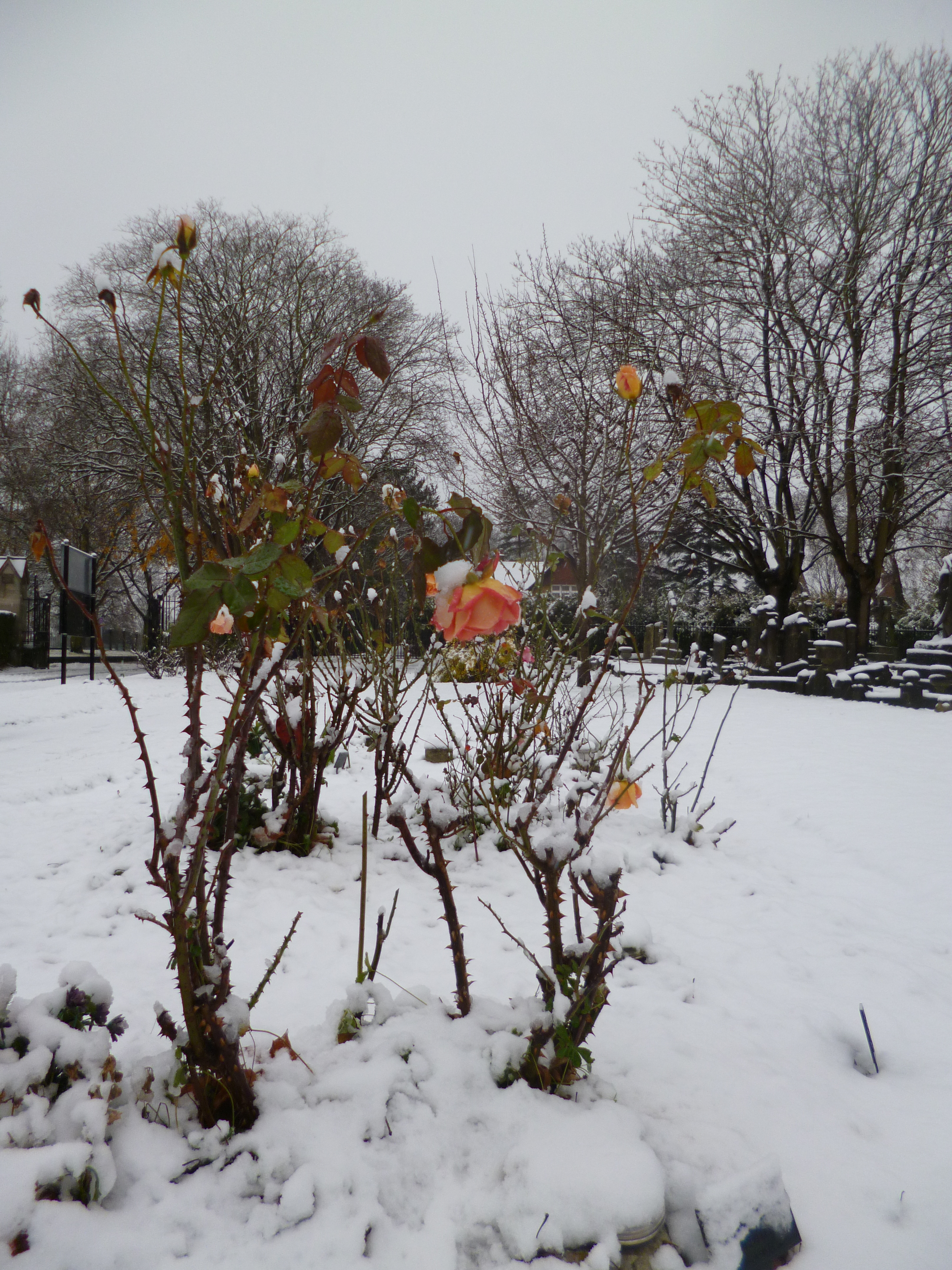
Glowing roses, golden with red rims, standing in thick snow amongst bare trees.Weißer Schnee auf bunter Mütze
Und dein Lachen wie Gesang
Häherschrei von Tannenspitze
Glockenruf minutenlang

Weißer Schnee auf roten Rosen
Weißer Hauch auf rotem Mund
Ja, auch ich hab dich erlesen
Niemals tat ich es dir kund

Erster Schnee auf grauen Gänsen
Jede Flocke wie ein Stern
Weißer Schnee auf roten Rosen
Und ich weiß: Du hast mich gern

Christina Egan © 2017

White snow melting on red roses.
Photograph: Christina Egan © 2017.

This is the second of two love songs which could stand alone or be sung by a woman and a man — from opposite ends of a stage or hall, though…

In White snow on white roses, the first person confesses she (or he) still secretly wishes they had got together a long time ago, and wonders if her friend feels the same.

In White snow on red roses, the second person reveals that he (or she), too, has longed for this relationship all along, but he never lets his friend know… not now either.

Each of them sings into the wind, into the snow… The ‘years that flew away’ like the wild geese in the first poem and the ‘late buds surprised’ by the snow in the second poem show that the pair are at a later stage of life.

Weißer Schnee auf weißen Rosen

Weißer Schnee auf weißen Rosen

Wie die grauen Gänse zogen
Mit dem schneegeladnen Wind
Sind die Jahre uns entflogen
Erst gemächlich dann geschwind

Wie die Flocken niedertaumeln
Daß die Welt zu Weiß gerinnt
deckt die Zeit die bunten Träume
Erst gemächlich dann geschwind

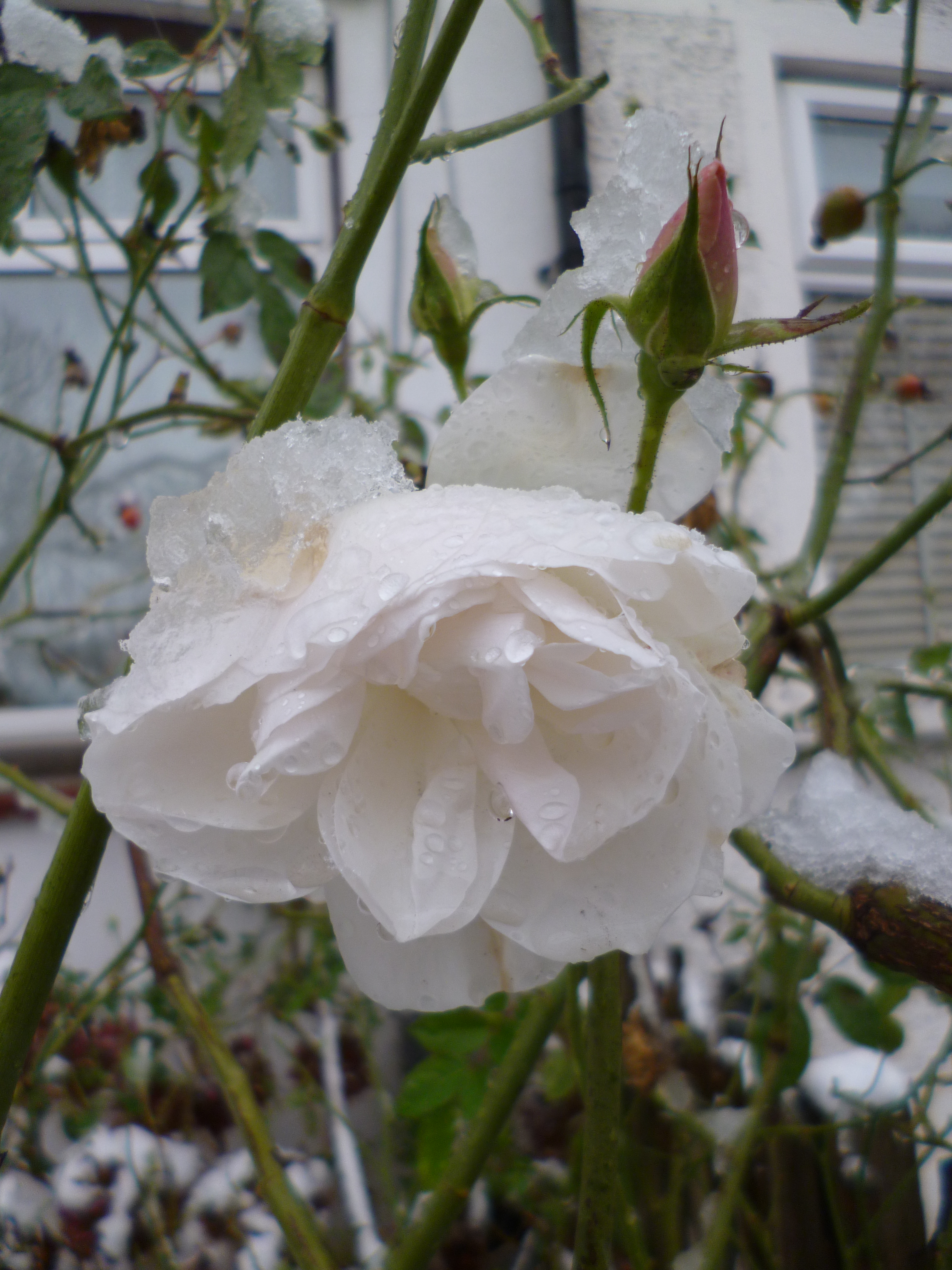
White rose, pink buds, hawthorns, all covered by melting snow.Stehst auch du am stillen Fenster?
Rührt der wilde Schnee auch dich?
Haschst auch du noch Luftgespinste?
Denkst auch du noch stets an mich?

Blumenflammen sind vergangen
Und die Welt wird farbenblind
Niemals hab ich dich umfangen
Niemals gab ich dir ein Kind

Wilder Schnee: ein stummes Tosen
In dem strengen reinen Wind
Weißer Schnee auf weißen Rosen
Erst gemächlich dann geschwind

Christina Egan © 2017

White snow melting on white roses.
Photograph: Christina Egan © 2017.

This is the first of two love songs which could stand alone or be sung by a woman and a man — from opposite ends of a stage or hall, though…

In White snow on white roses, the first person confesses she (or he) still secretly wishes they had got together a long time ago, and wonders if her friend feels the same.

In White snow on red roses, the second person reveals that he (or she), too, has longed for this relationship all along, but he never lets his friend know… not now either.

Each of them sings into the wind, into the snow… The ‘years that flew away’ like the wild geese in the first poem and the ‘late buds surprised’ by the snow in the second poem show that the pair are at a later stage of life.

Standing in the Slush

Standing in the Slush
(February Haiku )

*

Standing in the slush,
by the bus stop, I’m looking
for lost memories.

*

Wet empty benches,
wet winding sand paths, furrowed
by hurried footsteps.

*

I’m rubbing my eyes,
weighed down by dreams, and there –
first leaves like lances!

*

Christina Egan © 2013


Like February Sparks, these haiku were written at the hardest time of the year, when our strength is about to be exhausted entirely. This is when we have to be strongest, when we have to fight hardest, as the previous post, Venus and Mars, describes. At least, in southern England, flowers appear very early, in winter, really, to cheer you up…!

I Sought the Star / Weihnachtskerzenflamme

I Sought the Star

Weary was, had wandered far…
        Again, it snowed.
Without a doubt, I sought the star
        above the road:

 The star that had been made for me,
        a radiant face,
above the maze of destiny,
        above the ice.

I climbed a random rugged hill –
        and there it burned!
Above a shelter bright and still
        and warm and firm.

And still they glow, the tiny spark
        and snowed-in home,
both given to my hungry heart
        by faith alone.

Christina Egan © 2010


Weihnachtskerzenflamme

Wie eine Weihnachtskerzenflamme strahlt
dein sanftes schmales Angesicht,
auf dem sich langersehnte Freude malt,–
so hell bist du und ahnst es nicht.

Wie hoheitsvolle Rosenknospen stehn
die Hände in dem goldnen Licht,
so zart, als würden sie im Wind vergehn,–
so weich bist du und weißt es nicht.

Christina Egan © 2014


A ‘Christmas Candle Flame’ as an image for a joyful, gentle, guileless face works only where, like in Germany, the tradition of real candles is upheld!

The second stanza compares the person’s hands to tender, graceful, regal rosebuds. The poem appears to describe a child but was in fact written for an adult.

Beetles on the Ark / Urban Copse

Ripples of People

Ripples of People
(Spring Equinox)

*

Ripples of people,
uneven waves, sudden whirls,
fast currents of cars:
a wayward river within
a canyon of grand buildings.

*

These neat white windows,
row upon row, road after road,
a thousand eyes
trying to catch light, praying
to touch the feeble sunset.

*

Christina Egan © 2013

Busy junction in the dusk, with red and yellow lamps of cars and buses glaring.

These tanka were written in Knightsbridge, London,
in the last days of March — after equinox! —
when after months of dull and dark skies,
you may still be desperate for light and warmth.
For similar poems in German, see Alles drängt vorwärts.

Photograph: Deptford Broadway, London.
Michael Oakes © 2016

Friday in Lent

Friday in Lent

Friday morning.
The city is busy and tired
under the closely curtained sky.

The headlines shout out:
Things fall apart,
trains, towns,
countries, couples.

Life hurts.

The day is a prison, a lenient one,
with gardens and books as windows
and magical messages beamed onto screens,
with the freedom of speech
and the purple pursuit of the heavens.

Christina Egan © 2001


Purple is the colour of Lent, representing suffering; you will find churches decorated —and their statues covered up — with purple fabrics. Purple (violet, lilac, mauve) is a slightly melancholy colour, but it also has dreamlike and spiritual qualities. My ‘purple pursuit’ has all these shades of meaning; ‘the heavens’ could refer to religious faith or simply to a decent and fulfilled life on earth, as in ‘Liberty and the pursuit of Happiness’.

Friday is the time when Christians remember Jesus’ passion and keep some fasting, a miniature Lent within each week… or at least the time when they do remember their faith during Lent. The positive messages on your screen could come from a friend — or from God, if you believe in Scriptures!

For a German and English poem about Lent, go to Fastenzeit / Lent.

Le tesson / The Shard

Le tesson

En février givré, je fouille
les feuilles mortes pour des fleurs
modestes et fortes et courageuses :
soldats contre la froideur

ou des pierres précieuses
éparpillées en bas, fragments
pâlis de la Cité Céleste
que quelques éblouis attestent.

Parfois, une sphère lumineuse
me frappe, vive mais tranquille :
plutôt que le premier bouton
ton œil est le tesson qui brille.

Christina Egan © 2017

A pair of mauve crocusses, wide open, in bright sunlight, with honey-bee hovering above.

The Shard

In frosty February, I scour
decaying leaves for the first flower:
some modest soldiers, strong and bold
against the kingdom of the cold,

or precious stones on muddy ground,
some faded fragments of the round
of Heavenly Jerusalem,
that dazzling more-than-real realm.

At times a circle full of light,
as calm as lively, strikes my sight:
but rather than spring’s early guard
your eye is the resplendent shard.

Christina Egan © 2017


For a German and English parallel poem about the first spring flowers, go to my previous post, King Spring / König Frühjahr.

Photograph: Christina Egan © 2017.
Crocusses with honey-bee, captured in London in mid-February!

Mitte Februar / Schnee über Nacht

Mitte Februar

Die Welt hat allen Glanz verloren
wie eine ganz verwelkte Frau.
Am Himmel Wolken, Schnee am Boden –
ein Leichentuch von blassem Grau.

Dahinter kämpft mit langem Atem
das fern verbannte Feuerrund:
Unmerklich schmelzen schon die Schatten,
und Farbe braut im Untergrund.

Die schwarzen Zweige sind lebendig,
das nasse Moos voll neuem Saft,
und das ermattete Gelände
wird auferstehn mit satter Kraft.

Christina Egan © 2012


Schnee über Nacht

Der Schnee hat wie ein Federbett
die kahle Erde zugedeckt,
begräbt die Schuld,
begräbt den Schmerz
in Gottes gnädiger Geduld,
in Gottes unbegrenztem Herz.

Christina Egan © 2012


Mitte Februar was published in the Rhönkalender 2015 (entitled Ende Februar). The 2017 calendar includes three poems by me and is still available.