This poem was inspired by walks through the grounds of 18th century palace Schloss Fasanerie, (Eichenzell near Fulda, Germany), which are freely accessible to the public.
Is this moon new or young, a sliver or a crescent, silver or golden in the deep blue, the newly deep sky, is it striking or dazzling or mesmerising?
Is this a late spring, belated and all the more welcome, bursting with life, with green, bright green, saturated with rain and sunshine, saturated with colour and heat, heat unfamiliar and all the more welcome, or is it sudden summer?
Is this life at last, is this joy, is this joy of life, is it zest, is it just new life-force or is it happiness or elation or bliss?
Reality, as it laps up against the shores of your eyes and your ears and your nose, reality as it washes over the leas of your skin and seeps beneath, cannot be captured in words, not even in verse: reality, so dense it feels like a dream, is not a dream cloud nor a word cloud.
Although this poem would make a good one, with the message of sudden summer sounding out like birdcall, flooded with light and colour, steeped in joy, as if words were written from life and for life, as if words were part of life, of the wide earth and the deep sky and the reality beyond, of the ever-flowing life-force.
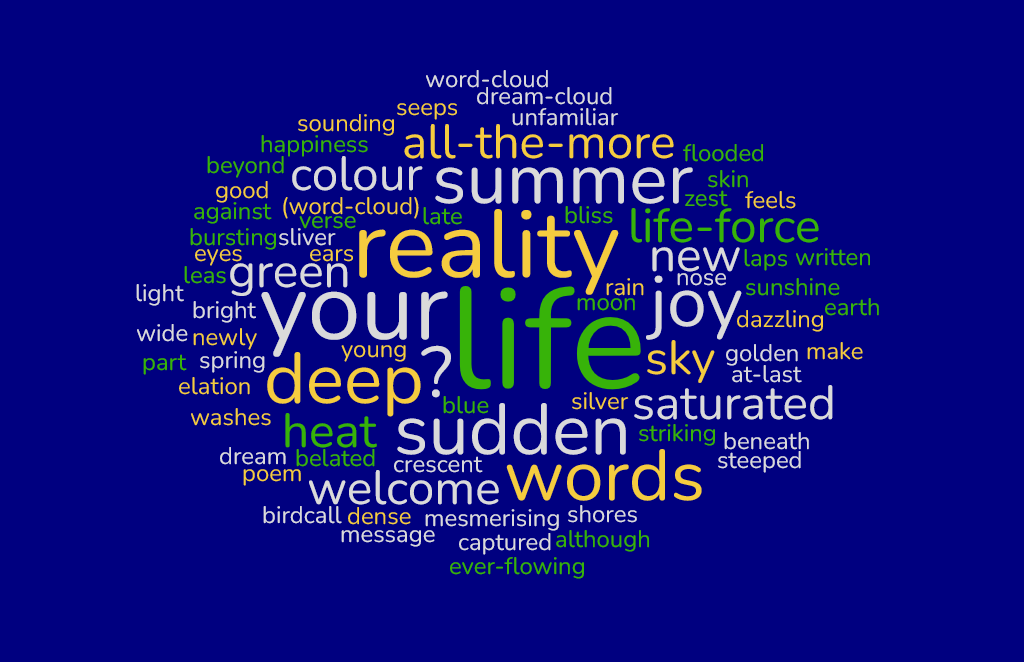
Word cloud of the poem Sudden Summer (colours edited but randomly allocated).
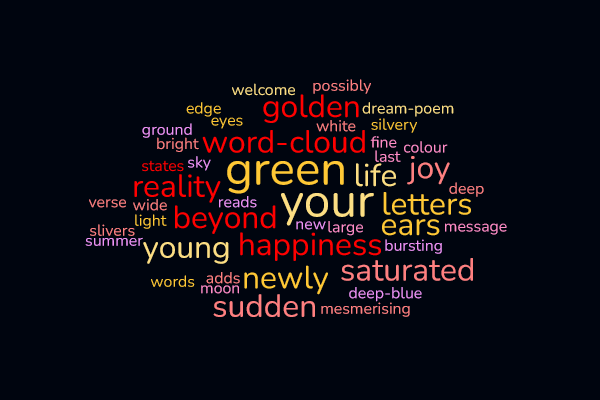
Happiness Beyond (Word Cloud)
Your life is a green reality, it reads in large green letters, and newly young; the sky is golden at last, it states in fine golden letters, and saturated with joy; eyes and ears are bursting with wide bright light, it adds in silvery white; and at the edge there is happiness beyond colour on deep-blue ground.
These are welcome words, sudden and possibly deep, a mesmerising message from slivers of verse in your ears, from the new dream poem, from the word cloud of Sudden summer: Your life is a green reality saturated with joy under the newly young moon.
Das Spiel des Lichtes und das Spiel der Winde auf goldnem Haar und goldnem Mauermoos, die Käferlandschaft rauher brauner Rinde und große Schmetterlinge, schwerelos…
Hundertmal dieselbe Runde drehen, wenn zuletzt die Lebenskraft verfällt,– aber nie hat man sich sattgesehen, nie am Erdkreis noch am Himmelszelt!
Blaue Gaukeleien: Himmelssplitter! Feuerfarbne Falter: Funkenflug! Vogelchor, Geläute und Gewitter,– niemals trinken Aug und Ohr genug.
The title means “Looking forward at the beginning of spring” in one word: “spring-beginning-forward-joy”! A poem about old age, full of hope and zest. It was written on spring equinox, after a walk round the block with a very aged person. Poignantly, soon after, the person grew too weak for walks.
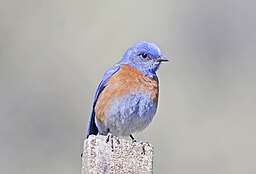
A January poem from a northern part of Europe… The bluebird does not live here, but it got into the poem because its feathers are of a luminous orange and blue like the sun and the sky!
A new poetic form: three lines in each stanza, with irregular lenght and irregular rhymes — but each stanza having ten stressed syllables, with one unstressed syllable in between, making the flow of the language regular, natural and musical at the same time!
The poem was written on February 14th. The Rhön mountains have a harsh climate with long winters characterised by cold and snow and fog. All the more is spring welcome, even the early signs of it…


 Christina Egan