Schöpfung (Darß)

Schöpfung
(Darß)

I.

schwebend zwischen ungeheuern
wassern und verwunschnen teichen
will die erde sich erneuern
wälder zeugen dünen häufen

II.

wird die see den see erwählen
kraft die ruhe salz die süße
muß sich blau dem grau vermählen
daß es ineinanderfließe

III.

wie die schaumgekrönte göttin
einst dem wilden meer entstieg
so dem bloßen sand die blüte
und dem wüsten schmerz das lied

Christina Egan © 2015


On the Darß (Darss), you can observe ‘Creation’ at work:
between ocean and ponds, between dunes and woods.

The last poem describes the ‘Creation’ of art as another
natural, elemental, process: beauty born out of pain.

You can read an English poem about the Darss at
Midsummernight Far North.

Parallel English and German poems about a similar
phenomenon on the German North Sea coast are at
Views of North Sea Islands.
Buchenland / Heimaterde

Buchenland

Schon der Frühherbst
Schüttet Nebel aus
Über die Hügel hin
Haufenweis.

So verschwimmt mir der Pfad
Bevor noch die Buchen brennen
Und die stolzen Wiesen vergehn
Zu lustlosem Staub.

Doch unterm zerklüfteten Fels
Sitzt sommersatt das Moos
Blüht mondhell die Distel
Aufs Geheiß verborgener Geister.

Christina Egan © 2013

heimaterde

unter der haut
schimmert sie durch
die rote krume
der ich entwuchs

hinter den augen
blinzelt es vor
das urgestein
schwarz und gewaltig

unter dem haar
wirbeln sie hoch
nebel und wind
die mich umfingen

unter der zunge
schlummert sie noch
die fruchtbare sprache
die mich entfachte

Christina Egan © 2013

The first poem describes an autumnal landscape with trees in flaming colours and fog drifting in the dales. The name, Land of Beech Trees, stems from the times when most of Germany was covered by dense forests.

Nature appears as animate, sentient, and even spiritual: the meadow is proud and the moss content, while hidden spirits command a thistle to blossom bright as the moon.

The second poem reminds us that our bodies are made of the world around us — the air and water, the earth and its fruit, the flesh and bone of our ancestors while our minds are moulded by the language of our parents and ancestors.

The speaker imagines that red soil shines through his or her cheeks and black rock blinks through her pupils, while her hair is softened by thick fog and tousled by rough wind.

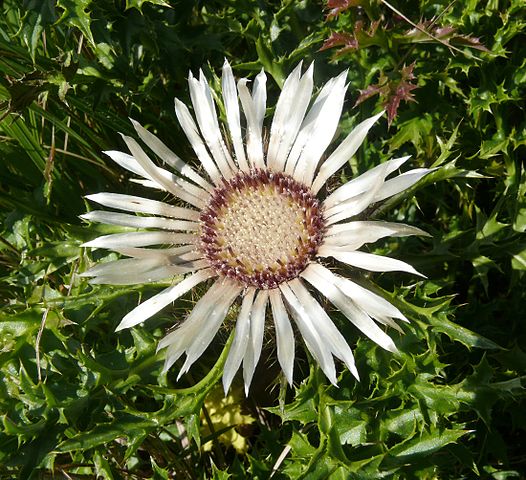
526px-Carlina_acaulis_160907These words were inspired by the landscape and climate of the Rhön Mountains in Germany.

Their symbol is a rare wildflower, the silver thistle.

Photograph: „Carlina acaulis 160907“
by Bernd Haynold via Wikimedia Commons


Auf den Höhen der Rhön

Auf den Höhen der Rhön
(Juli-Haiku)

*

Mit blauen Blumen
bestickt, bläht sich das goldne Korn,
ein Tanzgewand.

*

Auf dem Kiefernduft
gleitet der Habicht dahin
hoch über den Höhn.

*

Die Kuppen im Dunst,
ein perlgrauer Scherenschnitt
vorm Silberhimmel.

*

Im kupfernen Laub
ganze Quader von Jade:
bemooste Felsen.

*

Christina Egan © 2003

The Rhön Mountains, part of the Central Uplands of Germany, stand out through their wild and austere beauty. – This series of haiku has just been published in the photo calendar Rhönkalender 2016.

English speakers: This text, titled On the heights of the Rhön, works quite well in a translation software. You can also see two wonderful panoramas of the mountains at the link to the calendar and some more on Wikipedia.

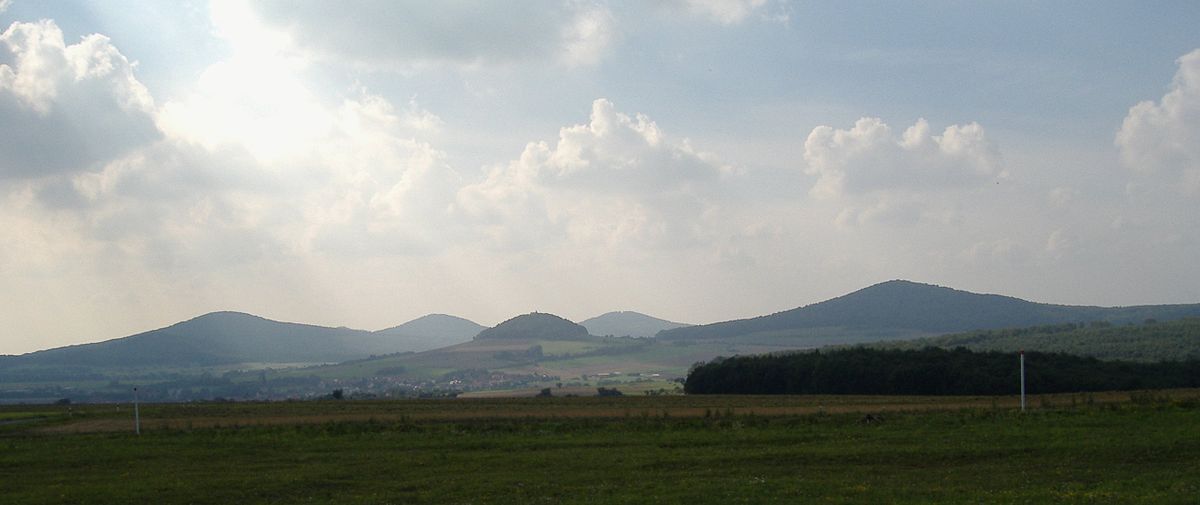
Silhouette of low silver-blue mountain range against silver-blue sky, just like in the poem.

Photograph: “Kegelspiel” by N8mahl at the German language Wikipedia.

Midsummernight Far North

Midsummernight Far North
(Darss)

This is the edge of the land.
The number of signals is seven:
The shimmering sand,
the green in the sea,
the red in the sky,
the crescent and star,
the bonfire’s glint,
the lighthouse’s fan,
the flashing afar —

The number of wonders is seven.
This is the midsummernight,
this is the height of the light,
this is the hem of the heavens.

We are alive.
We are together.
This is all here.
This is forever.

Christina Egan © 2015

The Darß (Darss) is a  tranquil strip of land between some lakes and the Baltic Sea.
Around summer solstice, dusk is only between ten and eleven (summertime). 
A German poem about dusk on the Darss is ostseeschlaflied (Baltic Sea Lullaby).

ostseeschlaflied (Darß)

ostseeschlaflied
(Darß)

hinaus tritt aus dem hohen wald und schau
wie sand auf see und see auf himmel trifft
wie sich am abend spiegelklares blau
in unverhofftes violett verwischt
wie sich der wellen und der wolken grau
in hundert regenbogenschatten bricht
zurück nun tauche in die dunkle au
die nacht ist nah doch ewig ist das licht

Christina Egan © 2015

The Darß (Darss) is a majestic primeval
island at the very edge of Germany.

You can read an English poem about
the Darss at Midsummernight Far North
and more German ones at Schöpfung (Darß).