Glazed Clay

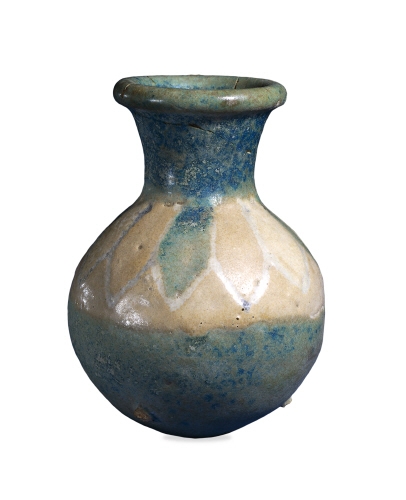
Jar, elegantly curved, with brown and blue glaze.Glazed Clay

Two mighty rivers’ ceaseless flow
beneath a high and cloudless sky;
to either side the ochre glow
of arid countries rolling by;

and here and there a golden maze,
the buildings’ cubes, the cities’ grid:
this jar with blue and brownish glaze
from Babylon still mirrors it.

Christina Egan © 2016

Mesopotamian jar (9th to 7th c. BC) Photograph: © The Trustees of the British Museum.

The city and country of ‘Babylon’ were under Assyrian rule at the time the little jar was made, but I just used the name as the most familiar for all the civilisations of Mesopotamia.

For a German poem about Babylon with the Euphrates and the Hanging Gardens, see Die Hängenden Gärten.

The perfect elegance of this tiny everyday object is an example for the simple beauty I call for in Fewer Things, where you can also see a red Roman bowl. 

Ein Muster aus Muscheln / Greek Islands

Ein Muster aus Muscheln

Ein Muster aus Muscheln und Bernstein und Bein,
mit Karneol und Koralle durchsetzt,
auf lapislazuliblauem Grund:
So leuchten die Inseln im Sonnenschein,
vor dreitausend Jahren… und letzthin… und jetzt:
ein Mosaik, ein vollendeter Fund.

Vors Fenster des sinkenden Flugzeugs gespannt,
vom Guckloch des finsteren Turmes gerahmt
– nur einen Moment – nur einen Moment –
das Muster aufs wartende Auge gebannt,
die Farben ins wache Gedächtnis gemalt:
ein Bild, das nach dreißig Jahren noch brennt.

Christina Egan © 2016

Standard_of_Ur_BM_121201

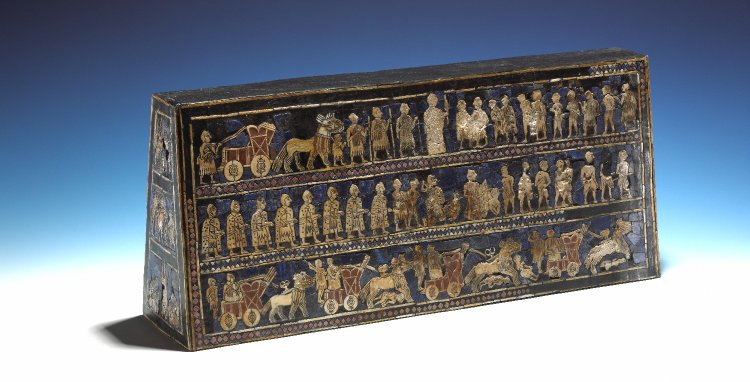
Standard of Ur (2500 BC). – Photograph© The Trustees of the British Museum.

I am showing this ancient object – twice as old as our classical antiquity – because it must have inspired my poem about Greece. The images on the box are made of shell, lapis lazuli, and red limestone, but I did not remember those details or  even think of the thing. When you have the chance to go to London, do not miss out on the Sumerian galleries of the British Museum!

The longing for a return to Greece, both for the Mediterranean environment and for the ancient civilisation, is also expressed in On Eating Olives / Beim Olivenessen  and in Greek Islands  (below). There are a number of poems about Crete in German and English on this website.


Greek Islands

There is more blue in the air
between here and the horizon,
between morning and evening,
than the cup of the eye can hold.

So my soul may flow over
into the sky,
into the sea,
into this scattered paradise…

Christina Egan © 2012 


On the topic of the blue Mediterranean Sea, see also Meine blaue Mauer  and O Heimatland aus Stein und Licht. On the manifold colours of the same sea, see The Purple Sea / Das lila Meer.

gesternmuster / Zeit-Räume

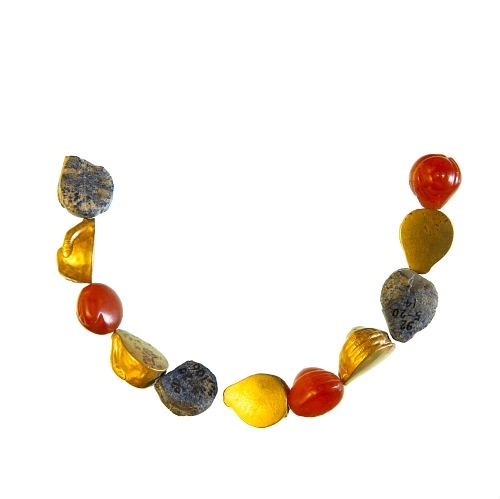
A dozen beads of gold, lapis lazuli, cornelian.gesternmuster
(Knossos)

die kolossalen säulen
der stolzen pinien
jener erhabene baldachin
der schutz vor der sonnenflut bietet

die schwarzen weißen blutroten pfeiler
im heiteren palastlabyrinth
jene flecke in einem gesternmuster
das jahrtausendealt ist

Christina Egan © 2016

This is a translation of The pattern of a yesterday . At that post, you can find some photos and a link to an artistic impression of the palace 3,500 years ago.

Photograph: Minoan beads from Crete in gold, lapis lazuli, cornelian, ca. 1700-1500 BC. – © The Trustees of the British Museum.

Zeit-Räume
(Knossos)

Terrassen, Treppen, rote Säulen
zwischen himmelhohen Bäumen,
Marmorschwellen, rote Wände,
um die Ecken neue Treppen…

Wie im Traume muß man wandern
durch die Höfe, durch die Säle,
durch die Wärme, durch die Kühle,
still von einem Raum zum andern…

Schlanke Bäume, schlanke Menschen
stehn vor heitrem Himmel drinnen
in den buntbemalten Zimmern
heute wie vor tausend Jahren.

Keine Läden vor den Fenstern,
in den Türen keine Flügel,
keine Grenzen zwischen Innen,
Außen, Unten oder Oben,

keine Pforten zwischen Heute,
Gestern oder Vorvorgestern
zwischen einem bunten Zeit-Raum
unter Pinien und dem andern.

Christina Egan © 2016

Geflecht / Geflechte

Geflecht

Jedes Leben ist verstrickt,
Masche um Masche, Stich um Stich,
in die Leben neben ihm,
ob wir’s wollen oder nicht.

Jede Reihe ist verschlungen,
ohne daß das Garn je bricht,
in das vorige Geflecht,
ob wir’s wissen oder nicht.

Jeder Jahrgang ist der Boden
für die nächste bunte Schicht:
Kaum geboren, sind wir Ahnen
für ein künftiges Geschlecht.

Christina Egan © 2015

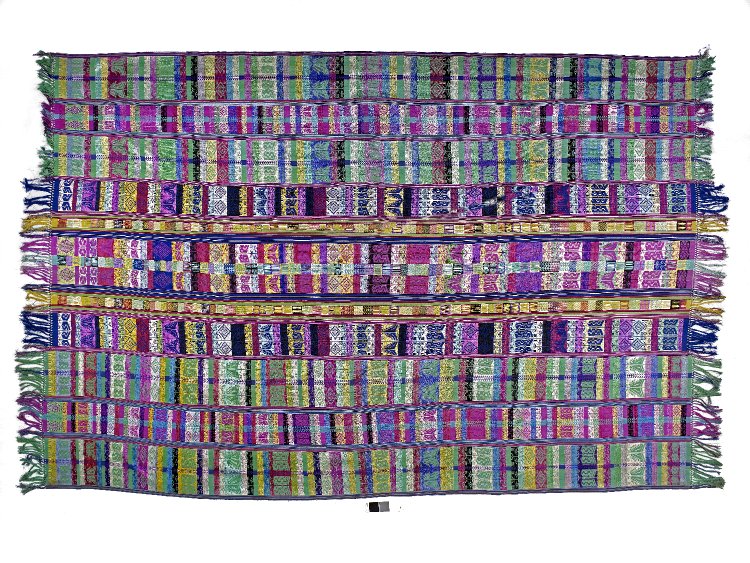
Silk cloth dominated by vivid pinks and greens.

Geflechte
(Altstadt von Köln)

Reihen auf Reihen von Häusern,
hell und freundlich im Frühlingslicht,
Reihen auf Reihen von Fenstern,
schimmernd in allen Augenfarben.

Und hinter einem jeden Fenster
Gesichter… Geschichten… Geflechte.
Und unter einem jeden Pflaster
Pflaster… Pfade… Schwellen.

Stockwerk um Stockwerk von Leben,
hinauf ins ausgelassene Blau!
Schicht um Schicht von Geschichte
bis in den unbetretenen Staub.

Ich strecke mich hin auf dem Mäuerchen hier
und höre die Vögel und höre ein Herz –
Das Herz diese Platzes? Das Herz dieser Stadt?
Mein eigenes Herz, wie es schlägt für die Stadt?

Christina Egan © 2016


These poems describe human life as a knitted or woven tissue: every person is a mesh amongst, above, and below others. Every little life is part of a layer of history, as every modest buidling and ordinary street is.

Every life is interwoven with  others. Every single one of us is history!

I wrote the second poem on the way back from Cologne, where I had briefly rested on a little wall, which turned out to be in the area of the ancient forum and which in hindsight reminded me of excavated foundations.

For a poem on weaving words into a poem, see the previous post, Word Weaver.

Photograph: Silk cloth from Madagascar. – © The Trustees of the British Museum

Die Hängenden Gärten / Palmyra Perennis

Die Hängenden Gärten

Schwarz liegt der Strom, von Gestirnen benetzt,
blendend erhebt sich der Herrscher der Nacht
über die Hängenden Gärten,
über den künstlichen Gipfel,
welcher den Hügel ins Flachland versetzt,
welcher den Wald in die Großstadt gebracht,
über die plätschernden Gärten,
über die flüsternden Wipfel…
Flimmernd erhebt sich die Harfe zuletzt,
warm liegt die Stadt in versilberter Pracht.

Christina Egan © 2015

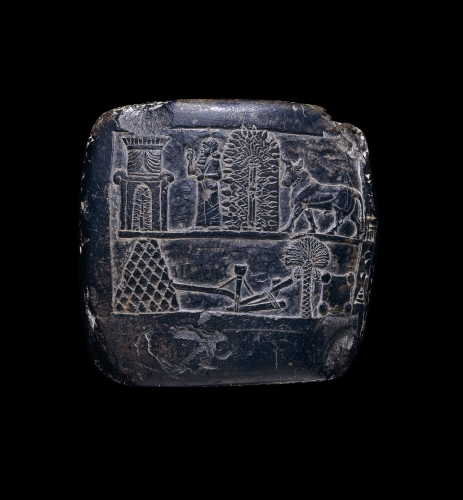
Basalt stone with carved images of trees, with a building, an animal and a man

The city of Babylon. Assyrian, 7th c. BC. —
© The Trustees of the British Museum
(Ref. no. 00032445001)

These musical lines evoke Babylon by night:
the moon and stars reflected in the Euphrates,
the Hanging Gardens rising above the big city,
murmuring fountains and a sparkling harp…
It could be the instrument which rises
sparkling like a star — or its voice.

Palmyra Perennis

Sank auch der stolze Bogen dahin mit dreifachem Seufzer,
ragt uns sein Bildnis im Geist schwerelos über dem Sand.
Sind auch zum Staube gekehrt der Ahnen goldene Hallen,
tragen das Erbe wir fort: sanften Triumph der Vernunft.

Christina Egan © 2015

For a picture of the ruins of Palmyra and a comment on
this poem on enlightenment, please look at my
MOTTO.

The view that cultural vandalism should be recognised as
a war crime akin to genocide has been discussed recently.

Ode to London Wall

Ode to London Wall

Moss is conquering your broken stones,
weeds are rooting between your bricks;
but you still stand tall, Wall,
facing the winds, the seasons, the years.

The round foundations of your towers
harbour herbs now, neatly labelled;
but your walkways bore watchmen once,
to guard the goods going round and the people.

You lie at my feet now, tall Wall,
I look down from the walkway above you;
but when I step down by two thousand years,
I see you could shelter me still or crush me.

And then I seem to remember –
we have met before, Wall –
you guarded me indeed –
and I guarded you!

On the treacherous clay we erected you,
in the obnoxious fog and sleet:
even and straight and strong as a rock,
forming a line in the marshy meadow,

forming a square along the vague river,
forming a knot in the net of roads,
from London to Chester and York,
from Paris to Sousse and Palmyra.

O Wall of soldiers and explorers,
O Wall of merchants and accountants:
yes,
you still stand tall and you talk,
you tell me to tell your story to all.

Christina Egan © 2015

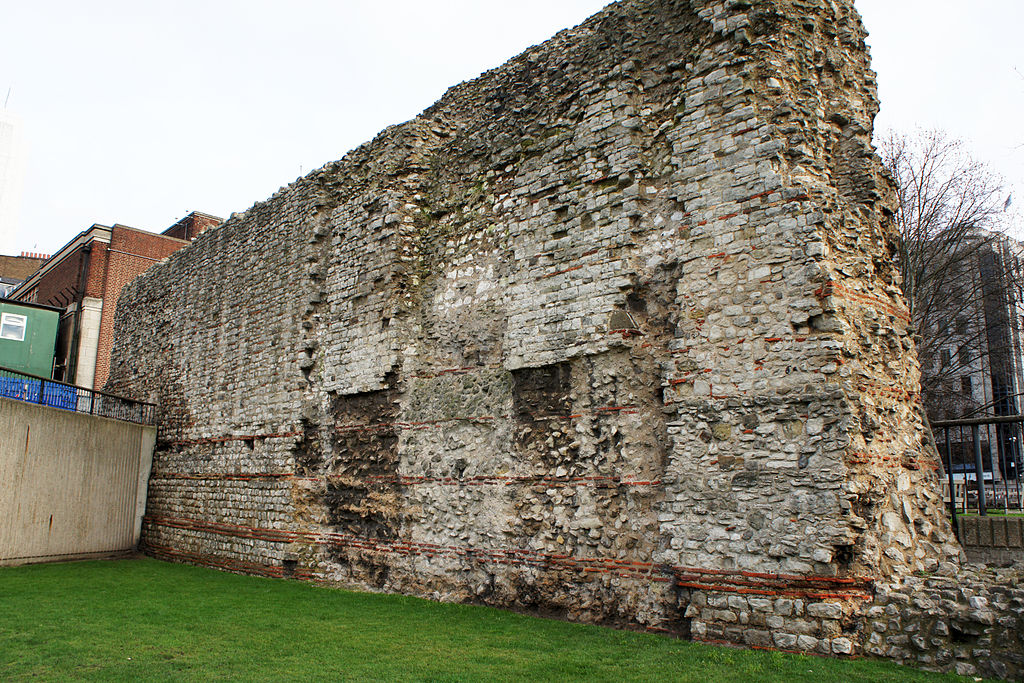
High wall of neatly piled stone and brick in the midst of the city

You can see a section of the Wall of London and learn more about it in the Roman Galleries of the Museum of London. A visit there inspired me to write these lines. I talk to the stones as they talk to me; and I pass their story on.

Photograph: Roman city wall near Tower Hill Tube station,
by Mariordo (Mario Roberto Durán Ortiz).

London Wall Had Fallen Down

London Wall had fallen down,
brick by brick and stone by stone;
in the crenellation’s crown,
storks and starlings built their home.

London Wall stood in the mud,
but we fixed it brick by brick,
and we filled the wasteland up
with new lanes across the grid.

London Wall was melting down,
but we used it stone by stone;
and we built a bigger town
on the ground of proud old Rome!

Christina Egan © 2015

After the end of the Roman Empire, the Roman City of London was left uninhabited for generations, while a new city sprung up next to it; later, the original precincts became the centre again. This area is now known as ‘The City of London’, although it forms only a small part of the centre of town.

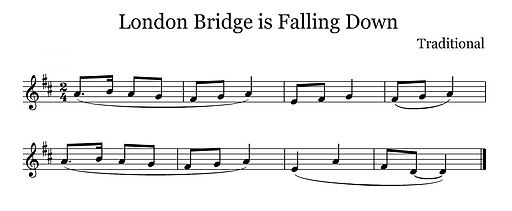
Musical score of 'London Bridge is falling down'


This little song alludes to the nursery rhyme London Bridge is falling down.

Heimkehr nach Köln

Heimkehr nach Köln

Die türmenden Inseln
der Kirchen,
die aschgrauen Schachteln
der Häuser,
die lärmenden Räder
der Plätze –

Geborgen bin ich
im Schoß meiner Stadt,
die mich die Sprache lehrte,
die vergessene Sprache,
die schlichten Gesänge
verschütteten Glücks.

Ein goldenes Antlitz taucht
aus dem bunten Dämmer hervor.
Wer bist du?
Geh nicht fort, Gesicht
ohne Namen, leihe mir
mein Geheimnis heut nacht!

Christina Egan © 1992

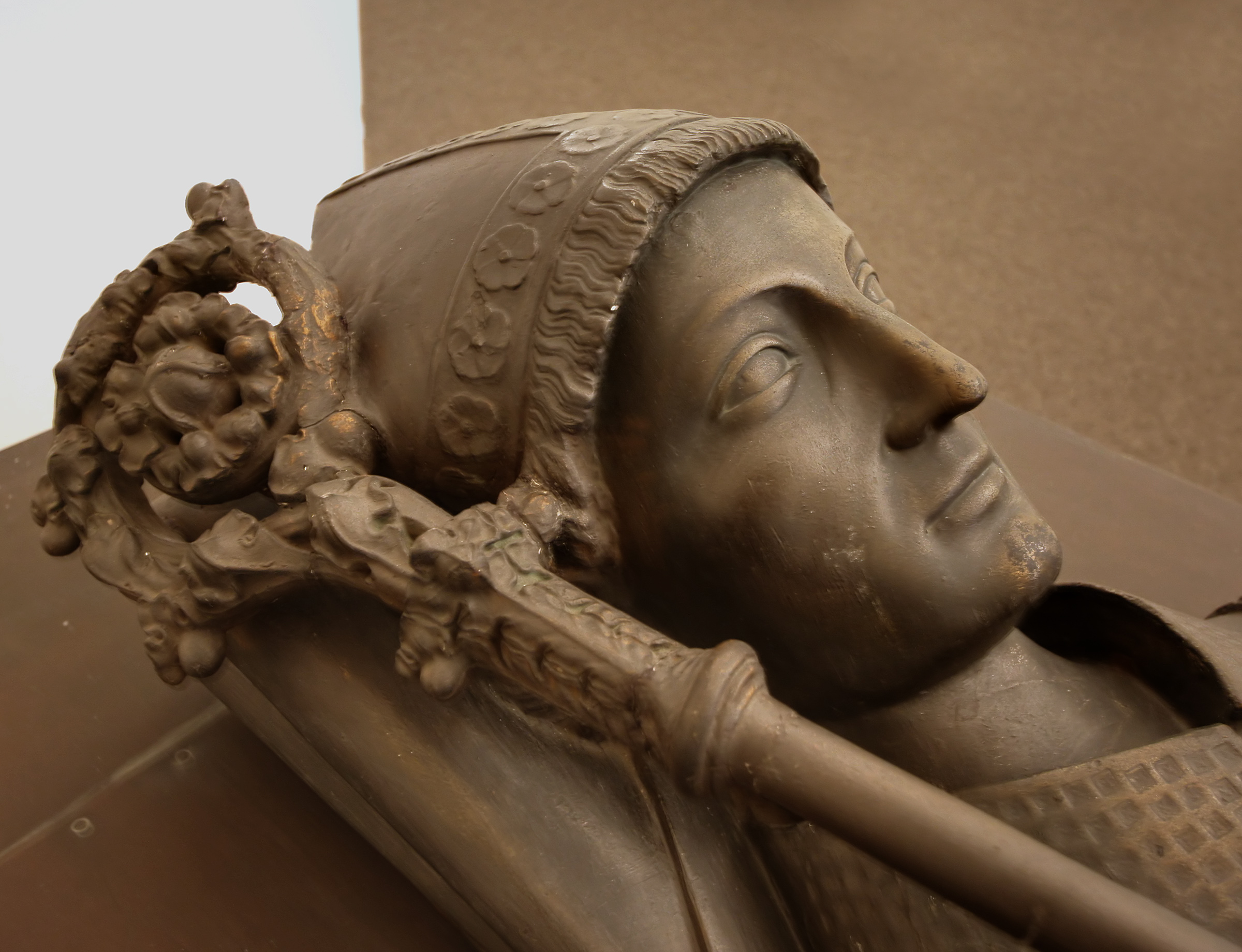
This poem about homecoming to a big city could refer to a place where someone grew up; or where they lived in the past; or where they may have lived in a former life on earth.

Bronze head of a bishop, mediaeval yet classical in appearance.Therefore, the mysterious golden face which is the key to the past could be a late relative; or a lost friend; or else a historical figure. I was thinking of this portrait at the back of Cologne Cathedral.

Photograph: „Grabmal Konrad von Hochstaden Gipsabdruck“ von Elke Wetzig (Elya)

Heimat gibt es doppelt

Heimat gibt es doppelt

Heimat gibt es doppelt: Heimat deiner Jugend,
Kopfsteinpflaster unter den karierten Schuhn;
anderswo vielleicht dann Heimat deines Herzens,
wo gewundne unsichtbare Wurzeln ruhn,

wo die Glocken süß und voll Verheißung beben
wie die frühen fliederfarbnen Azaleen,
wo die vielen flachen blassen Hausfassaden
lächeln, wenn die Wolkenschatten weiterwehn….

wo vor himmelstürmend hohen Kirchentürmen
glutrot oder sonnengelb die Blüten sprühn
und der Teppich der Jahrhunderte darunter
ruft, um deinen Lebensstrang hineinzuziehn.

Christina Egan © 2010

Another love letter to my favourite city, Cologne!

Am Rad der Weltgeschichte

Ich möcht am Rad der Weltgeschichte stehn

Ich möcht am Rad der Weltgeschichte stehn
Und eine Nacht beharrlich rückwärts drehn
Das Telefon zerfällt in deiner Hand
Der Flachbildschirm entgleitet deiner Wand
Das Internet verweht wie bunter Rauch
Die Rapmusik verebbt im Morgenhauch
Durchs Weltall stürzen Sonden zu uns her
Die schwarze Fahne rutscht vom Schießgewehr
Palmyra schüttelt sich aus Schutt und Sand
Manhattans Splitter fügen sich zum Band

Und wenn die Mauer aus dem Staube steigt
Dann halt ich an – und die Geschichte schweigt

Dann geh ich aus und such und finde dich
Und nichts und niemand hält und hindert mich

Der Rest darf weiterrasseln wie zuvor
Die Mauer stürzt es platzt das Wüstentor
Die rote Fahne sinkt die schwarze steigt
Und Pluto wird gefilmt und Mars erreicht
Das Internet wird um die Welt gespannt
Der Bildschirm schrumpft in deine hohle Hand
Doch mitten in des Lebens Wirbelsturm
Stehn du und ich wie jener Doppelturm

Zweitausendfünfzehn schrieb ich dir dies Lied
Denn ich bin müde und die Zeit entflieht

Christina Egan © 2015


Dense layers of rusty gearwheels.The narrator imagines that he or she can turn back the wheel of history.

Tiny hand-held telephones, huge television screens, and the whole internet dissolve; one after the other, the Arch of Palmyra, the Twin Towers, and the Berlin Wall rise from the debris.

Then the person stops history to find the beloved one this time round and live a new life together, while everything else rolls on as before: the monuments fall, the internet rises, till we arrive back in 2015.

These lines could be developed into a rock song. I imagine hard music which grows more intense until it stops when history stops!


Rusty gear wheels. Photograph by susannp4 (Susann Mielke).

Crystal Rock

Crystal Rock
(Béziers)

View from Gothic cathedral, almost vertical, onto structures forming a pattern

You follow a hidden winding staircase
and step down inside a crystal rock.

You have become very small and dark
or the space around you tall and light.

You stand on the ground of a tower of ice,
a polygon of translucent stone.

Is it a cavern? Is it a glacier?
No, it’s a chapel beneath a chapel!

Gothic cathedral in winter, dark grey against light blue

It is a cell in an ancient cluster:
a grey cathedral crouched on a rock.

Your soles touch a surface beneath the soil,
your eyes reach a tent of light like the sky.

This staircase does not lead to a nightmare:
it should be baptised a lightmare instead.

That era should not be known as Dark Ages:
it ought to be honoured as Ages of Light!

Christina Egan © 2016

Photographs: Christina Egan © 2016

These lines refer to the same ancient town of Béziers as the last post, Roof-Tile / Plateau. There, you can see more views from the roofs of the Cathedral.