King Spring / König Frühjahr

King Spring

The highway under my window is suddenly flooded with sun.
I see a strange person passing – his face is greenish and long,
his hat is purple and pointed – and followers thronging, hatless.
Is it a pharaoh? A druid? A dancer in fancy-dress?
I’ve spotted a spearhead of petals, magenta pushed up into blue,
the first magnolia flower: King Spring and his retinue!

Christina Egan © 2016

Large long buds above a road, with one opening in bright magenta, the folded petals looking like a hight hat.

König Frühjahr

Die Landstraße unter dem Fenster liegt plötzlich im Sonnenlicht.
Da geht ein fremder Geselle mit grünlichem langem Gesicht
und purpurner spitzer Mütze; Barhäuptige folgen ihm.
Ein Pharaoh? Heidenpriester? Ein Tänzer im Narrenkostüm?
Es ist eine Lanzenspitze, rosenrot hochgereckt,
die erste Magnolienblüte: Ich hab’ König Frühjahr entdeckt!

Christina Egan © 2016

Photograph:  Magnolia buds (England, February). Christina Egan © 2016.

Mitte Februar / Schnee über Nacht

Mitte Februar

Die Welt hat allen Glanz verloren
wie eine ganz verwelkte Frau.
Am Himmel Wolken, Schnee am Boden –
ein Leichentuch von blassem Grau.

Dahinter kämpft mit langem Atem
das fern verbannte Feuerrund:
Unmerklich schmelzen schon die Schatten,
und Farbe braut im Untergrund.

Die schwarzen Zweige sind lebendig,
das nasse Moos voll neuem Saft,
und das ermattete Gelände
wird auferstehn mit satter Kraft.

Christina Egan © 2012


Schnee über Nacht

Der Schnee hat wie ein Federbett
die kahle Erde zugedeckt,
begräbt die Schuld,
begräbt den Schmerz
in Gottes gnädiger Geduld,
in Gottes unbegrenztem Herz.

Christina Egan © 2012


Mitte Februar was published in the Rhönkalender 2015 (entitled Ende Februar). The 2017 calendar includes three poems by me and is still available.

Siegeskranz

Siegeskranz

Vor fünfzehnhundert Jahren,
da hab’ ich einen Kranz
aus Lorbeer und aus Ölzweig
gelöst und eingepflanzt.

Mein einst mit dunklem Lorbeer
gekröntes goldnes Haar
blieb fortan ungefeiert
und bleichte Jahr um Jahr.

Nach sieben Sommern aber
bot meine Ölbaumschar
die  bittersüßen Früchte
mit stolzem Lächeln dar.

Und Völker schwollen, ebbten,
und Rom verging in Rauch;
doch aus dem Kreis von Zweigen
entsproß noch Strauch um Strauch.

Und Bäume blühten, dorrten
und sanken in den Staub;
doch immer wieder grünte
das zähe Ölbaumlaub.

Nach fünfzehnhundert Jahren
betret’ ich einen Hain
aus silberhellen Hölzern
und spüre: Er ist mein.

Christina Egan © 2015

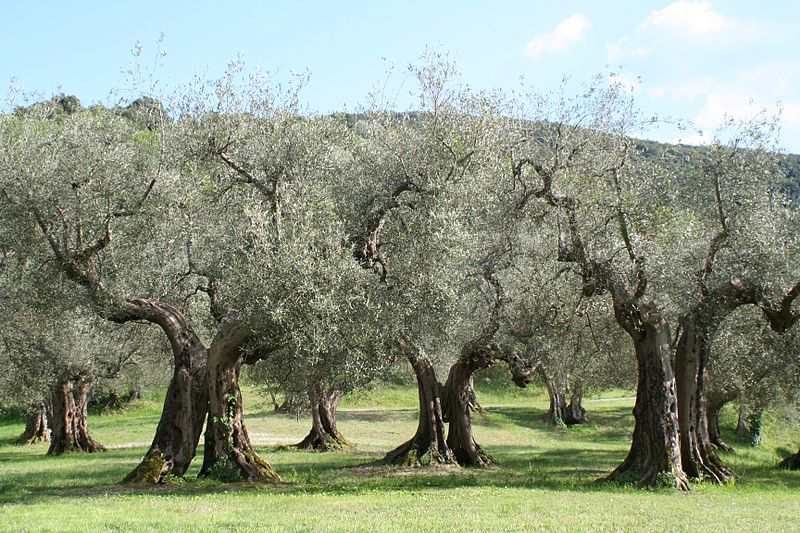
Olive grove, trunks and tree-tops silvery grey, like ashes.

Someone plants an olive grove towards the end of the Roman Empire, comes back to earth fifteen hundred years later — and recognises the descendants of her or his trees, which have survived the Dark Ages and are still thriving.

The narrator had taken the original olive shoots from her (more likely, his) victory garland, for instance for a poetic contest; so they could be an image for a contribution to civilisation in late antiquity which is relevant to this day.

For an English story about the end of Rome and its afterlife, go to The City Lit Up.

Photograph: ‘Olivenbäume in Umbrien’ by Adrian Michael.

Fewer Things!

Fewer Things!

We need to churn out fewer words,
we need to burn out fewer lamps,
we need to fashion fewer things,
Roman_bowl_01_MusLon
but those, of perfect elegance:

a shallow bowl with turned-out rim,
just like a pale and slender hand;
a silver ring with single stone,
as if the sky and moon descend. 

Christina Egan © 2013

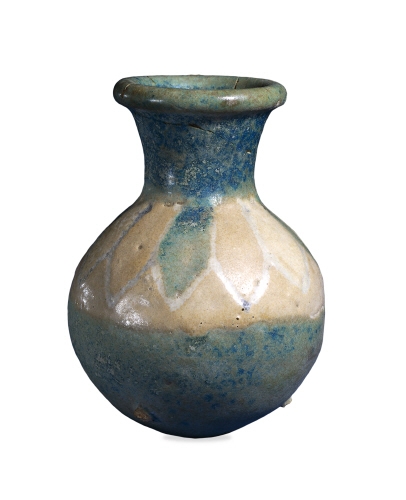
Jar, elegantly curved, with brown and blue glaze.


Roman bowl. Photograph from the
website of the Museum of London.

See also my musings on the little
Mesopotamian jar, Glazed Clay.

Assyrian jar, glazed pottery. Photograph:
© The Trustees of the British Museum.

Get Up and Follow Me

Get Up and Follow Me

Love sometimes does  pass our little lives
and stops and speaks: Get up and follow me.
We look, look up, into each other’s eyes,
get up, leave all and follow hand in hand.
There is a love that’s larger than the sun,
it knows the shade, the night, it knows no end,
it’s definite and infinite, it flows
through our hearts, till two are truly one.

Christina Egan © 2000


These lines were inspired by the biblical stories of Jesus calling his followers, who literally got up, left everything behind and — followed him. Just imagine you are getting up from your desk this minute to walk out of your life!

I wrote this poem for my own wedding and recommend it also for anniversaries; a long time together is not eternity yet, but a great achievement and a great gift. Perhaps you could even use it for Valentine’s Day.

Venus and Mars

Venus and Mars

The darker the night,
the stronger the stars,
the fiercer the fight
of Venus and Mars.

They fight not each other
but darkness and cold,
they each hold a banner
embroidered with gold.

The later the hour,
the likelier dawn,
with fire and flower
in splendour reborn!

Christina Egan © 2016


This poem takes up my thoughts about the elements in the previous post: here, the male and female principles are involved in a common struggle rather than a struggle against each other.

‘Dawn’ refers to the dawn of the new year in early spring as much as to the time of the day; and springtime is even more unpredictable than daylight, precisely in a northern country.

Moment dans la mare

Moment dans la mare
(Boulogne-sur-Mer)

À la plage immense, vidée de la mer,
le vent est trempé du soleil et du sel :
caresse chanceuse de l’univers,
regard maternel rempli d’étincelles.

La mare autour des chevilles surprises,
le sable mouillé, moulé de soleil :
tout ça – l’océan et la boue et la brise –
tout est mêlé et tout est pareil.

Tout est tiède et tout est limpide,
tout est liquide autour des doigts…
Tout est un rêve réel, et le vide
commence à se combler de joie.

Il n’y a pas de bataille, il n’y a pas de triage
de quatre ou cinq éléments lumineux :
plutôt une étreinte éternelle, mariage
de plage et marée, bénit des cieux.

Christina Egan © 2016


The poem refers to the four or five elements which make up the universe, an ancient philosophical concept found in variations in many civilisations.

Greek philosophers held that war, or conflict, between the forces of nature generate everything and challenge us to greatness. I propose that the Greek elements of fire, air, water, earth — and spirit — exist, but work through interaction and union, and that humans grow most when working within and with nature.

This makes harmony instead of conflict the driving force of the universe. It is also a female philosophical approach rather than a traditional male one.

In French literature, the ‘void’ is essential, marking loneliness, mortality, and the pointlessness of life; I want to hold up the ‘void’ or ‘silence’ as an experience of peace and fulfilment, communion with the universe, and a foretaste of eternal life.

When I stood on the beach of Boulogne at sunset, the sky and the sea and the sand were gleaming in streaks of otherworldly purple and orange.

An automatic translation into English may convey the sense of these lines well, but in the original French, they are conceived to sound like music… like waves.

The Spirits of Nimrod

The Spirits of Nimrod

The Spirits of Nimrod
stood tall and stood fast
to guard empty castles
of empires past.

The spirits of marble
were shaken at last:
their wings broken off,
their beards ground to dust.

The proud heads of Nimrod
are curls without face,
their eloquent pedestals
frames without phrase.

Yet some still have lips
to whisper by dusk
and some stir their wings
deep under the mud.

The Spirits of Nimrod
will rise like the sun,
invincible eagles:
beware when they come!

Christina Egan © 2016

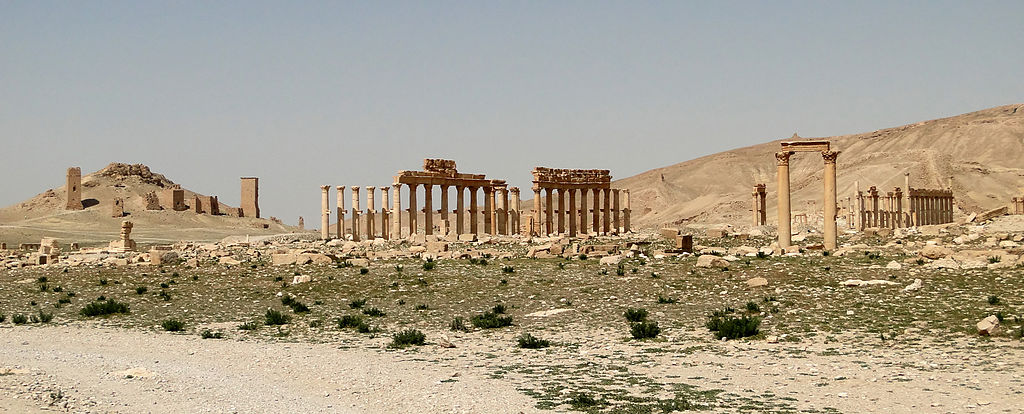
Ruins with many columns in arid, hilly land.

Invaluable buildings and sculptures of great antiquity and beauty have recently been destroyed by Daesh (so-called Islamic State). Nimrod was one place affected by those war crimes and Palmyra another.

These lines evoke the return of the gods — not as pagan deities but as statues: as witnesses of history and works of art, which we worship in our own way and will reconstruct, recreate, document, or remember.

Photograph: Diocletian’s camp in Palmyra, Syria (2010). By Bernard Gagnon (Own work) [GFDL], via Wikimedia Commons.

Warten ist der Winter

Warten ist der Winter

Warten ist der Winter, Warten
auf den endlich wieder starken
Glanz, der sanft ins Leben küßt,
was vor Gram verblichen ist.

Einsam ist der kleine Garten,
während Garben aller Farben
unter altem Laub und Moos
schlummern im verdorrten Schoß.

Hilflos ist das lange Darben
für den unbemerkten Garten:
hilflos, doch nicht hoffnungslos,
denn der Himmel ist sein Trost.

Christina Egan © 2012

Word cloud in pink and green on black; in the middle, £waiting" and "fog" in grey, "garden" and "bright" in yellow.

The other poems are Hinter dem Olivenbaum, Mitte Februar, Fastenzeit, Der Nebel hebt sich, Wende (Bestickt mit Blüten), Bunter Zwirn, Aprilabend.

Many thanks to the Simple Word Cloud Generator!